"BRICS is Not a Threat to the US"
On the 1st (local time), the White House announced that it would encourage Chinese President Xi Jinping to attend the upcoming Group of Twenty (G20) summit to be held in India on the 9th and 10th.
John Kirby, White House National Security Council (NSC) Coordinator for Strategic Communications, mentioned during a phone briefing that regarding President Xi not attending the G20, he referred to President Joe Biden's statement the previous day saying, "I want to meet President Xi at the G20," and added, "The United States will encourage President Xi to attend, but whether he attends is up to him."
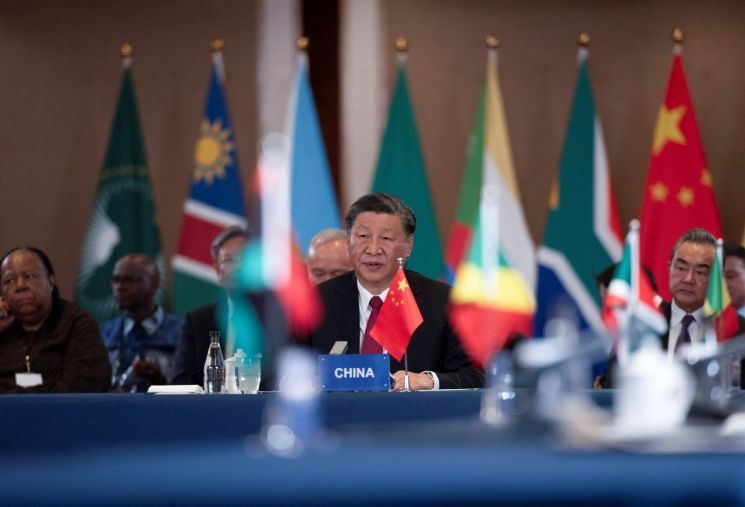
He continued, "Looking at the agenda of the G20 summit, whether it is climate change, multilateral development, or investment opportunities, China's interests are involved," and added, "Also, the G20 itself will be on the agenda as a forum to improve opportunities for global economic cooperation and prosperity, including where the G20 is headed."
Coordinator Kirby responded to criticism that with Vice President Kamala Harris attending the ASEAN-related summit in Indonesia from the 5th to 7th instead of President Biden, it might appear that U.S. interest in the region is waning, by citing the South Korea-U.S.-Japan Camp David summit and stating, "Looking at what we have done since the start of the administration, it is hard to say that the United States is not interested in the Indo-Pacific."
Regarding the China-led economic bloc BRICS (Brazil, Russia, India, China, South Africa, and other emerging five countries), he said, "We do not view BRICS as a kind of anti-American alliance or a hostile group against U.S. national interests and its vast alliance network." He emphasized, "Many member countries participating in BRICS have good bilateral relations with the United States. We do not see BRICS as any kind of threat."
Coordinator Kirby commented on BRICS' decision to admit Argentina, Iran, Saudi Arabia, and the United Arab Emirates (UAE) as members, stating, "Any country can decide with whom and how to form alliances," calling it a "sovereign decision." He added, "The United States is not in a position to tell any country who they should be friends with."
At the summit that ended on the 24th, BRICS admitted six new member countries out of 22 applicant countries. Although the leaders agreed on expanding membership, there were differences in the pace of expansion, and the BRICS joint currency agenda initially proposed by China was not even discussed.
President Xi aims to rapidly expand BRICS to create an anti-American bloc surpassing the U.S.-led Group of Seven (G7), but existing members such as India and Brazil set stringent conditions for expansion, resulting in failure to achieve this goal.
One foreign media outlet reported, "Leaders supported expanding BRICS' size but differed on the speed of expansion." India reportedly insisted that new members should not be subject to international sanctions and that clear economic criteria such as per capita GDP are necessary. Even Luiz In?cio Lula da Silva, the pro-China President of Brazil, stated, "BRICS is not a counterweight to the G7, nor is it establishing a competitive system with the United States."
© The Asia Business Daily(www.asiae.co.kr). All rights reserved.
![Clutching a Stolen Dior Bag, Saying "I Hate Being Poor but Real"... The Grotesque Con of a "Human Knockoff" [Slate]](https://cwcontent.asiae.co.kr/asiaresize/183/2026021902243444107_1771435474.jpg)















