Increased Manufacturing Facility Investments in Georgia, Kentucky, Tennessee
Transforming Rural Villages into Areas with Large Factories
Preparing by Building Housing and Educational Facilities Amid Job Surge
As investments in electric vehicle manufacturing facilities pour into the United States, southern regions such as Georgia, Kentucky, and Tennessee are rapidly transforming. Large-scale factories are being established one after another in rural towns with small populations, prompting state governments and others to work busily on building infrastructure for the workers who will be employed there. Since the local workforce is limited, competition to secure workers is expected once factories begin to emerge one by one.
According to the Wall Street Journal (WSJ) on the 30th (local time), BlueOvalSK, a joint venture launched in July last year by Ford Motor Company and SK On, is constructing a battery production plant in Stanton, Tennessee. The plant aims to start mass production in 2025. Since development has just begun, the factory site is still surrounded by farmland.
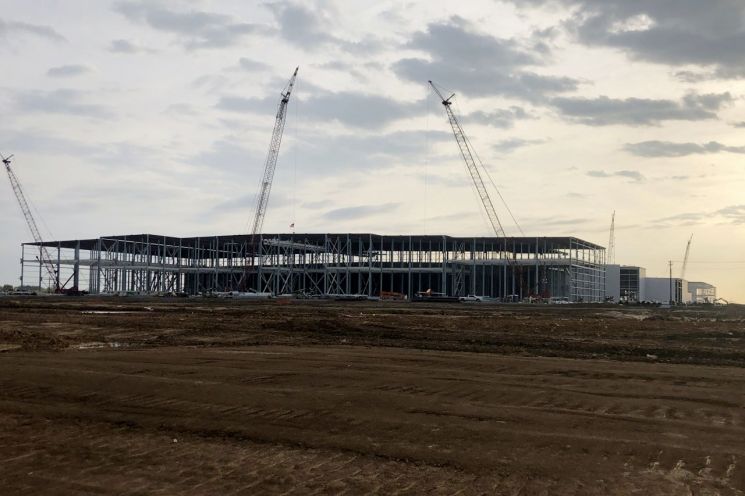
With this plant being built, the rural town of Stanton, which has a population of only 400, is inevitably facing major changes. This is because a large-scale factory employing about 6,000 people?approximately 15 times the local population?is being established.
Allen Sturbinski, mayor of Stanton, Tennessee, is currently making every effort to build infrastructure, including constructing new housing for factory workers, establishing an education system, and expanding police personnel. Expressing a "pleasant dilemma," he said, "We are in a situation where we have to do everything."
WSJ reported that in recent years, the electric vehicle boom has brought attention to southern U.S. states such as Georgia, Kentucky, and Tennessee, with automakers announcing investments one after another for product assembly or battery manufacturing facilities. According to the nonprofit Automotive Research Center based in Ann Arbor, Michigan, since 2018, automakers have announced over $110 billion (approximately 145.55 trillion KRW) in electric vehicle-related investments in the U.S., with about half of that concentrated in southern states.
Georgia, where Hyundai Motor Group is investing, is one of the southern U.S. regions undergoing transformation. In May last year, Hyundai announced it would invest $5.5 billion to build an electric vehicle-only plant with an annual capacity of 300,000 units in Georgia. This is the largest economic development project in Georgia's history and is expected to create 8,100 jobs through this investment.
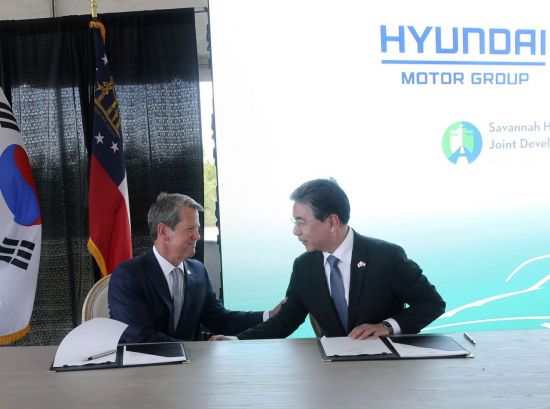 In May of last year, Jang Jae-hoon, President of Hyundai Motor Company (right), and Brian Kemp, Governor of Georgia, signed the "Electric Vehicle Dedicated Factory Investment Agreement" in Elaville, Bryan County, Georgia, USA, and shook hands afterward.
 [Image source=Yonhap News]
Hyundai explained that when selecting the site in Georgia, they considered various factors such as how quickly mass production could begin and how the nearby supply chain was established. They added that Georgia’s efforts to prepare the local workforce were also among the considerations. Georgia even sent people to Hyundai plants in Asia to build an employee training center near the factory.
As automotive manufacturing facilities cluster in the southern U.S., Detroit, which was the center of the automotive industry until the 1940s, is expected to decline even faster than before.
According to the U.S. Bureau of Labor Statistics, the number of automotive industry workers in the Great Lakes region, including Michigan, was 382,000 in 2021, a 34% decrease over 20 years. Meanwhile, the number of automotive workers in the southern U.S. has rapidly increased to 213,000. Once the planned factories are completed in the coming years, at least 40,000 additional jobs are expected to be created.
However, WSJ predicts that since major American automakers such as General Motors (GM) and Ford still have their headquarters in Detroit and conduct research and development (R&D) in the area, their influence will be somewhat reduced but will maintain a certain level.
Although jobs are increasing in the southern U.S., there is a shortage of workers to fill them, leading to competition for labor between companies and local communities. The automotive industry anticipates that finding thousands of workers capable of working in electric vehicle-related factories will not be easy. Additionally, as the population grows, more workers will be needed in shops and restaurants, but since factories offer higher wages, labor may be drawn away, causing concerns among local small business owners.
Furthermore, WSJ reported that as the population increases, traffic congestion, parking shortages, and crime rates are expected to rise, making comprehensive social changes inevitable and prompting local authorities to accelerate preparations for countermeasures.
© The Asia Business Daily(www.asiae.co.kr). All rights reserved.
![Clutching a Stolen Dior Bag, Saying "I Hate Being Poor but Real"... The Grotesque Con of a "Human Knockoff" [Slate]](https://cwcontent.asiae.co.kr/asiaresize/183/2026021902243444107_1771435474.jpg)
















