Increased Japanese Beer Consumption Due to 'Asahi' Popularity
"Consumers Separate Political Issues from Consumption"
Despite Japan's discharge of contaminated water from Fukushima, there has been no emergence of an extreme 'No Japan' movement. The 'No No Japan' campaign in 2019 was a movement that arose in response to Japan's trade retaliation, with a strong push to completely avoid Japanese products. However, the current situation appears different. Japanese beer, which was once shunned by both consumers and sellers, is now in such high demand that it is hard to keep in stock.
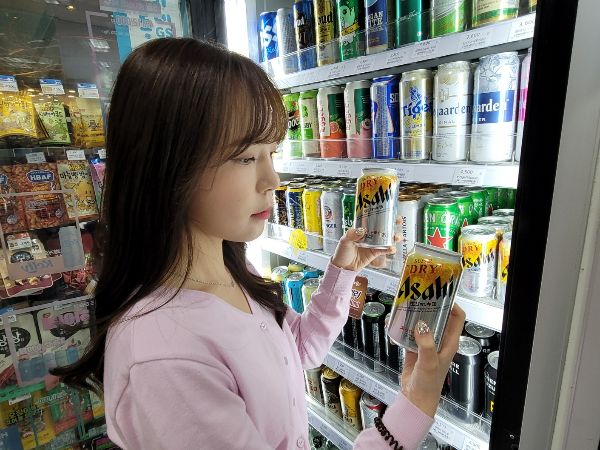 A customer is looking at an Asahi Super Dry draft beer can at a convenience store.
 [Photo by GS Retail]
According to GS25, a convenience store operated by GS Retail, sales of Japanese beer increased by 35% in the recent week (22nd to 28th) compared to the same period last month. This contrasts with imported beer sales, which decreased by 1.2%. CU showed a similar trend. While sales of Japanese beer rose by more than 13% compared to the previous month, imported beer sales only saw single-digit growth. This means more consumers visiting convenience stores were choosing Japanese beer over imported beer. Emart24 showed a growth rate of around 4% compared to the previous month, but when expanding the period to two months ago (June 20th to 26th), related sales surged by approximately 220%.
Although many expected that Japan's discharge of contaminated water from Fukushima on the 24th would lead to distrust and boycotts of Japanese products, consumers made different choices. The introduction of 'Asahi Super Dry' draft beer, which features a rich creamy foam upon opening and was launched domestically in May, ignited demand for Japanese beer, leading to a shortage crisis and boosting sales. Convenience store industry insiders commonly report that Asahi Super Dry draft beer sells out immediately upon arrival at stores. Although there are differences between stores, order quantities are limited to around 20 units per store.
The situation in large supermarkets is similar. While consumer demand for imported beer has stagnated, Lotte Mart's sales of Japanese beer increased by 5% compared to the previous month and by about 20% compared to two months ago. A distribution industry insider said, "Many consumers are willing to buy other Japanese beers if Asahi Super Dry is unavailable, so compared to a year ago, sales have jumped by several hundred percent," adding, "There appears to be no impact from the Fukushima contaminated water discharge."
The argument that the Fukushima contaminated water discharge would dampen consumption of Japanese products seems to be losing momentum. Although there were efforts, mainly from opposition parties, to link the contaminated water discharge to a No Japan movement, the changed consumer tendencies have weakened the impact more than expected. Professor Eunhee Lee of Inha University's Department of Consumer Studies said, "Consumers who have learned from the mad cow disease crisis and the Japanese boycott movement will decide whether to consume based on their own judgment," adding, "Many consumers feel uncomfortable with attempts to connect political issues with consumption, making it difficult for a vigorous boycott movement to develop."
© The Asia Business Daily(www.asiae.co.kr). All rights reserved.
![Clutching a Stolen Dior Bag, Saying "I Hate Being Poor but Real"... The Grotesque Con of a "Human Knockoff" [Slate]](https://cwcontent.asiae.co.kr/asiaresize/183/2026021902243444107_1771435474.jpg)
















