Survey Results from the Special Committee on Political Reform Experts
47% of Respondents Say the Number of National Assembly Members Should Be Increased
Six out of ten political scientists and legal scholars answered that if the number of National Assembly members is maintained at 300, the number of constituency members should be reduced and the number of proportional representation members should be increased. Nearly half of the election system experts responded that the number of members should be increased.
According to the "Survey Results of Experts on the Reform of the National Assembly Election System" announced by the National Assembly Special Committee on Political Reform (Jeonggae Teukwi) on the 29th, among 489 political scientists and legal scholars, 57% (279 people) answered that if the current number of National Assembly members is maintained at 300, the number of constituency members should be reduced and the number of proportional representation members should be increased. Opinions that proportional representation should be reduced accounted for 23% (113 people), and those who preferred the current system accounted for 20% (97 people).
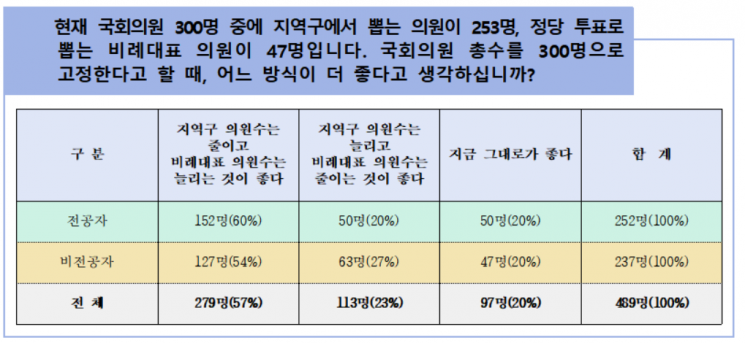
Regarding the number of National Assembly members, the largest opinion was that it should be increased from now on, at 47% (231 people). Opinions that the current number should be maintained accounted for 27% (130 people), and those that it should be reduced accounted for 26% (127 people).
Regarding the current "semi-linked proportional representation system," which has sparked controversy over "satellite parties," 68% (334 people) answered that they were dissatisfied. Among the reasons for dissatisfaction (multiple responses allowed), the most cited was "weakening of the system's purpose due to the creation of satellite parties" (285 people). This was followed by "low proportion of proportional representation seats" (139 people) and "linkage applied only to some proportional representation seats" (117 people).
When asked about preferences for single-member districts, medium-member districts, and large-member districts, the preference for single-member districts was the highest. 48% of all respondents answered that they preferred (including strongly preferred) single-member districts. Medium-member districts accounted for 47%, and large-member districts for 15%.
This survey was conducted targeting about 2,000 regular members of the Korean Political Science Association and about 1,000 regular members of the Korean Public Law Association, with 360 political science majors and 129 law majors responding.
Nam In-soon, chairperson of the Special Committee on Political Reform, stated, "The remaining task for the Jeonggae Teukwi is the reform of the National Assembly election system," and added, "This expert survey is meaningful in that it directly heard experts' opinions on various amendment bills pending before the Jeonggae Teukwi. As chairperson, I will do my best to derive a reform plan that the public can accept through in-depth consultations between the ruling and opposition parties."
© The Asia Business Daily(www.asiae.co.kr). All rights reserved.
![Clutching a Stolen Dior Bag, Saying "I Hate Being Poor but Real"... The Grotesque Con of a "Human Knockoff" [Slate]](https://cwcontent.asiae.co.kr/asiaresize/183/2026021902243444107_1771435474.jpg)















