US Secretary of Commerce: "No Compromise or Negotiation on National Security Issues"
The United States and China have established a deputy minister-level consultative body for exchanging information related to export controls and plan to hold their first meeting in Beijing on the 29th. The two countries will also form a deputy minister-level working group to discuss trade and investment issues.
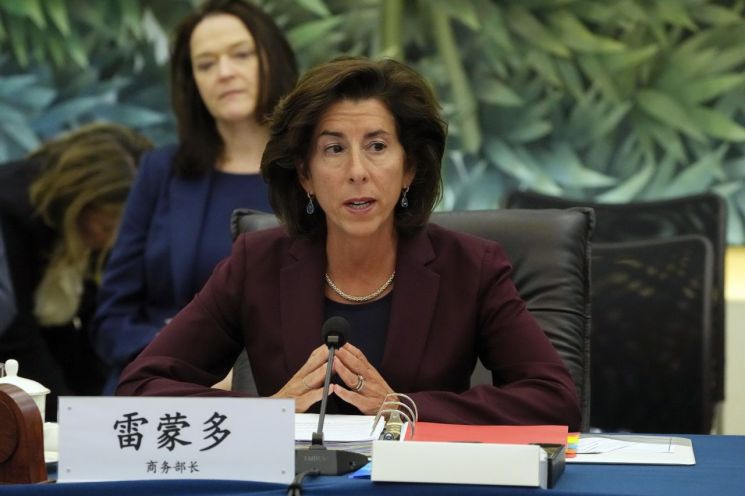
Gina Raimondo, U.S. Secretary of Commerce, met with Wang Wentao, Minister of Commerce of China, in Beijing on the 28th and agreed on this plan, the U.S. Department of Commerce announced in a press release.
The U.S. Department of Commerce described the information exchange on export controls as "a platform to reduce misunderstandings about U.S. national security policies."
The two countries also agreed to communicate regularly at the ministerial or ministerial-level regarding commercial and economic issues. To this end, they agreed to hold at least one face-to-face meeting annually.
The first face-to-face meeting is scheduled to be held at the Ministry of Commerce in Beijing on the 29th. On the U.S. side, Matthew Axelrod, Deputy Assistant Secretary for Export Enforcement at the Department of Commerce, is expected to attend. Amid escalating tensions as China responds to U.S. export controls on advanced semiconductors and equipment with export controls on rare earth minerals, attention is focused on whether the newly established dialogue platform can ease tensions between the two countries.
Secretary Raimondo emphasized during the meeting with Minister Wang that "export controls are very narrowly targeted only at technologies that have clear impacts on national security and human rights," and that "they are not intended to suppress China's economic growth."
However, she made it clear that the export control information exchange between the U.S. and China is not a policy dialogue. After the meeting, Secretary Raimondo told reporters, "This is a dialogue to increase transparency and clarify what we are doing regarding export control enforcement," adding, "We do not compromise or negotiate on national security issues."
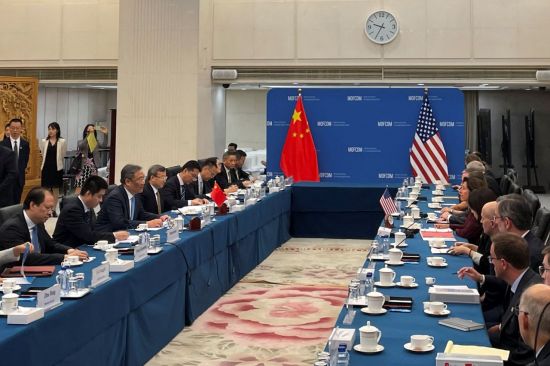
The United States has maintained trade and economic relations with China based on the so-called "small yard, high fence" principle, while continuing measures to block China's access to U.S. advanced technology.
Additionally, Secretary Raimondo conveyed concerns about China's actions against U.S. semiconductor companies, such as blocking Intel's mergers and acquisitions (M&A) and banning sales of Micron products in China. They also exchanged views on China's export controls on rare earth minerals such as gallium and germanium.
During her visit to China, scheduled until the 30th, Secretary Raimondo is expected to meet consecutively with Chinese economic officials including Premier Li Qiang and Vice Premier He Lifeng.
The Biden administration has been strengthening high-level communication with China by promoting Secretary Raimondo's visit following those of Secretary of State Antony Blinken, Treasury Secretary Janet Yellen, and Climate Envoy John Kerry since June. This reflects a strategy to responsibly manage U.S.-China competition through "de-risking" rather than "decoupling."
© The Asia Business Daily(www.asiae.co.kr). All rights reserved.
![Clutching a Stolen Dior Bag, Saying "I Hate Being Poor but Real"... The Grotesque Con of a "Human Knockoff" [Slate]](https://cwcontent.asiae.co.kr/asiaresize/183/2026021902243444107_1771435474.jpg)

















