Announcement of Plans for Strengthening Radiation Inspection and Promotional Events
As contaminated water from the Fukushima nuclear power plant in Japan is discharged into the ocean, Changwon Special City in Gyeongnam held a briefing on the 28th to announce measures to strengthen seafood safety management and promote consumption.
Changwon City stated that it will make every effort to promote seafood consumption to minimize damage to fishermen and small business owners caused by the nuclear power plant's contaminated water discharge into the ocean.
To alleviate citizens' concerns about food safety, the city will shorten the radiation inspection cycle at the seafood production and auction stages from 1-2 times a month to once a week.
The number of species inspected will increase from 2-3 per inspection to more than 5, focusing on species that are produced in large quantities seasonally or are popular among citizens, such as jeoneo (gizzard shad), flatfish, conger eel, mussels, ark shells, and sea squirts.
Following Masan Fisheries Cooperative, Jinhae Fisheries Cooperative, Bukyeong New Port Fisheries Cooperative, and Anchovy Purse Seine Fisheries Cooperative, one simple radiation detector will be provided to each of the Diving Fisheries Cooperative, Masan Fish Market, and Jinhae Central Market, operating a total of seven devices.
Radiation inspections of seafood distributed at large marts and sashimi restaurants, including Masan Fish Market, will be expanded from once a month to twice a month starting this September.
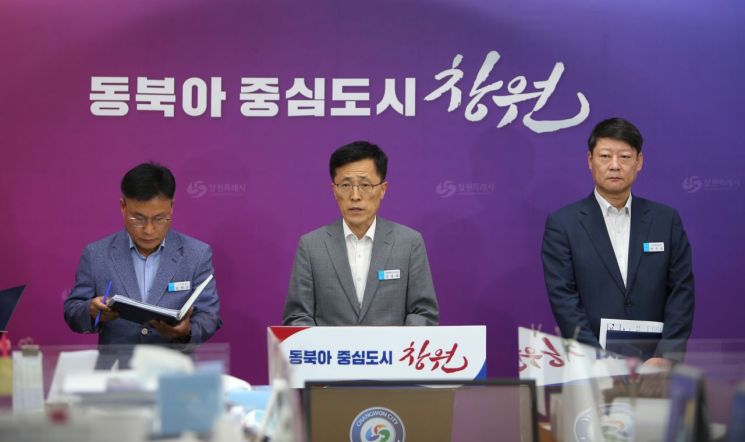 Kim Jong-pil, Director of the Marine, Port, and Fisheries Bureau of Changwon Special City, Gyeongnam, is announcing the plan for seafood safety management and consumption promotion.
 [Photo by Lee Se-ryeong]
The 'Radiation Inspection Citizen Observation System,' where citizens directly collect inspection samples, will be conducted twice a month from today until the end of the year at Masan Fisheries Cooperative, Jinhae Fisheries Cooperative, and the Masan branch of the Anchovy Purse Seine Fisheries Cooperative.
For the repeated radiation inspections of seawater, the city plans to request the Ministry of Oceans and Fisheries to add the sea area in front of Gusan-myeon to the existing inspection points of Masan Bay, Jinhae Bay, and Jindong Bay.
Information on radiation inspection dates, fish species, and inspection results within the jurisdiction will be immediately posted on the city hall website and also communicated to citizens through 20 disaster safety electronic signboards.
The origin labeling inspection, currently conducted once a month, will be increased to once a week, and six honorary monitors will be recruited to operate from September.
To minimize damage to fishermen and small business owners in the seafood industry, the city will issue a dedicated mobile regional gift certificate worth 2 billion KRW, which can only be used for seafood purchases, marking the first such initiative among local governments nationwide.
The gift certificates will be sold at a 15% discount, with a purchase limit of up to 200,000 KRW per person.
They can be used at 497 stores registered as affiliated merchants of the Korea Seafood Expo gift certificate, including traditional markets.
Before Chuseok, a refund event will be promoted at Masan Fish Market, where up to 20,000 KRW per person and up to 30% of the purchase amount will be returned in Onnuri gift certificates when purchasing seafood.
In October, the Fresh Seafood Festival will be held, followed by the Masan Mussel Festival in November, with a total of five consumption promotion events planned through the end of the year.
A field situation team composed of the head of the Fisheries Division and nine staff members from the city and district fisheries departments will monitor seafood consumption status, price trends, and difficulties and suggestions from the seafood industry.
Kim Jong-pil, Director of the Marine Port and Fisheries Bureau, said, “Despite the discharge of contaminated water from the nuclear power plant, we will conduct more thorough inspections and transparently provide information related to radiation and seafood safety so that citizens can consume seafood with confidence and minimize damage to fishermen and small business owners.”
© The Asia Business Daily(www.asiae.co.kr). All rights reserved.
![Clutching a Stolen Dior Bag, Saying "I Hate Being Poor but Real"... The Grotesque Con of a "Human Knockoff" [Slate]](https://cwcontent.asiae.co.kr/asiaresize/183/2026021902243444107_1771435474.jpg)















