Welfare Points for Public Officials, Regulations on Welfare Expenses and Supplies
Controversy Over Different Standards Compared to General Workers' Welfare Points
Different standards are being applied to welfare points for regular workers and public officials, sparking renewed controversy.
Public Officials' Welfare Points Classified as 'Material Expenses'... Excluded from Income Tax and Health Insurance Premiums as Non-Taxable Income
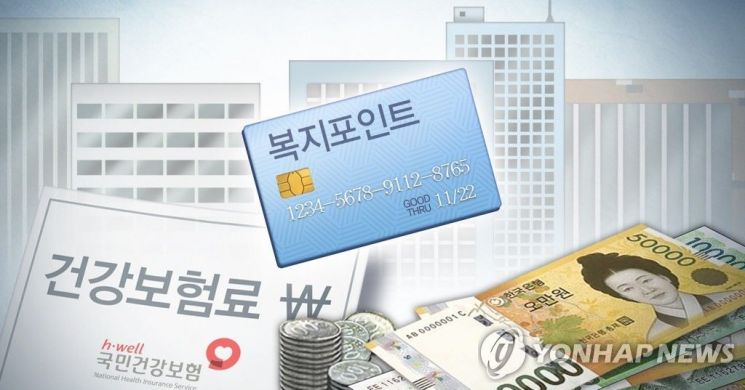
According to the National Health Insurance Service on the 28th, under current regulations, welfare points for public officials are classified as 'material expenses' rather than 'personnel expenses,' and thus are excluded from income tax and health insurance premium (health insurance fee) assessments.
However, welfare points paid to regular workers in private companies, public enterprises, and general public institutions are classified as 'earned income,' and are subject to both income tax and health insurance premiums.
The National Health Insurance Service has considered that welfare points received by public officials, whose employer is the state, should naturally be included and has attempted to impose health insurance premiums since 2010, but has been unable to do so for over ten years.
This is because the Ministry of Economy and Finance and the Ministry of the Interior and Safety, based on the Legal Affairs Office's authoritative interpretation, have stipulated in budget guidelines that welfare points for public officials, monthly fixed position allowances, and specific work expenses are categorized as welfare expenses or material expenses with a specific purpose, rather than personnel expenses.
In other words, although public officials receive welfare points effectively as a form of salary, these are not considered compensation for labor provided by the public officials.
Recently, the court explained, "Unlike welfare points in private companies, etc., where the employer can autonomously set the scope, items, and point allocation criteria, public officials' welfare points are subject to restrictions under regulations related to public officials' welfare," and added, "Considering that a significant portion of public officials' welfare points must be mandatorily used for group insurance premiums, welfare points and welfare scores cannot be regarded as the same."
Accordingly, welfare points for public officials are classified as non-taxable income under the Income Tax Act, exempting them from income tax, and are also excluded from the scope of health insurance premium assessments under the Health Insurance Act, which only imposes premiums on earned income.
Public officials' welfare points have been implemented as a welfare system since January 2005 across all central government departments following a pilot project in 2003, and for local public officials starting with Seoul in 2005.
Welfare points for public officials can be used like cash for medical and hospital fees, medicine costs, eyeglass purchases, academy tuition, book purchases, accommodation fees during travel, movie and theater tickets, and flower delivery services for anniversaries.
"Welfare Points of Private Companies, Public Institutions, and Public Enterprises Closely Linked to Labor" Ruling

On the 21st, the Seoul Administrative Court Administrative Division 2 (Presiding Judge Shin Myung-hee) ruled against Hanwha Claims Service in a lawsuit filed against the Seoul Mapo Tax Office seeking a refund of approximately 47 million won in labor income tax imposed on welfare points paid to its employees.
The court explained, "Earned income under the Income Tax Act is a broader concept than wages under the Labor Standards Act," and added, "Even if welfare points do not constitute wages under the Labor Standards Act, they fall under earned income for tax purposes and can be subject to taxation."
It further stated, "Considering that Hanwha Claims Service regularly provided welfare points to employees at the beginning of each year based on rank and years of service, and additionally awarded points for overtime work, these points correspond to earned income."
This reaffirmed that welfare points paid by companies to employees, while not ordinary wages under the Labor Standards Act, fall within the scope of earned income under the Income Tax Act, justifying the imposition of labor income tax.
Health insurance premiums for employees are calculated based on the monthly remuneration received from the company, multiplied by the premium rate (7.09% this year), according to the Health Insurance Act.
The calculated premium is then split equally between the employee and the employer, with each bearing half.
Monthly remuneration refers to salaries, wages, compensation, annual allowances, bonuses, allowances, and other similar payments received as remuneration for labor, as defined by Presidential Decree. Welfare points of private companies, public institutions, and public enterprises are included in the remuneration defined by Presidential Decree, and thus health insurance premiums are imposed on them.
Retirement pay, rewards, translation fees, manuscript fees, and non-taxable earned income under the Income Tax Act are excluded from remuneration and therefore are not subject to health insurance premiums.
© The Asia Business Daily(www.asiae.co.kr). All rights reserved.
![Clutching a Stolen Dior Bag, Saying "I Hate Being Poor but Real"... The Grotesque Con of a "Human Knockoff" [Slate]](https://cwcontent.asiae.co.kr/asiaresize/183/2026021902243444107_1771435474.jpg)

















