[Upcoming Hydrogen Economy]
Electrolytic Water Splitting Separates Hydrogen and Oxygen
Overcoming Technological Gaps with Advanced Countries
Domestic Companies Accelerate Projects
Currently, 99% of the hydrogen produced on Earth is so-called gray hydrogen, made from fossil fuels. Methane (CH4), the main component of natural gas, reacts with water at a high temperature of 700℃ to produce hydrogen and carbon monoxide, and this carbon monoxide then reacts with water again to obtain additional hydrogen. Carbon dioxide is generated during this process.
There is also by-product hydrogen obtained by refining gases that are additionally produced in petrochemical or steelmaking processes. Carbon dioxide is also emitted here, and if this is captured and stored, it becomes blue hydrogen. It is more environmentally friendly than gray hydrogen but faces the challenge of storing the captured carbon dioxide.
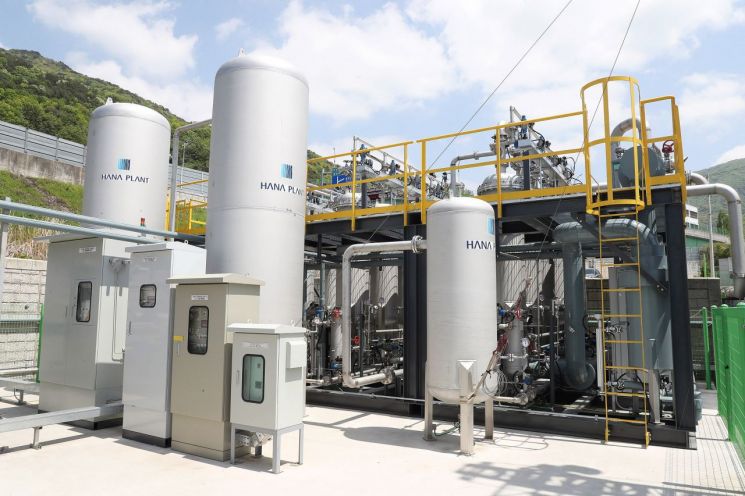 On the afternoon of the 27th, the country's first blue hydrogen facility was unveiled at the Seongju Hydrogen Charging Station (hydrogen production + charging facility) in Seongsan-gu, Changwon-si, Gyeongnam. This facility, made with domestic technology, captures approximately 8 tons of carbon dioxide generated when producing 1 ton of hydrogen using natural gas at the Seongju Hydrogen Charging Station, storing and supplying it in a liquefied state. April 27, 2023 [Provided by Changwon City. Resale and DB prohibited] [Image source=Yonhap News]
For hydrogen to firmly establish itself as a truly clean future energy source, the production of green hydrogen, which emits no carbon, is essential. This requires two key elements: renewable energy and water electrolysis technology.
Unfortunately, South Korea lags behind advanced countries in both aspects. Renewable energy, which is greatly influenced by geographical factors, faces certain limitations in development due to domestic conditions, according to energy experts. This is why the government and companies are pursuing plans to produce hydrogen overseas where renewable energy is abundant and import it.
On the other hand, water electrolysis has the potential to narrow the gap with advanced countries through technological development. Water electrolysis, a technology that splits water into hydrogen and oxygen using electricity, is the exact opposite of fuel cells, which generate electricity and water from hydrogen and oxygen. Depending on the electrolyte, alkaline water electrolysis and polymer electrolyte membrane (PEM) water electrolysis methods are expected to be commercially viable soon.
Alkaline water electrolysis is an old and stable technology that has been researched since the 1920s. It has the advantage of being relatively inexpensive because it does not use costly rare metals, but its efficiency is low. PEM water electrolysis can produce high-purity hydrogen, but the supply of iridium, a key material, is a concern.
Iridium is widely used in organic light-emitting diodes (OLEDs), and recently, demand has surged sharply for TVs and smartphones. The annual mining volume is estimated to be about 8 tons. Because of this, the price of iridium increased sixfold in 2021 alone. To expand PEM water electrolysis facilities, a substitute material for iridium is needed, but research is still ongoing.
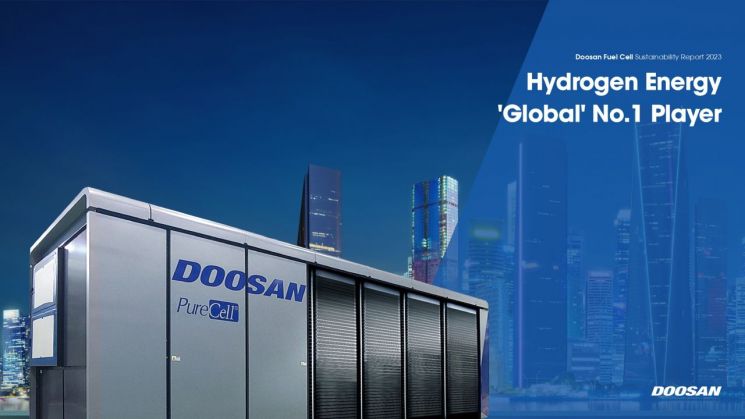
Several companies in South Korea are also accelerating their water electrolysis businesses. Doosan Fuel Cell plans to commercialize a proton exchange membrane (PEM) based water electrolysis system in the second half of the year. In July, it received approval from the Regulatory Sandbox Committee to operate and verify an on-site hydrogen refueling station that produces hydrogen and refuels hydrogen vehicles immediately.
Techcross, the world's number one company in ship ballast water electrolysis treatment systems, is also developing an alkaline water electrolysis system. At a symposium held on the 23rd, Kwon Kyung-an, head of Techcross Research Institute, stated, "We possess core technology for seawater electrolysis and have the capability to develop and manufacture key equipment such as electrodes and membranes," adding, "We plan to demonstrate marine water electrolysis facilities that can be integrated with offshore wind power within this year."
SK E&S is preparing to enter the water electrolysis business through a joint venture called 'SK Plug Hyverse' in partnership with the U.S. hydrogen specialist Plug Power. Plug Power holds a 95% market share in fuel cells for forklifts in the U.S. and possesses technology for manufacturing water electrolysis electrolyzer equipment. On the 19th, SK E&S also signed a memorandum of understanding with Korea Southern Power to collaborate on green hydrogen projects and co-firing power generation.
While alkaline and PEM methods operate at low temperatures, there is also a high-temperature water electrolysis method. This is pink hydrogen, produced using nuclear power. The government is preparing a pilot project for a 10MW-class nuclear clean hydrogen production demonstration next year, following the design of a nuclear-linked hydrogen production plant as a national research project, with a demonstration project planned for 2027.
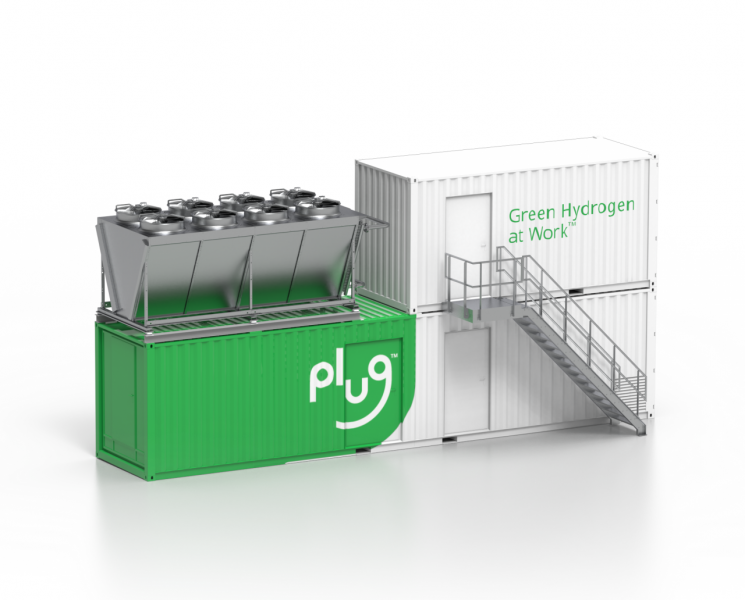 1MW-class polymer electrolyte membrane (PEM) type water electrolysis facility of the U.S. hydrogen company 'Plug Power,' which established a joint venture with SK E&S
© The Asia Business Daily(www.asiae.co.kr). All rights reserved.
![Clutching a Stolen Dior Bag, Saying "I Hate Being Poor but Real"... The Grotesque Con of a "Human Knockoff" [Slate]](https://cwcontent.asiae.co.kr/asiaresize/183/2026021902243444107_1771435474.jpg)


















