The three major indices of the U.S. New York stock market showed a decline in early trading on the 24th (local time) as they awaited the economic outlook speech by Federal Reserve (Fed) Chair Jerome Powell scheduled for the next day at the economic symposium 'Jackson Hole Meeting.' The New York stock market, which had started higher due to Nvidia's earnings surprise, soon turned downward.
At around 10:53 a.m. at the New York Stock Exchange (NYSE), the Dow Jones Industrial Average, composed of blue-chip stocks, was trading around 34,403, down 69.27 points (0.2%) from the previous close. The S&P 500 index, focused on large-cap stocks, fell 13.67 points (0.31%) to 4,422, and the tech-heavy Nasdaq index dropped 79.81 points (0.58%) to 13,641.
Currently, within the S&P 500, discretionary consumer goods, technology, and communication-related stocks are declining, while real estate, financials, utilities, and materials-related stocks are rising. Nvidia, which released its earnings shortly after the previous day's close, rose nearly 2% and continued its upward trend today. However, the Nvidia effect did not lift the entire market. Major tech stocks such as Apple and Tesla, which had risen alongside Nvidia on expectations of its earnings, are showing declines. Boeing and Spirit AeroSystems fell about 3% and 16%, respectively, following news that deliveries of the Boeing 737 Max are delayed due to manufacturing defects. AMC dropped more than 29% after completing a stock split. Dollar Tree fell over 10% due to weak earnings. T-Mobile declined 1% after announcing plans to reduce its workforce by nearly 7%.
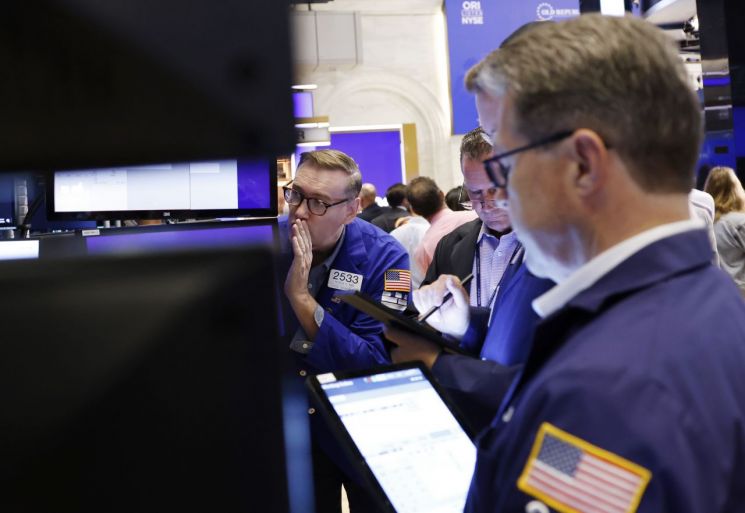
Investors are closely watching the Jackson Hole Meeting, which opens today in Wyoming, digesting corporate earnings, economic indicators, and movements in government bond yields. Nvidia's Q2 earnings per share, released after the previous day's close, came in at $2.70, surpassing market expectations of $2.09. Notably, Nvidia forecasted third-quarter sales of $16 billion, higher than expected, fueling optimism for an AI rally. Conversely, Dollar Tree's disappointing pre-market earnings raised concerns about consumer spending. The Wall Street Journal (WSJ) reported, "Amid concerns that consumer spending is slowing, retail sector stocks have generally declined over the past few weeks."
The manufacturing data released today was weak. New orders for durable goods in July fell 5.2% month-over-month, marking the largest decline since April 2020. This result was worse than Wall Street's forecasted 4.1% drop. The preliminary Purchasing Managers' Index (PMI) released by S&P Global the previous day also showed the lowest level in six months. The manufacturing PMI fell below the baseline of 50, indicating a sharper-than-expected contraction in business conditions, and the service sector PMI, which had been supporting the economy, also dropped to its lowest level in six months.
On the other hand, weekly initial jobless claims, an indicator of the U.S. labor market, decreased for the second consecutive week, suggesting that employment demand remains solid. According to the U.S. Department of Labor, claims for the week of the 13th to the 19th totaled 230,000, down 10,000 from the previous week and below the Dow Jones estimate of 240,000.
Investor attention is focused on the Jackson Hole Meeting opening today. Chair Powell is scheduled to deliver his economic outlook speech on the morning of the 25th. As this event offers insight into the direction of monetary policy at the tail end of the tightening cycle, market reactions are expected to be inevitable depending on the tone of his remarks. Powell is anticipated to reaffirm a data-dependent stance and keep the possibility of further rate hikes open if necessary. Bloomberg News reported, "Powell is using Jackson Hole as a final push in the fight against inflation," adding, "This speech comes as the battle against inflation enters its most difficult phase." Before the symposium officially begins this evening, Patrick Harker, President of the Federal Reserve Bank of Philadelphia, and Susan Collins, President of the Federal Reserve Bank of Boston, are also scheduled to speak.
James Bullard, former President of the Federal Reserve Bank of St. Louis and known as a prominent hawk (favoring monetary tightening), reaffirmed in an interview with Bloomberg TV today that additional rate hikes could occur due to a strong economy. Recently appointed dean of the Purdue University Krannert School of Management, he said, "This economic acceleration puts upward pressure on inflation, suppresses the disinflation we are seeing, and could delay the Fed's plan to end monetary tightening." He had previously conveyed similar messages in an interview with the WSJ.
The market still largely expects a rate hold in September. According to the CME FedWatch tool, federal funds futures this morning reflect an over 84% probability that the Fed will hold rates steady in September. Although the Fed's June dot plot indicated the possibility of one more hike this year, investors are increasingly favoring a scenario with no further rate increases in 2024. The probability of one or more hikes this year stands around 42%. The remaining FOMC meetings this year are in September, November, and December.
In the New York bond market today, the benchmark 10-year U.S. Treasury yield is around 4.21%, and the 2-year Treasury yield, sensitive to monetary policy, is near 4.99%. The dollar index, which measures the value of the U.S. dollar against six major currencies, rose more than 0.3% to about 103.7.
European stock markets are mixed and mostly flat. Germany's DAX index is down 0.49%, and France's CAC index is down 0.29%. Meanwhile, the UK's FTSE index rose 0.23%.
© The Asia Business Daily(www.asiae.co.kr). All rights reserved.
![Clutching a Stolen Dior Bag, Saying "I Hate Being Poor but Real"... The Grotesque Con of a "Human Knockoff" [Slate]](https://cwcontent.asiae.co.kr/asiaresize/183/2026021902243444107_1771435474.jpg)
















