Receiving related questions through SNS and spreading misconceptions
Expert: "A kind of vanity, concerns about forming wrong values"
On the 28th, when searching the hashtag '소년원' (juvenile detention center) on social networking services (SNS) mainly used by teenagers, related posts recorded over 20 million views. Hashtags like '소년원출신' (juvenile detention center alumni) and '소년원출소' (juvenile detention center release) also showed over 900,000 and 500,000 views respectively. A significant number of these posts were from people who had been to juvenile detention centers or were about to go. One video, which asked viewers to inquire about juvenile detention centers while dancing to popular music, received about 50,000 'likes' and over 1,500 comments. Another post about receiving a 'juvenile medical protection facility consignment'?a step before being sent to a juvenile detention center?also garnered nearly 60,000 likes and 358 comments.
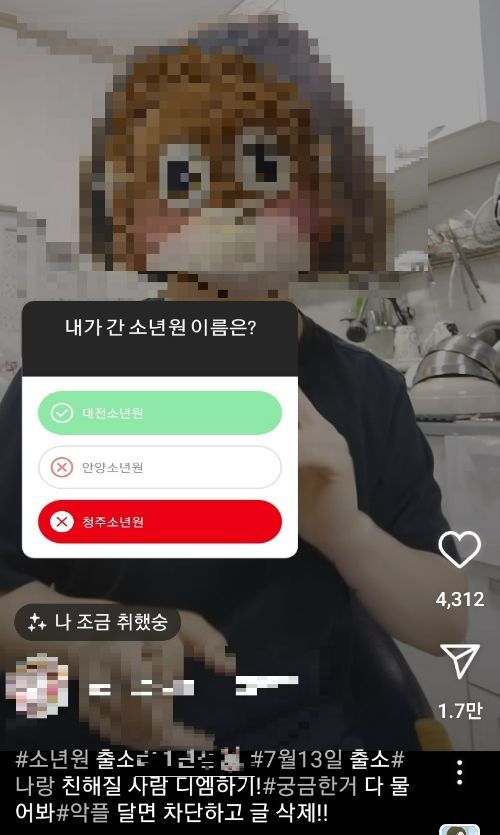 A minor posted a video on SNS posing a multiple-choice quiz asking viewers to guess which juvenile detention center they had attended among Daejeon, Anyang, and Cheongju, seeking to make friends. [Image source=SNS capture]
In response to a post inviting questions about juvenile detention centers, when someone asked, "Are the people there (juvenile detention center) scary?" the author replied, "They're surprisingly all kind." To the comment, "How do you spend two years there?" the answer was "Enjoyably." In another post, when asked, "How do you get a 9th disposition (short-term juvenile detention center sentence of up to 6 months)?" the reply was, "If you cry in front of the judge, they go easy on you." To the comment, "Do you get 'connections' after going to a juvenile detention center?" the response was, "If you get close, maybe." Some responses showed enthusiasm using emojis or expressing fandom. One user posted a video inviting others to guess which juvenile detention center they attended and looking for friends. Although there were criticisms asking if boasting about having been to a juvenile detention center was appropriate, such comments were relatively few. Minors who committed crimes and received protective measures are consuming their juvenile detention center experiences as intriguing content on SNS.
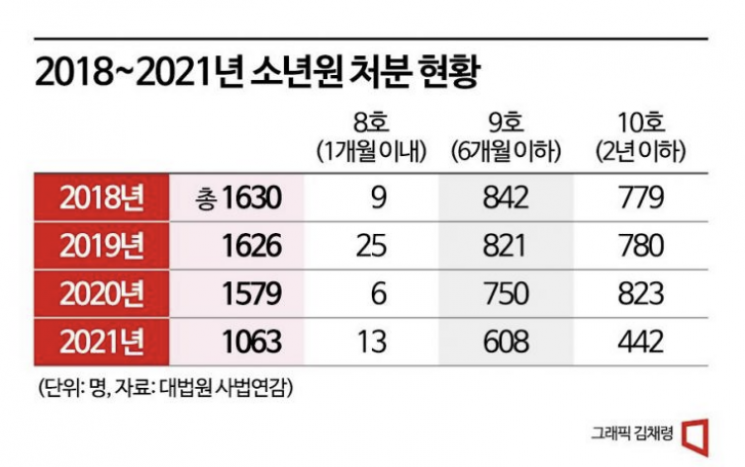
A juvenile detention center is a school-like correctional education facility that houses 'chokbeopsonyeon' (children under the age of criminal responsibility) and 'beomjoe sonyeon' (juvenile offenders) who have committed crimes and received protective measures. Children aged 10 to under 14 (chokbeopsonyeon) cannot be criminally punished but can be sent to juvenile detention centers. Juveniles aged 14 to under 19 (beomjoe sonyeon) can be criminally punished, but depending on the severity of the crime, protective measures may be imposed. Juvenile detention centers receive those who have been given protective measures corresponding to dispositions 8 to 10. Disposition 8 is up to 1 month, 9 is up to 6 months, and 10 is up to 2 years. Protective measures are less severe than criminal punishment and do not leave a criminal record, but they clearly indicate that a crime was committed.
However, on SNS, many posts by teenagers flaunting their experience of having been to juvenile detention centers are receiving high view counts. Professor Kwak Geum-ju of Seoul National University's Department of Psychology diagnosed this as "a kind of hero complex typical of adolescence, where they want to boast about experiences others have not had." Professor Lee Yun-ho, Chair Professor of Police Science at Korea Cyber University, also said, "It seems to be a form of showing off by posting about juvenile detention centers."
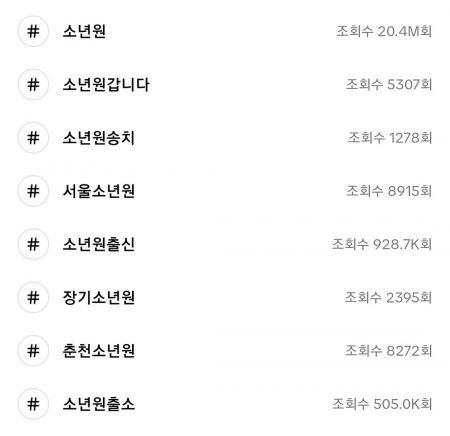 Posts with hashtags related to juvenile detention centers are gaining high views on a certain SNS. [Image source= SNS capture]
There are concerns that the trivialization and casual consumption of juvenile detention centers could lead to the formation of misguided values and encourage crime. In fact, on SNS, videos and posts asking "how to go to a juvenile detention center" can be found. In one post, a minor danced happily and asked, "I was kicked out of my house, can someone tell me how to go to a juvenile detention center?" Comments included, "If you spray a fire extinguisher inside a police station, it's possible," and "If you steal an expensive-looking bicycle, you can get in easily." On June 8, a teenage boy was caught placing a 30 cm rock on the tracks at Singyeongju Station on the Gyeongbu High-Speed Railway, saying he wanted to go to a juvenile detention center. Professor Lee pointed out, "If the culture of trivializing juvenile detention centers continues, the crime deterrent effect will weaken," adding, "Especially for youths on the 'borderline' who are contemplating committing crimes, this could act as a trigger." Professor Kwak also expressed concern, saying, "Children tend to trust peers they consider on their side more than adult advice," and "In a situation where moral and ethical values are not yet formed, a wrong value system that crime is nothing serious can develop."
Experts believe that measures are needed to block posts and videos that deviate from social norms and positively portray crime, as they pose problems. Professor Kwak said, "Self-regulation efforts such as creating internal platform regulations are necessary," adding, "If self-regulation does not occur, as a second-best option, it may be necessary for the government to create regulations or directly request platform companies to take action."
© The Asia Business Daily(www.asiae.co.kr). All rights reserved.
![Clutching a Stolen Dior Bag, Saying "I Hate Being Poor but Real"... The Grotesque Con of a "Human Knockoff" [Slate]](https://cwcontent.asiae.co.kr/asiaresize/183/2026021902243444107_1771435474.jpg)


















