Visit to Boston, USA and Toronto, Canada
"AI is the future game changer triggering innovation in all industries"
"Bio is a small seed, but we must challenge to grow it into a giant tree"
Gu Kwang-mo, CEO of LG Corporation leading the LG Group, is visiting Boston, USA, and Toronto, Canada, for four days starting on the 21st (local time). He is checking the current status of future preparations and fostering strategies in the fields of bio and artificial intelligence (AI).
On the 24th, LG announced that CEO Gu visited LG Chem’s Boston branch of the Life Sciences Division, Aveo, and LG Electronics’ AI Lab in Toronto to review strategies for expanding future businesses in bio and AI fields into the global market.
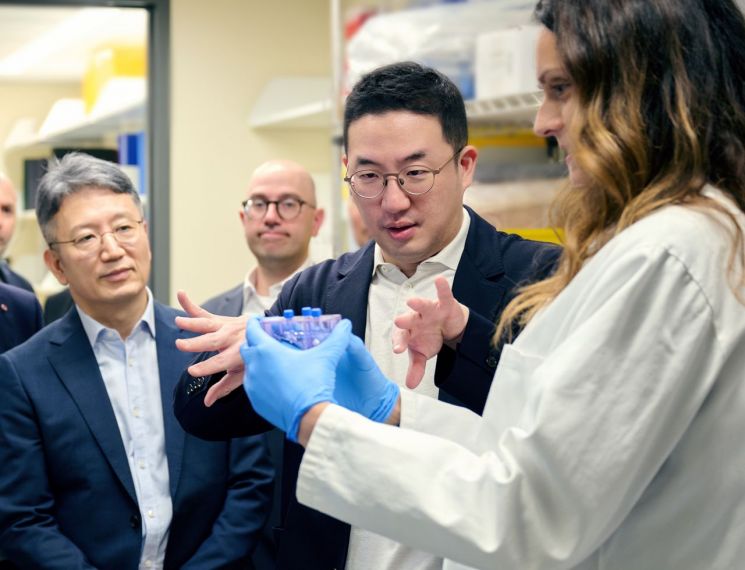 Koo Kwang-mo, CEO of LG Corporation, visited the Dana-Farber Cancer Institute in Boston, USA, on the 21st local time and received an explanation about the process of selecting cells that enhance anticancer functions during the production of cell therapy products.
Reviewing Bio Fostering Strategies in Boston, the Global Hub of the Bio Industry
Boston, USA, known as the global hub of the bio industry, is home to over 2,000 bio-related companies and research institutions worldwide. LG Chem’s Life Sciences Division established its Boston branch (Innovation Center) in 2019 to introduce innovative bio technologies and develop global new drugs. Aveo Pharmaceuticals, a U.S. cancer drug company acquired by LG Chem in January this year, has integrated its existing office with the Life Sciences Boston branch and is expanding cooperation.
CEO Gu met with Son Ji-woong, head of LG Chem’s Life Sciences Division, Lee Dong-soo, head of the Boston branch, and Michael Bailey, CEO of Aveo, at the Global Innovation Center to review the direction of the new drug business, strengthen global commercialization capabilities, and discuss Aveo’s fostering strategy. They reviewed strategies for developing innovative new drugs such as cancer drugs and cell therapies and carefully examined the status of business competitiveness enhancement after acquiring Aveo. LG Chem has announced plans to become a global top-tier pharmaceutical company by 2030.
CEO Gu said, “Looking back on the growth history of the group, LG has always prepared 10 to 20 years in advance to lead new industries,” adding, “One of LG’s core businesses today, the battery business, is a history of challenges supported by over 30 years of technology development and investment, continuing relentless execution despite numerous trials and errors.” He expressed expectations by saying, “LG’s bio business is a small seed now, but if we continue to strive and challenge without faltering, it will grow into a future giant representing LG.”
Moving to Toronto to Check Future Preparations in the AI Field
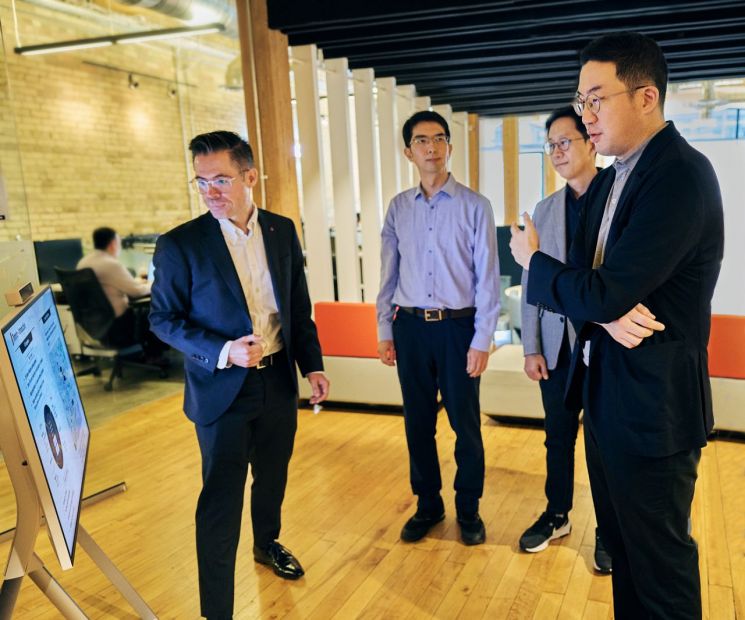 Koo Kwang-mo, CEO of LG Corporation, is discussing AI strategy during his visit to LG Electronics AI Lab in Toronto, Canada, on the 22nd local time. From the left, Kevin Pereira, Head of LG Electronics Toronto AI Lab; Lee Hong-rak, CSAI at LG AI Research Institute; Bae Kyung-hoon, Director of LG AI Research Institute.
After examining the bio field in Boston, CEO Gu visited Toronto, Canada, on the 22nd to continue future preparations in the AI field. Toronto is a city specialized in AI research. LG Electronics established the global AI research base ‘AI Lab’ in Toronto in 2018.
CEO Gu visited the AI Lab and held meetings with Baek Kyung-hoon, head of LG AI Research Institute, Lee Hong-rak, Chief Scientist of AI (CSAI), and Kim Byung-hoon, CTO (Chief Technology Officer) of LG Electronics, directly checking the status of AI promotion at the business site and discussing future research and development (R&D) directions and ways to strengthen cooperation among affiliates. Currently, the AI Lab is focusing on advanced research in AI within LG Electronics while conducting industry-academic cooperation projects with the University of Toronto. LG Electronics is applying the advanced research results of the AI Lab to smart home and smart car solutions, as well as online channels.
At the site, CEO Gu emphasized, “AI will trigger innovation in all industries in the future, and how we prepare for it will have a huge impact on the business landscape as a future game changer.” He added, “The evolution speed of AI-related technologies is very fast, and competition is becoming increasingly fierce. Let’s quickly apply the technologies we have secured so far to translate them into tangible business results at the affiliates’ business sites.” He also demanded, “Innovation through AI should go beyond simple improvements of products and services and fiercely consider the value that can be provided from the customer’s perspective.”
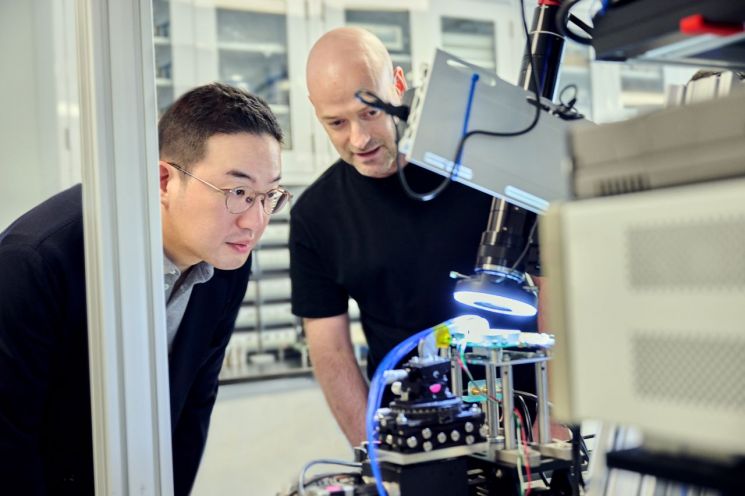 Koo Kwang-mo, CEO of LG Corporation, is listening to Christian Withbrook, CEO of Xanadu, explain experimental equipment related to quantum computing at Xanadu's research institute in Toronto, Canada, on the 22nd local time.
Visiting World-Class Research Institutions and Startups in Boston and Toronto
During this business trip, CEO Gu also visited world-class research institutions and startups located in Boston and Toronto to observe future market trends and discuss collaboration plans.
In Boston, he visited the Dana-Farber Cancer Institute, the world’s top cancer research facility affiliated with Harvard Medical School, and LabCentral, an incubator facility for startups in the bio and pharmaceutical fields. He exchanged opinions with Dana-Farber CEO Laurie Glimcher on cooperation models between research hospitals and pharmaceutical companies and new trends in cancer research. He was introduced to Boston’s bio startup ecosystem and global innovation startup fostering models by Johannes Pruenhaupt, founder and CEO of LabCentral.
In Toronto, he visited the Vector Institute and the Xanadu Research Institute to examine the latest technological trends in AI that could elevate LG’s AI competitiveness to the next level. The Vector Institute is a place where companies, universities, and startups collaborate on applied research in various AI fields such as machine learning, deep learning, and robotics. Google’s deep learning, Uber’s autonomous driving, and Nvidia’s computer vision technologies originated here. Xanadu, established in 2016, is a leading quantum computing company.
© The Asia Business Daily(www.asiae.co.kr). All rights reserved.
![Clutching a Stolen Dior Bag, Saying "I Hate Being Poor but Real"... The Grotesque Con of a "Human Knockoff" [Slate]](https://cwcontent.asiae.co.kr/asiaresize/183/2026021902243444107_1771435474.jpg)

















