Second Attempt at Military Reconnaissance Satellite After May... Failed Again
North Korea "System Error Occurred... Will Launch Third in October"
Seemingly Targeting Workers' Party Founding Day... Condition for Completing Nuclear Force
Kim Jong-un, Chairman of the State Affairs Commission of North Korea, has once again suffered a major embarrassment as the military reconnaissance satellite relaunch attempt, made after three months, failed. The consecutive failures of reconnaissance satellites, considered a core element of the 'completion of the nuclear force system,' have increased the burden on the leadership. It is expected that North Korea will attempt a third launch around the major political anniversary, the 'Founding Day of the Workers' Party,' in October.
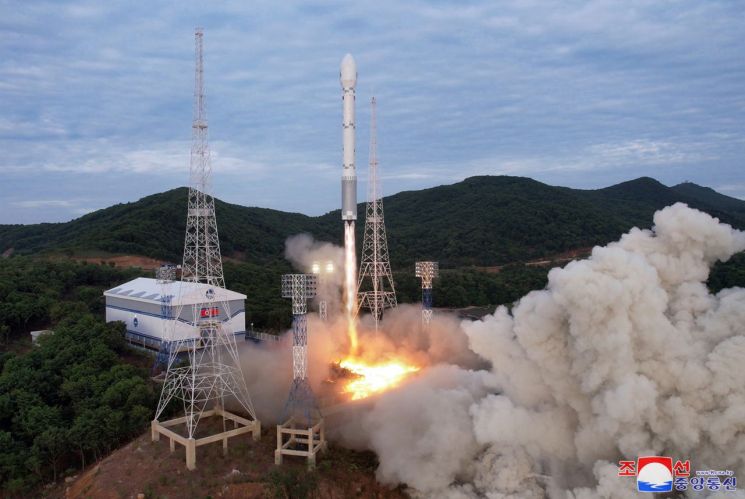
According to the Joint Chiefs of Staff on the 24th, North Korea launched one space launch vehicle southward from the Seohae Satellite Launching Ground in Cholsan County, North Pyongan Province, at around 3:50 a.m. This was a challenge made 85 days after the first failed launch on May 31, and the result was a failure again. A military official stated, "We immediately detected the launch and continuously tracked and monitored it, and it is assessed as a failure."
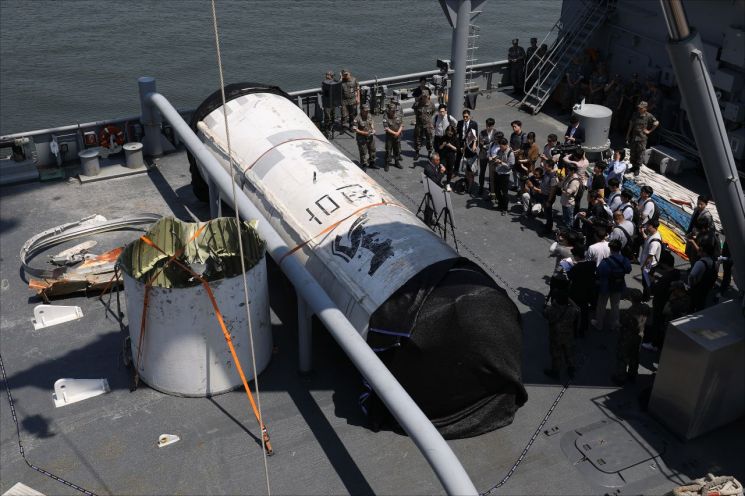 Military authorities are raising and revealing debris from North Korea's space launch vehicle 'Chollima-1' from last June. [Image source=Yonhap News]
North Korea also officially announced the launch failure. The Korean Central News Agency reported that "the National Aerospace Development Administration carried out the second launch of the reconnaissance satellite 'Malligyong-1' mounted on the new satellite carrier rocket 'Chollima-1' at the Seohae Satellite Launching Ground in Cholsan County, North Pyongan Province." It added, "The first and second stages of Chollima-1 flew normally, but an error occurred in the emergency explosion system during the third stage flight, resulting in failure."
The military plans to analyze the orbit and debris of the North Korean launch vehicle and then proceed with a recovery operation. When North Korea's satellite fell into the West Sea in May this year, the military detected it with about 180 radars. Although debris was recovered and analyzed afterward, it was judged to be 'militarily inappropriate,' and no parts were disclosed. This is interpreted as an intention to pressure North Korea by maintaining a kind of 'strategic ambiguity.' For North Korea, depending on what technology South Korea has secured, it can implement a 'tailored strategy,' so this possibility is being blocked at the source.
Despite repeated failures, North Korea has announced additional launches. The continued attempts to launch reconnaissance satellites are because they are a key link in the 'nuclear force system.' In particular, the consecutive launch failures are also seen as an effort to dispel the stigma that North Korea's rocket technology, including intercontinental ballistic missiles (ICBMs), is unstable. Reconnaissance satellites, along with nuclear warheads and ballistic missiles to carry them, are considered the three major conditions for completing nuclear forces. Unlike the increasingly advanced nuclear and missile capabilities, reconnaissance capabilities have been evaluated as remaining at a 'blind' level.
Jang Young-geun, Director of the Missile Center at the Korea Institute for National Strategic Studies, analyzed, "The emergency explosion system seems to refer to the flight termination system (FTS). It is judged that the third-stage rocket exploded due to a technical malfunction, not an intentional command after reaching space, and the satellite mounted on the third stage was also lost." He added, "The announcement that the third launch will be conducted immediately in October suggests that there are no problems with the operation and stage separation of the first to third-stage rockets, and the issue lies with the flight explosion device, so a relaunch is possible right away."
Aiming for the October Party Founding Day... "Technical Improvements May Not Be Easy"
The North Korean leadership is expected to exert stronger pressure on the military and technicians in the future. The designation of October as the timing for the third launch is analyzed to consider the major political holiday, the 'Founding Day of the Workers' Party.' North Korea commemorates October 10, 1945, when President Kim Il-sung delivered a keynote speech at the Conference of Party Leaders and Enthusiasts of the Northwest Five Provinces of the Korean Communist Party, as the Party Founding Day. Although this year is not a milestone anniversary divisible by five, it is an important political schedule for the North Korean regime, so a satellite launch attempt is expected around this time.
The problem is that it will not be easy to identify the cause of the launch failure and improve the technology. It is expected to take 4 to 6 months just for improvements and reorganization. Testing and evaluation must also be conducted, which requires considerable time, so if the launch is rushed, the possibility of additional failures is high. The satellite's technical issues also need to be resolved. Our military authorities judge that North Korea's reconnaissance satellites have no military utility. The joint investigation by South Korea and the United States on the debris of the satellite launched in May concluded that it was of very poor quality.
The camera resolution mounted on Malligyong-1 does not even reach the sub-meter level of less than 1 meter. It is practically impossible to use it for military purposes. Generally, a camera resolution must be at the sub-meter level to represent an area of less than 1 meter by 1 meter as a single point in satellite images, but North Korea's satellite resolution is worse than or comparable to that of Google Earth's satellite images. Previously, the satellite images North Korea released after launching a medium-range ballistic missile (MRBM) in December last year had a resolution of only 20 meters.
© The Asia Business Daily(www.asiae.co.kr). All rights reserved.


















