El Salvador's 'War on Gangs'
12,000 Incarcerated Following State of Emergency Declaration
The government of El Salvador, which has declared a "war on gangs" and attracted global attention, has now revealed the appearance of a massive prison where these gang members are incarcerated, drawing attention for its resemblance to the Netflix drama "Squid Game."
On the 23rd (local time), AFP reported a visit to the prison known as the Terrorist Detention Center (CECOT) along with photos.
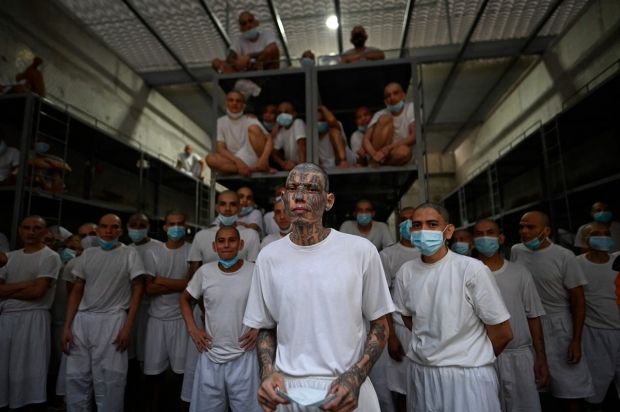 Inside view of the terrorist detention center where El Salvador gang members are imprisoned
 [Photo by AFP Yonhap News]
Located in Tecoluca, about 74 km southeast of the capital San Salvador, this prison was built by the El Salvador government to incarcerate suspects arrested in the war against gangs and opened on February 24.
The prison facility covers an area of 1.65 million square meters with a building area of 230,000 square meters, making it one of the largest in South America. It is surrounded by electric barbed wire and thick concrete walls 11 meters high and 2.1 km long. The prison consists of eight buildings, each containing 32 cells approximately 100 square meters in size, capable of housing over 100 inmates per building.
According to reports, the Terrorist Detention Center, which can accommodate about 40,000 people, currently holds around 12,000 inmates.
Most of the inmates are reportedly members of the notorious gangs "Mara Salvatrucha" (MS-13) and "Barrio 18." The Salvadoran authorities stated that the gangs number in the tens of thousands and have committed murder, extortion, drug trafficking, and other crimes.
About 60 to 75 inmates live in a 30-pyeong sized room... tightly packed three-tier metal beds reminiscent of 'Squid Game'
Approximately 60 to 75 inmates live together in a room about 100 square meters in size, roughly equivalent to a typical apartment in South Korea measuring about 30 pyeong. Notably, the rooms are filled with tightly packed three-tier metal bunk beds, evoking the Netflix drama "Squid Game."
Inmates must share two toilets, two sinks, and two water dispensers. Although there are a dining lounge, gym, and ping-pong tables, inmates are not allowed to use them. There is a punishment room without windows for inmates who commit violations, and family visits are prohibited. All inmates wear white shorts and T-shirts, are barefoot, and many have tattoos on their bodies.
Local humanitarian organizations have raised concerns about the treatment of inmates. These groups claim that inmates must live without mattresses, have no opportunity to breathe fresh air, and are subjected to beatings and torture by prison guards. Human rights lawyer Raquel Caballero also reported that inmates complained about insufficient food.
However, Andr?s Guzm?n, Director of Human Rights in El Salvador, asserted that "the condition of the inmates is good and their human rights are respected."
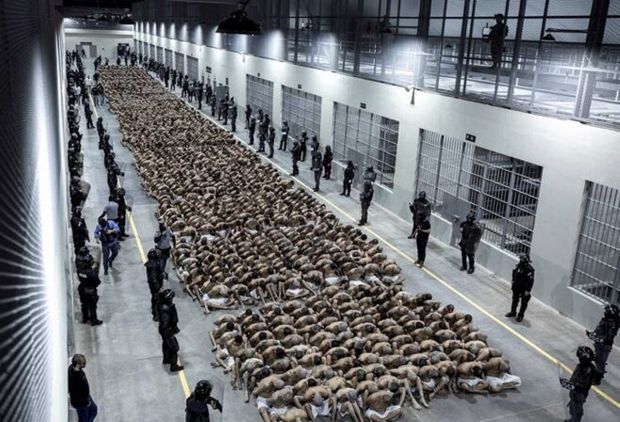 Inside view of the terrorist detention center where El Salvador gang members are imprisoned
 [Photo by AFP Yonhap News]
Once known as "the most dangerous country in the world," El Salvador experienced 62 homicides in a single day on March 26 last year. The following day, President Nayib Bukele (42) declared a state of emergency and began implementing a high-intensity security policy.
As a result, the number of suspects arrested has reached 70,000 to date, and the homicide rate, which was 17.6 per 100,000 people in 2021, dropped by more than half to 7.8 per 100,000 last year, reaching levels comparable to Canada and the United States.
However, human rights organizations criticize the government for numerous human rights violations, including detentions and arbitrary searches of residences without warrants or clear evidence.
As of the end of last year, President Bukele's approval rating stood at 91%, enjoying the support of citizens fearful of crime.
© The Asia Business Daily(www.asiae.co.kr). All rights reserved.
![Clutching a Stolen Dior Bag, Saying "I Hate Being Poor but Real"... The Grotesque Con of a "Human Knockoff" [Slate]](https://cwcontent.asiae.co.kr/asiaresize/183/2026021902243444107_1771435474.jpg)
















