Europe's Largest Nuclear Plant Safety Concerns
"Plans to Create More Wells"
Since the dam explosion accident last June, concerns about a shortage of cooling water have persisted at the Zaporizhzhia Nuclear Power Plant site in Ukraine, where a plan is being promoted to dig about 10 wells and supply groundwater as cooling water for the nuclear power plant.
The International Atomic Energy Agency (IAEA) announced on the 23rd (local time) in a statement that "as a measure to cool the six reactors within the Zaporizhzhia nuclear power plant, a well was recently created and water supply has begun, with plans to create more wells."
The IAEA explained, "A well was recently created near the reservoir supplying cooling water to the nuclear power plant, supplying 20 cubic meters of groundwater per hour to the reservoir." The Zaporizhzhia plant operators plan to create about 10 to 12 similar wells to utilize for cooling water supply, the IAEA added.
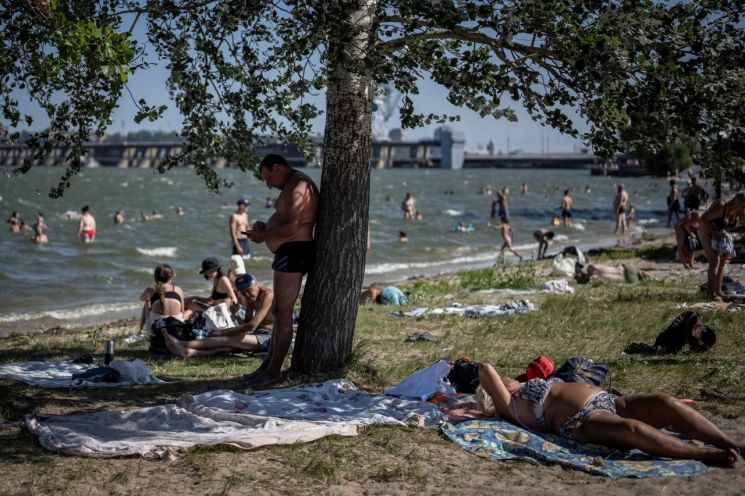 Citizens of Zaporizhzhia Oblast, Ukraine, are cooling off in the Dnipro River on the 6th (local time). Recently, Ukraine has been experiencing a heatwave with temperatures exceeding 40 degrees Celsius.
 [Image source=Yonhap News]
Zaporizhzhia Nuclear Power Plant, the largest nuclear power plant in Europe, is a site where concerns about radiation safety have intensified amid the conflict between Russia and Ukraine. If a problem occurs with facility safety, it could potentially lead to the worst nuclear accident. Cooling water is directly linked to nuclear power plant safety. Failure to supply cooling water to the plant in time can lead to a nuclear fuel rod core meltdown, causing radioactive materials to be exposed to the outside.
The cooling water supply issue became a major concern for nuclear power plant safety management following the explosion of the Kakhovka Dam in Ukraine last June. The Zaporizhzhia plant used lake water filled by the Kakhovka Dam for cooling the reactors and spent nuclear fuel, but after the dam explosion, the lake water level has continuously dropped.
Although there is enough cooling water remaining in the cooling water reservoir within the Zaporizhzhia plant site to supply the reactors for several months, various measures to draw water must be prepared to maintain nuclear power plant safety in the mid to long term. The IAEA reported that the reservoir water level is dropping by 1 cm per day.
The Zaporizhzhia plant operators are also implementing a plan to draw water from the discharge channel of the nearby Zaporizhzhia Thermal Power Plant (ZTPP). On this day, the IAEA reported that the leakage found in the steam generator of reactor unit 4’s containment building at the Zaporizhzhia plant was caused by a crack in the welded pipe joint. Accordingly, the plant operators re-welded the pipe and are conducting a steam generator operation test. The IAEA stated, "No radioactive materials were released due to this leakage accident."
© The Asia Business Daily(www.asiae.co.kr). All rights reserved.
![Clutching a Stolen Dior Bag, Saying "I Hate Being Poor but Real"... The Grotesque Con of a "Human Knockoff" [Slate]](https://cwcontent.asiae.co.kr/asiaresize/183/2026021902243444107_1771435474.jpg)















