Birth at Brights Zoo in Tennessee Last Month
The World's Only Plain Giraffe... First in 51 Years
Giraffe Spots Also Serve to Regulate Body Temperature
The only giraffe without spots on Earth was born at a zoo in the United States, attracting attention.
On the 21st (local time), foreign media including CNN and BBC reported that a female giraffe without the characteristic white spots was born on the 31st of last month at Brights Zoo in Tennessee, USA.
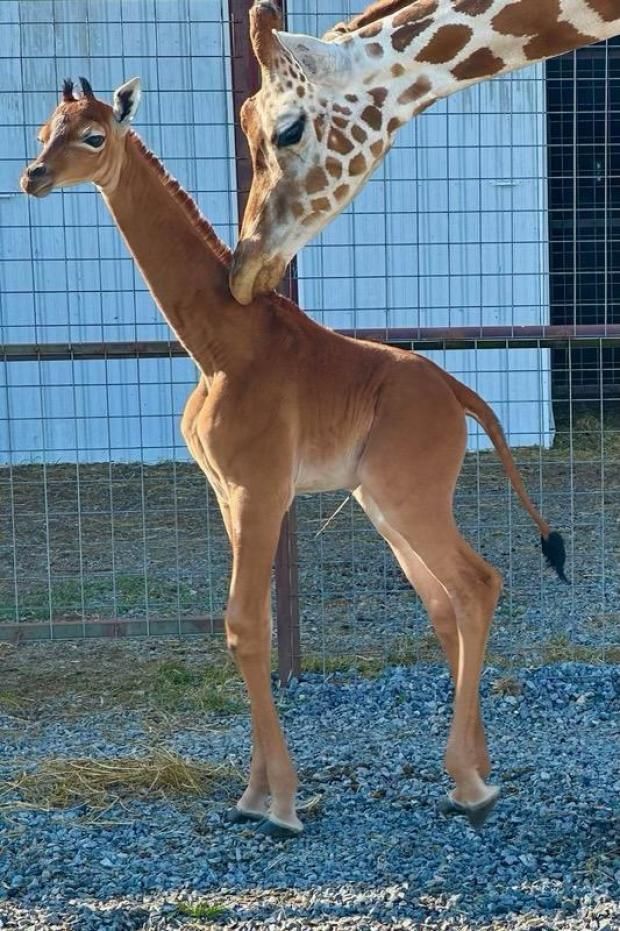 On the 31st of last month, the world's only plain giraffe was born at a zoo in Tennessee, USA.
 [Photo by Brights Zoo]
According to the zoo, this giraffe has already exceeded 180 cm in height and is being cared for by its mother and zoo staff. David Bright, the head of Brights Zoo, said, "Giraffe spots serve as a form of camouflage in the wild, and it is very rare to be born without these spots," adding, "We believe this giraffe is special."
He continued, "The last recorded case was in 1972 at Ueno Zoo in Tokyo, Japan, where a giraffe named Toshiko was born with a net-like pattern mixing brown and orange but without spots." Giraffes have a lifespan of 25 to 30 years, and Toshiko is reported to no longer be alive.
Giraffe Spots Also Function in Thermoregulation
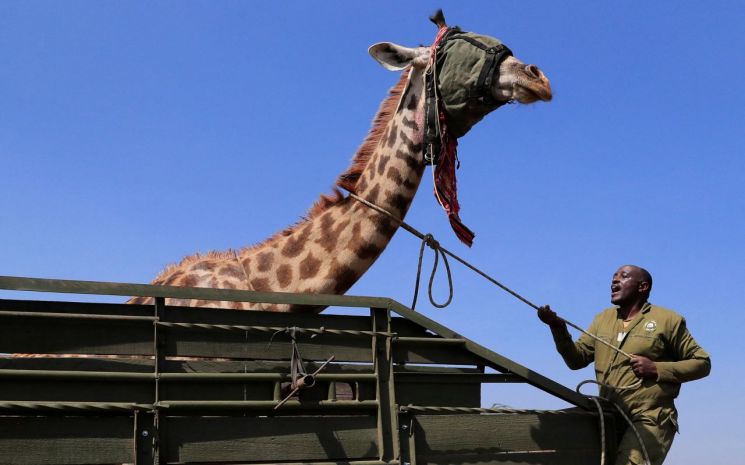 The habitat of giraffes is mainly in northern Kenya, southern Ethiopia, and the Somalia region. Currently, giraffes are threatened with survival due to habitat fragmentation in Africa and illegal poaching, with their population having decreased by 40% over the past 30 years.
 [Photo by Reuters·Yonhap News]
Underneath the giraffe's spotted skin are blood vessels that release heat, serving as a kind of thermoregulation function. Except for this spot-free giraffe, all giraffes at Brights Zoo have their own unique spot patterns, and researchers have analyzed that these patterns are inherited from their mothers.
Famous as the tallest herbivore on land, giraffes are divided into two types based on their body patterns: net-like and Maasai. The newborn giraffe belongs to the net-like giraffe category, which is classified as vulnerable on the International Union for Conservation of Nature (IUCN) Red List, with about 8,500 individuals remaining in the wild.
Giraffes mainly inhabit northern Kenya, southern Ethiopia, and the Somalia region. Currently, giraffes face threats to their survival due to habitat fragmentation and illegal poaching in Africa, with their population having decreased by 40% over the past 30 years.
In response, the zoo hopes that the birth of this unique spot-free giraffe will help raise awareness of the difficulties giraffes face worldwide.
Meanwhile, the zoo announced that it will hold a contest open to the public to name this giraffe. Candidates include Kipeki, meaning "unique" in Swahili, and Shakiri, meaning "most beautiful."
© The Asia Business Daily(www.asiae.co.kr). All rights reserved.
![Clutching a Stolen Dior Bag, Saying "I Hate Being Poor but Real"... The Grotesque Con of a "Human Knockoff" [Slate]](https://cwcontent.asiae.co.kr/asiaresize/183/2026021902243444107_1771435474.jpg)

















