Rocky Shore Angler Donates to National Marine Biodiversity Institute
'Considered a Precursor to Earthquakes' but Lacks Scientific Evidence
A rare deep-sea fish species, 'Sangalchi,' which had not been seen in the West Sea coastal waters, was discovered at Maldo Island in the Gogunsan Islands, Gunsan, Jeonbuk.
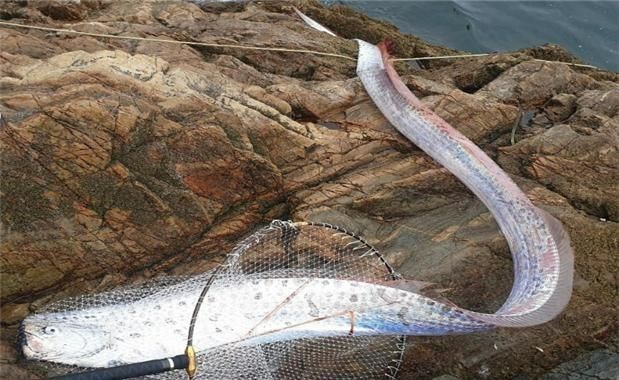 The deep-sea rare fish species 'Sanggalchi' was discovered for the first time on the coast of Gogunsan Archipelago, Gunsan, Jeonbuk.
 [Photo by National Marine Biodiversity Institute of Korea]
On the 23rd, the National Marine Biodiversity Institute of Korea announced that on the morning of the 16th, around 6 a.m., a Sangalchi about 2 meters long was found washed ashore on the coast of Maldo Island in the Gogunsan Archipelago, approximately 40 km south of Gunsan, by a rock fishing enthusiast who then donated it.
Resembling a hairtail fish, the Sangalchi is a species found at depths of 400 to 500 meters in the Pacific Ocean, Indian Ocean, and the East and South Seas of Korea.
It has a magnificent appearance, with a gigantic body length reaching up to 10 meters and a red dorsal fin.
Sangalchi is associated with various legends and many stories in both Eastern and Western cultures.
In Korea, Sangalchi is called so because of the legend that "the star on the mountain lives 15 days in the mountains and 15 days in the sea within a month, flying between the mountains and the sea."
On the 21st of last month, an earthquake occurred in the Puno region of southeastern Peru, and around the same time, a Sangalchi was caught off the coast of Punta Sal in Tumbes, attracting attention. The appearance of Sangalchi is sometimes considered a precursor to earthquakes and other phenomena, but this has not been scientifically proven.
 The deep-sea rare fish species 'Sanggalchi' was first discovered off the coast of Gogunsan Archipelago, Gunsan, Jeonbuk.
 [Photo provided by the National Marine Biodiversity Institute of Korea]
Since its opening in 2015, the National Marine Biodiversity Institute of Korea has secured over 560,000 marine biological resources, including 514 deep-sea resources through donations, actively utilizing them for marine biodiversity research.
Among these, through international joint research with experts from the Marine Biodiversity Institute, the Smithsonian Institution in the United States, and the National Oceanic and Atmospheric Administration (NOAA), two new species of deep-sea corals have been reported.
The newly acquired Sangalchi will also undergo follow-up studies through detailed morphological and genetic analyses.
Ahn Yong-rak, head of the Marine Biodiversity Division, stated, "Although there have been rare records of Sangalchi living in the deep waters near Korea’s East and South Seas, finding one in the West Sea is extremely unusual," adding, "Its external condition is also well-preserved, making it very valuable."
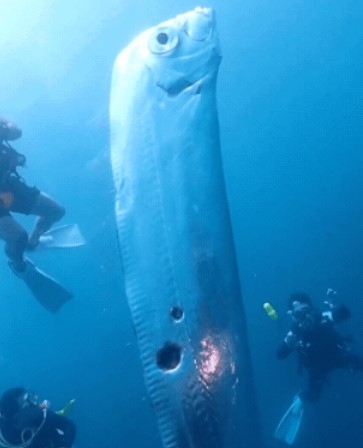 A cutlassfish encountered by divers in the sea near Ruifang District, New Taipei City, Taiwan, in early last month.
 [Photo source=Instagram capture]
Earlier last month, an 11-meter-long Sangalchi was filmed underwater off the coast of New Taipei, Taiwan, drawing public attention.
Adult male divers swimming beside the Sangalchi, which was about the height of a four-story building, appeared as small as children.
Wang Chenglu, the diver who discovered the Sangalchi, said, "You can see many amazing fish along the northeastern coast of Taiwan," but added, "This was my first encounter with such a gigantic Sangalchi," expressing his astonishment.
He explained, "It doesn’t seem that the Sangalchi came to the surface due to seismic activity," and added, "It looked like it had wounds from a shark bite. It was clearly dying and seemed to be trying to move toward shallower waters."
© The Asia Business Daily(www.asiae.co.kr). All rights reserved.
![Clutching a Stolen Dior Bag, Saying "I Hate Being Poor but Real"... The Grotesque Con of a "Human Knockoff" [Slate]](https://cwcontent.asiae.co.kr/asiaresize/183/2026021902243444107_1771435474.jpg)


















