Bank of Korea's 'August Consumer Sentiment Survey Results'
Despite the slowdown in inflation, the perceived inflation remains high, and the consumer sentiment index fell slightly this month for the first time in six months due to weakened expectations for export improvement amid China-related risks. On the other hand, the housing price outlook index reached its highest level in 1 year and 3 months as the perception spread that recent housing transaction volumes have increased and house prices have bottomed out.
According to the 'Consumer Sentiment Survey Results' released by the Bank of Korea on the 22nd, the consumer sentiment index this month (103.1) fell by 0.1 points compared to last month. The consumer sentiment index, which had shown an upward trend for five consecutive months from March, exceeded 100 for the first time in 13 months in June and remained above 100 for three months, but recently, due to growing domestic and international economic uncertainties such as those related to China, it slightly declined for the first time in half a year.
Hwang Hee-jin, head of the Bank of Korea's Statistics and Survey Team, explained, "Although the inflation rate has slowed, perceived inflation remains high, and expectations for export improvement have weakened due to recent China-related risks, causing the consumer sentiment index to decline slightly."
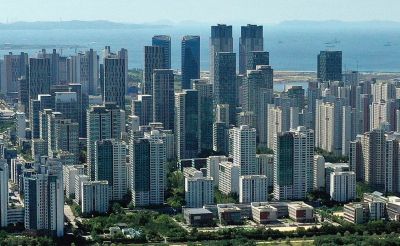
This month, the housing price outlook index rose 5 points from last month (102) to 107. This is the highest level in 1 year and 3 months since May last year (111). A housing price outlook index above 100 means that more consumers expect house prices to rise than to fall.
Hwang said, "There are still regional differences, so it is difficult to say that house prices have fully entered an upward trend," but added, "According to data from the Korea Real Estate Board, nationwide apartment prices have risen for five consecutive weeks, and the rate of change, which had been rising mainly in the metropolitan area, has turned positive nationwide." According to the Real Estate Board, the apartment sales price index rate of change, which was negative until June this year (-0.04%), turned positive in July (0.06%).
The interest rate level outlook index (118) rose 6 points from the previous month due to the continued interest rate hikes by major countries and the rise in loan interest rates, reflecting the upward trend in market interest rates. The perception has spread that the tightening stance may last longer than expected due to the strong U.S. economy, which could affect interest rates in Korea, and as market loan interest rates rise, more respondents expect future interest rates to increase.
Regarding the economic situation, the current economic conditions index (72) and the future economic outlook index (80) fell by 3 points and 4 points respectively compared to the previous month. Hwang explained, "Economic indices had been rising this year thanks to expectations of a 'low in the first half and high in the second half,' but recently, concerns about export sluggishness due to China-related risks and delayed semiconductor market recovery have caused a decline."
The inflation level outlook index (147) rose 3 points due to increases in international oil prices, agricultural product prices, and public utility charges.
The expected inflation rate remained at 3.3%, the same as the previous month. Hwang added, "Due to worsening weather conditions such as heavy rains and heatwaves, consumers still feel that inflation is high, so it remains at the previous month's level," and "There will also be an impact from public utility charges expected to rise in the second half, such as water and sewage and city gas costs."
© The Asia Business Daily(www.asiae.co.kr). All rights reserved.
![Clutching a Stolen Dior Bag, Saying "I Hate Being Poor but Real"... The Grotesque Con of a "Human Knockoff" [Slate]](https://cwcontent.asiae.co.kr/asiaresize/183/2026021902243444107_1771435474.jpg)















