Competition Held from 10th to 20th, 2023
All 5 Participants Won Medals, Overall 10th Place
South Korea ranked 10th overall with all participants winning medals at the 2023 International Astronomy and Astrophysics Olympiad.
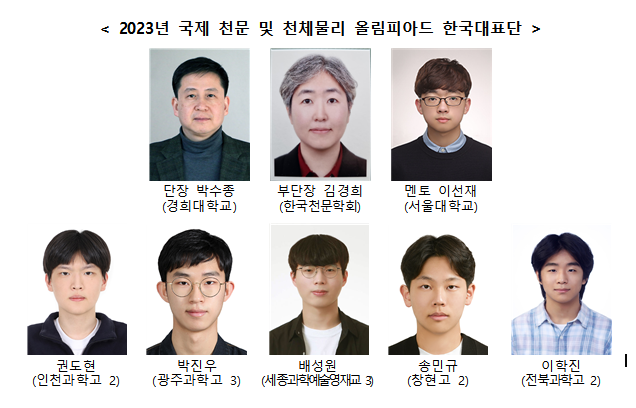
On the 21st, the Ministry of Science and ICT announced that five members of the South Korean delegation achieved these results at the IOAA held in Hołd?w, Poland, from the 10th to the 20th, lasting a total of 11 days.
At this competition, which featured 250 students from 51 countries worldwide, all South Korean participants won medals. Student Lee Hak-jin (Jeonbuk Science High School, Grade 2) won a gold medal; Bae Seong-won (Sejong Science and Arts Gifted School, Grade 3) won a silver medal; and Kwon Do-hyun (Incheon Science High School, Grade 2), Park Jin-woo (Gwangju Science High School, Grade 3), and Song Min-gyu (Changhyeon High School, Grade 2) each won bronze medals. This achievement secured 10th place overall for the country. The United Kingdom (5 golds) ranked first overall, India (4 golds, 1 silver) second, and Iran (3 golds, 2 silvers) third.
The competition was conducted and evaluated over four days, consisting of 50% theory (5 hours), 10% telescope observation (1.5 hours), 15% planetarium observation (1.5 hours), and 25% data analysis (3 hours). The theory problems covered a wide range of topics including ▲basic concepts of astrophysics, ▲time and coordinates, ▲planetary and stellar systems, ▲cosmology, and ▲space technology. This year, 13 problems were presented, including the ‘Asteroid Deflection Experiment’ to change the orbit of an asteroid to protect Earth, and the ‘Laser Interferometer Space Antenna’ for gravitational wave detection. The telescope observation section included 4 problems such as ‘Measuring the angular velocity of Starlink satellites and calculating the distance between satellites.’ The planetarium observation section had 3 problems, including ‘Determining physical quantities of the exoplanetary system TRAPPIST-1.’ The data analysis section featured 2 problems, such as ‘Determining the mass of a newly discovered black hole through analysis of observational data on microlensing phenomena.’
© The Asia Business Daily(www.asiae.co.kr). All rights reserved.
![Clutching a Stolen Dior Bag, Saying "I Hate Being Poor but Real"... The Grotesque Con of a "Human Knockoff" [Slate]](https://cwcontent.asiae.co.kr/asiaresize/183/2026021902243444107_1771435474.jpg)















