The Result of 10 Years Investigating the Massacre of Koreans: Book 'The Truth Denying the Kanto Earthquake Massacre'
Watanabe Nobuyuki "Academic Support Needed in the Civil Sector"
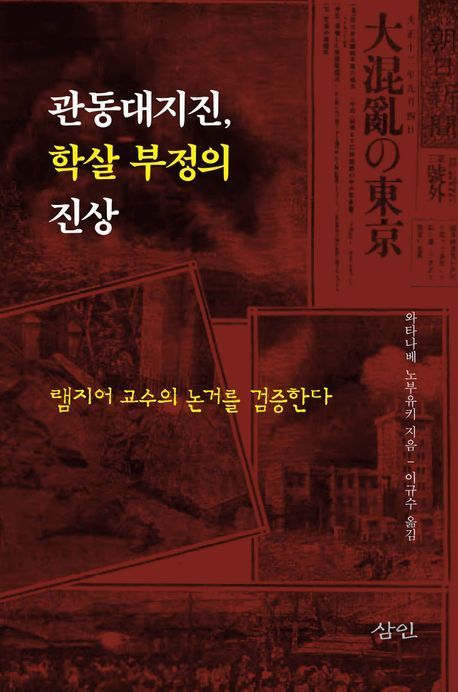
On September 1, 1923, a massive earthquake struck the Kanto region of Japan, resulting in the deaths of over 100,000 people and creating more than 2 million displaced individuals. At the time, the Japanese government declared martial law, but rumors such as "Koreans poisoned wells," "they are committing arson," and "they are armed and planning to harm Japanese people" spread rapidly, leading to the reported killing of approximately 6,000 Koreans by Japanese vigilante groups. However, the full truth behind these events remains shrouded in mystery and has never been properly uncovered. In the absence of concrete facts, Japanese right-wing groups claim that the Koreans who were killed were criminals posing a threat. Japanese journalist Watanabe Nobuyuki sheds light on the unjust sacrifice of Koreans 100 years ago in his book, The Denial of the Kanto Earthquake Massacre Truth.
Mr. Watanabe devoted the last ten years of his 40-year journalism career to investigating the Kanto Earthquake. Having developed an interest in history, he became curious about the near-total lack of information regarding Korean victims at the time and began his research. At a press conference held on the 18th at the Jeon Tae-il Memorial Hall in Seoul, he stated that the publication of his book was “not an act of conscience or progressivism by a Japanese person,” but rather “the result of a journalist’s investigation into historical facts.”
To conduct his research, he visited various exhibitions held in Japan ten years ago to commemorate the 90th anniversary of the Kanto Earthquake, but he could not find any information about Korean victims there. Although some exhibitions briefly displayed content about the massacre of Koreans, no one seemed to know the reasons behind the Korean casualties. The only speculation was that Koreans had earned resentment by taking jobs away from the lower-class Japanese.
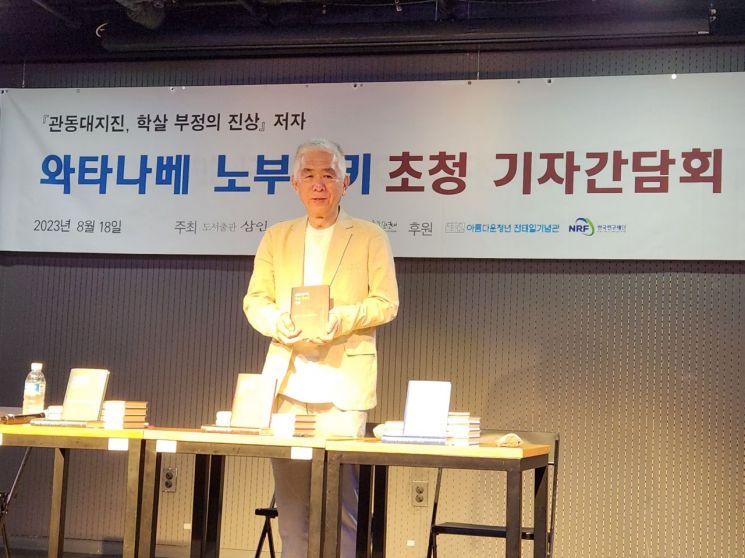 'The Great Kanto Earthquake, Denial of the Massacre Truth' Author Watanabe Nobuyuki
 Photo by Seo Mideum
Watanabe approached his investigation with the mindset that “a journalist is like a doctor searching for the causes of society’s ailments.” He focused on the vigilante groups. The core members of these groups were retired soldiers who had returned from overseas deployments. According to him, these soldiers mostly came from the poorest social classes and many had experience in the Siberian expedition. The problem was that in 1920, they had suffered defeat at the hands of Soviet communist forces and Korean independence fighters in Nikolaevsk (the Nikolayevsk Incident), a Soviet-occupied territory in Siberia. During that joint operation, about 700 Japanese soldiers and residents lost their lives. Watanabe speculated that upon returning home and forming vigilante groups, these men harbored hatred toward Koreans due to their defeat in Siberia.
Regarding suspicions that the Japanese government had ordered the killing of Koreans, he drew a clear line. He estimated that while the government tacitly permitted the killings, there was no direct order to murder Koreans. For example, in Yokohama, where the highest number of Korean victims occurred starting the evening of September 1, 1923, “seven out of eight police stations were burned down, there were no army troops stationed in Yokohama at the time, and communication and transportation with the outside were cut off, so government influence could not reach there.” It was a situation where neither local judgment nor influence from nearby Tokyo could have played a role. However, regarding post-event tacit approval, he noted that although the police at the time were aware of the facts, only two Japanese people were arrested in Yokohama, and the majority were not punished for murder.
He also criticized the falsity of the 2019 paper by Harvard University professor John Mark Ramseyer titled Privatizing Police: Japanese Police, the Massacre of Koreans, and Private Security Companies. The paper claimed that few Koreans were killed during the Kanto Earthquake and that some victims were criminals, thus justifying the killings as self-defense. Watanabe criticized this by pointing out the fictitious nature of the old newspaper articles Ramseyer cited as evidence. Due to the earthquake, transportation and communication were severed, resulting in inaccurate information being published in newspapers, and Ramseyer selectively quoted only parts of these. He said, “There is virtually nothing newly discovered or claimed,” and added, “It can be regarded as a paper pieced together from the claims made by right-wing groups.”
How should we approach an incident whose truth remains undisclosed even after 100 years? He argued that before the government takes action, academic research at the private level must come first to approach the truth. He said, “Rather than confronting each other over who is right, it is important to view the situation objectively,” and “To do so, it is crucial to create many academic conference forums at the private level.”
© The Asia Business Daily(www.asiae.co.kr). All rights reserved.
![Clutching a Stolen Dior Bag, Saying "I Hate Being Poor but Real"... The Grotesque Con of a "Human Knockoff" [Slate]](https://cwcontent.asiae.co.kr/asiaresize/183/2026021902243444107_1771435474.jpg)
















