Driving Range Up to 700 km on Full Charge
Improved Low-Temperature Charging Performance
Mass Production by Year-End, Shipments Next Year
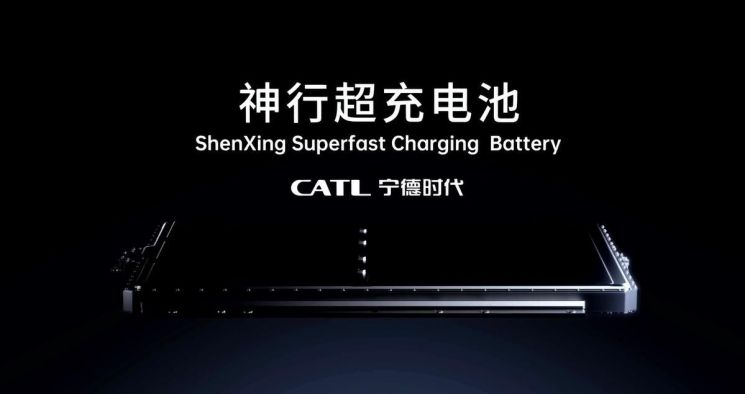
The world's largest secondary battery company, China's CATL (Ningde Shidai), has unveiled a new lithium iron phosphate (LFP) battery product capable of driving 400 km on a 10-minute charge. Although LFP batteries have been praised for their low cost and safety, they have been criticized for lower energy density and inferior performance. With CATL's new product addressing these issues, competition with domestic secondary battery companies is expected to intensify.
According to major foreign media, CATL held a press conference in China on the 16th to announce the launch of the new product, revealing the LFP battery named Sunsing (神行). Sunsing means "god-like movement," emphasizing its fast charging time. Gao Han, CATL's Chief Technology Officer (CTO), explained, "It can drive 250 miles (approximately 400 km) on a 10-minute charge and up to 700 km on a full charge." The 400 km range is roughly the distance from Seoul to Busan.
CATL stated that it applied its self-developed ion-ring superconducting electrolyte technology and ultra-thin film technology to Sunsing. CATL also emphasized that it solved the chronic low-temperature charging issue of lithium-ion batteries. According to CATL, Sunsing can charge from 0% to 80% within 30 minutes even at minus 10 degrees Celsius.
CATL explained that it plans to establish a mass production system by the end of this year and start shipping the product from 2024. Accordingly, electric vehicles launching next year may be equipped with CATL's new LFP battery. CATL currently supplies LFP batteries to BYD, China's largest electric vehicle manufacturer, and Tesla in the United States.
Tesla has applied LFP batteries to its low-cost electric vehicle models since 2021. With CATL releasing an improved performance product, it is expected that more global automakers will adopt it.
Until now, domestic companies have focused on ternary batteries (NCM, NCA) containing nickel in the cathode material, expecting ternary batteries, which have superior performance to LFP, to dominate the market. However, as the drawbacks of LFP batteries have been improved and global companies have successively introduced electric vehicles equipped with LFP batteries, the domestic industry has recently shifted toward active response.
According to SNE Research, a market research firm in the energy sector, CATL held the top position with a 36.8% share of the global electric vehicle battery market in the first half of this year.
© The Asia Business Daily(www.asiae.co.kr). All rights reserved.
![Clutching a Stolen Dior Bag, Saying "I Hate Being Poor but Real"... The Grotesque Con of a "Human Knockoff" [Slate]](https://cwcontent.asiae.co.kr/asiaresize/183/2026021902243444107_1771435474.jpg)















