Sharp Increase in Hydrogen Fuel Cell Vehicle Market Share in China in H1
Rapid Growth Focused on Commercial Vehicles, Korea Closely Chasing
China Actively Supports Hydrogen as Key Carbon Zero Measure
US and Germany Foster Hydrogen with Subsidies
Korea Cuts Hydrogen Budget and Lowers Development Goals
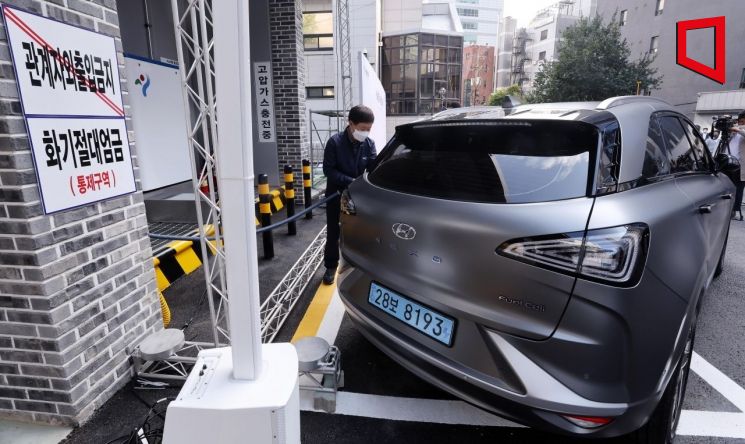 The 'Seosomun Office Hydrogen Charging Station' at Seoul City Hall Seosomun Building. Photo by Hyunmin Kim kimhyun81@
China is poised to surpass South Korea not only in electric vehicles but also in the hydrogen energy sector. While major countries are accelerating their efforts in hydrogen energy, South Korea, which was the first in the world to enact the 'Hydrogen Act,' appears to be faltering. There are calls for national-level support and attention.
According to SNE Research, a market research firm in the energy sector, China's global market share of hydrogen fuel cell vehicle sales increased by 18.1 percentage points from the same period last year to 33.3%, ranking second after South Korea (36.1%). South Korea maintained the top market share but saw a 16.8 percentage point drop over the year, threatening its number one position to China. The United States fell to third place with a 22.0% share, yielding second place to China.
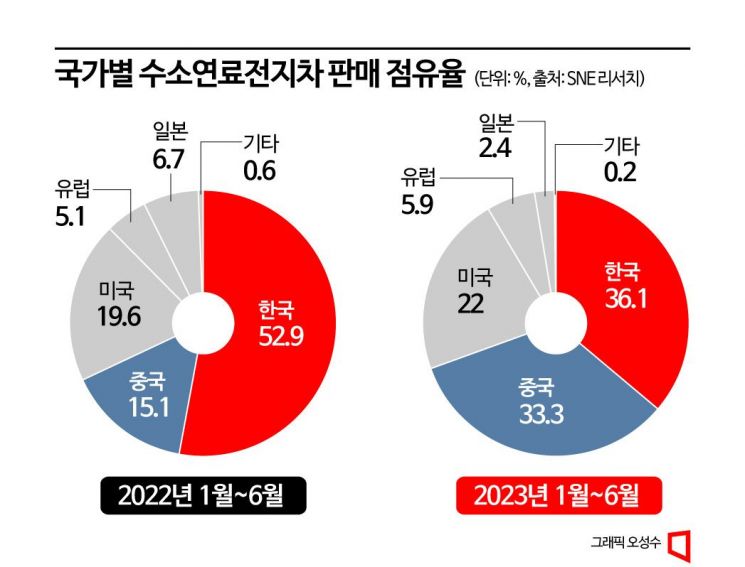
The hydrogen fuel cell vehicle market is still in its infancy, so overall sales volume is not large, but China's growth trend is clear. China sold 2,764 hydrogen vehicles in the first half of this year, a 95.3% increase compared to the same period last year. In contrast, South Korea's hydrogen vehicle sales dropped sharply by 39.7% to 2,992 units during the same period.
SNE Research analyzed, “Long-standing issues such as insufficient hydrogen vehicle charging infrastructure, rising hydrogen refueling costs, and limited consumer choices for hydrogen vehicles are factors hindering market growth,” adding, “China, focusing on hydrogen commercial vehicles, has shown rapid growth.”
South Korea currently has no alternative other than the Nexo, launched in 2018. As of the end of June, there are 179 hydrogen charging stations nationwide (with 251 dispensers), indicating that the charging infrastructure remains poor. Compared to the rapidly spreading electric vehicles, national interest has significantly declined.
China and Others Accelerate Hydrogen Energy Development
China is increasing policy support for hydrogen energy at a pace comparable to electric vehicles. It regards hydrogen, considered the 'ultimate clean energy,' as a key means to achieve a carbon-neutral society. According to data from the Korea Institute for International Economic Policy, over the past year, more than 50 hydrogen energy-related policies were announced by various government ministries and committees in China. Regionally, over 300 hydrogen energy policies were issued. The significant increase in hydrogen fuel cell vehicle sales in China is analyzed as a natural result of national interest and support.
China is the world's largest hydrogen producer but is understood to lag behind major countries in foundational technologies. To overcome this, the Chinese government has been rolling out support policies one after another. According to reports from the state-run Global Times, on the 8th, China's central government ministries announced the 'Construction Standard Guidelines for the Hydrogen Energy Industry' for the first time. These guidelines include standards for hydrogen energy production, storage, and transportation. In June, China submitted a 'Green Hydrogen Roadmap Report' to the World Economic Forum (WEF), emphasizing its commitment to hydrogen energy support.
Since designating hydrogen fuel cell vehicles as a key development area in the 'Made in China 2025' plan announced in 2015, China has continuously introduced hydrogen energy policies. Last year, the 'Medium- and Long-Term Plan for Hydrogen Energy Development (2021?2035)' set a goal to have 50,000 hydrogen fuel cell vehicles by 2025. Recently, the Beijing-Tianjin-Hebei metropolitan area (Jing-Jin-Ji) agreed to jointly establish hydrogen fuel cell industrialization and pilot cities.
China is not the only country driving the hydrogen push. According to a policy research report titled 'Strengthening Hydrogen Competitiveness' published by the Korea International Trade Association on the 27th of last month, major countries worldwide including Germany, the United States, Japan, and Australia are sparing no policy support for hydrogen energy.
Germany plans to invest 21.36 billion euros (approximately 31.2 trillion KRW) by 2030 to produce green hydrogen domestically and secure overseas supply chains. The United States, following the 2020 'Hydrogen Economy Roadmap,' announced the 'Clean Hydrogen Strategy Roadmap' this year to promote the hydrogen economy.
Since the inauguration of the Joe Biden administration, the U.S. has continuously introduced various subsidies. The Infrastructure Investment and Jobs Act (BIL) enacted in 2021 includes $1 billion for clean hydrogen electrolysis technology development, $500 million for clean hydrogen manufacturing and recycling initiatives, and $8 billion for clean hydrogen regional hub development. Additionally, the Inflation Reduction Act (IRA) provides tax credits ranging from at least 60 cents to up to $3 per kilogram to hydrogen producers through 2032.
Japan was the first country in the world to announce a national-level 'National Hydrogen Strategy' in 2017. In its 2020 'Green Growth Strategy for Achieving Carbon Neutrality by 2050,' hydrogen was selected as one of 14 core sectors, offering tax reductions and financial support to companies. The Ministry of Economy, Trade and Industry is expanding production bases and considering subsidies over the next 15 years to reduce hydrogen production costs, aiming to make hydrogen and fossil fuel power generation costs comparable.
South Korea Cuts Hydrogen Budget and Lowers Development Goals
South Korea, along with Japan, has long been interested in hydrogen fuel cells and led related technology development. In 2020, it became the first country to enact the 'Hydrogen Act.' However, recent reductions in government interest and support have caused the related industry to lose momentum.
Some hydrogen-related budgets have been cut, and targets have been lowered. The budget for building hydrogen production bases shrank from 66.6 billion KRW in 2021 to 8.8 billion KRW this year. This contrasts with competing countries that provide incentives to clean hydrogen production companies.
The 2021 Hydrogen Economy Implementation Basic Plan set a target hydrogen fuel cell power generation capacity of 27 terawatt-hours (TWh) by 2030, but the target presented in the 10th Electricity Supply and Demand Plan in January this year was 16 TWh. The Korea International Trade Association pointed out in its report, “Lowering long-term targets without detailed annual power generation plans or background explanations sends negative signals to companies and may result in a long-term contraction of the hydrogen market size.”
Kim Beom-su, head of the Hydrogen Economy Policy Division at the Ministry of Trade, Industry and Energy, explained, “For the hydrogen economy to develop, a virtuous cycle is needed across hydrogen fuel cell vehicles, charging infrastructure, and hydrogen production, storage, and distribution,” adding, “We are pursuing policies with a long-term perspective.”
© The Asia Business Daily(www.asiae.co.kr). All rights reserved.
![Clutching a Stolen Dior Bag, Saying "I Hate Being Poor but Real"... The Grotesque Con of a "Human Knockoff" [Slate]](https://cwcontent.asiae.co.kr/asiaresize/183/2026021902243444107_1771435474.jpg)

















