Lee Jae-myung, leader of the Democratic Party of Korea, two days before his summons by the prosecution on the 15th, preemptively disclosed a summary of his prosecution testimony regarding the 'Baekhyeon-dong development special favor' allegations on his social media (SNS) account.
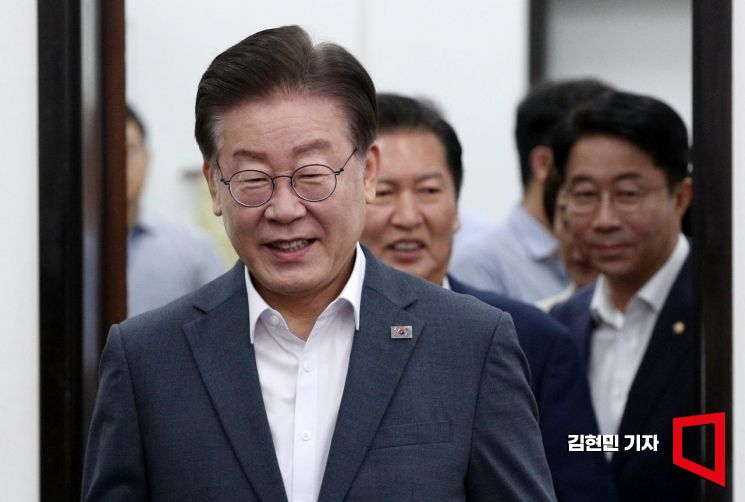 Lee Jae-myung, leader of the Democratic Party of Korea, is attending the Supreme Council meeting held at the National Assembly on the 7th. Photo by Hyunmin Kim kimhyun81@
On the afternoon of the same day, Lee posted a five-page document titled 'Summary of Prosecution Testimony' on Facebook. In this testimony, he refuted each allegation by stating, "The testifier did not gain a single won of profit."
Lee is suspected of having caused significant losses to Seongnam City by granting various special favors to private developers during the construction of apartments on the former Korea Food Research Institute site in Baekhyeon-dong, Bundang-gu, Seongnam City, while he was mayor from 2014 to 2015, enabling them to reap huge profits. The prosecution believes that Lee unusually changed the land use designation from natural and conservation green space to quasi-residential area and reduced the original condition of 100% private rental apartments to 10%, allowing the remaining 90% to be supplied as general sale apartments, thereby concentrating benefits to private developers. Although Seongnam Urban Development Corporation (hereinafter referred to as the Corporation) was supposed to participate in the development to secure public interest during the land use change process, the reason for its exclusion remains unclear.
Regarding the land use change, Lee countered, "It was not due to lobbying by private developers but due to former President Park Geun-hye's directive for land use change, demands from the Ministry of Land, Infrastructure and Transport and the national institution Korea Food Research Institute, and the implementation of national policy tasks."
Lee stated that from 2013 to 2014, former President Park and the Ministry of Land, Infrastructure and Transport instructed and demanded the land use change eight times, saying, "The only way to meet the government's demand to convert the land into apartment sites while aligning with the city's basic urban plan was to designate it as a quasi-residential area."
He reiterated that the Food Research Institute also requested the land use change three times to Seongnam City between 2014 and 2015, and each time the Ministry of Land, Infrastructure and Transport 'pressured' them with official documents. He added, "The benefits of the land use change were obtained by the state (Food Research Institute), which sold the land under those conditions, not by the private developers who bought the land," and argued, "The government demanded the land use change and took the benefits, yet they want to punish the mayor who approved the land use change."
He also refuted by stating that Seongnam City secured about 7,500 pyeong (approximately 24,793 square meters) of research and development (R&D) land worth about 100 billion won as a recovery of development gains from the land use change.
Regarding the supply of private rental apartments, he explained, "The Food Research Institute requested on December 28, 2015, to change private rental apartments to general sale apartments due to increased public contributions through building and land exchanges," and added, "The relevant department recommended accepting the request, which was approved through the approval line."
As for the Corporation's non-participation in the development project, he clarified, "The Corporation's participation was not decided as a condition of the land use change but was to be 'reviewed later,'" and stated, "Subsequently, Seongnam City and the Corporation ultimately did not participate in the project. According to the Board of Audit and Inspection report, the Corporation had no intention to participate in the project."
He also emphasized that he did not gain any personal profit from the Baekhyeon-dong project, stating, "Crimes require motive, but there is no motive to commit breach of trust. Breach of trust is logically impossible."
© The Asia Business Daily(www.asiae.co.kr). All rights reserved.
![Clutching a Stolen Dior Bag, Saying "I Hate Being Poor but Real"... The Grotesque Con of a "Human Knockoff" [Slate]](https://cwcontent.asiae.co.kr/asiaresize/183/2026021902243444107_1771435474.jpg)
















