LK-99 authenticity controversy sparks surge in related stocks
Seonam and Powerlogics also surge over 20%
As skepticism grows in the academic community that the material 'LK-99,' once thought to be a room-temperature and ambient-pressure superconductor, may not actually be a superconductor, the CEO of a fintech company with a PhD in physics has claimed that it is indeed a conductor, causing related stocks to surge again.
According to MarketPoint on the 14th, as of 9:16 AM, Powerlogics (047310) is trading at 16,280 KRW, up 26.50% from the previous trading day. Seonam (294630) has also risen by 19%, while Deoksung (004830) and Mobis (250060) surged by 23.47% and 21.98%, respectively.
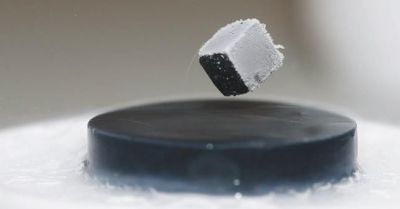 The Korean research team has developed a room-temperature, ambient-pressure superconductor, known as the "dream material," sparking waves of reaction in the international scientific community.
 [Photo by Yonhap News]
On the 10th, Kim In-gi, CEO of fintech startup Bonasapiens, stated via social networking service (SNS), "LK-99 is both a room-temperature superconductor and a new ferromagnetic material," adding, "The original authors discovered something even more remarkable than initially thought. Congratulations."
CEO Kim is an entrepreneur with a PhD in physics. He earned his bachelor's, master's, and doctoral degrees in physics from Inha University, worked as a postdoctoral researcher and research associate professor at POSTECH, and as a research professor at Yonsei University before founding Bonasapiens. His business model is an asset management platform that applies thermal diffusion theory in physics to achieve zero risk.
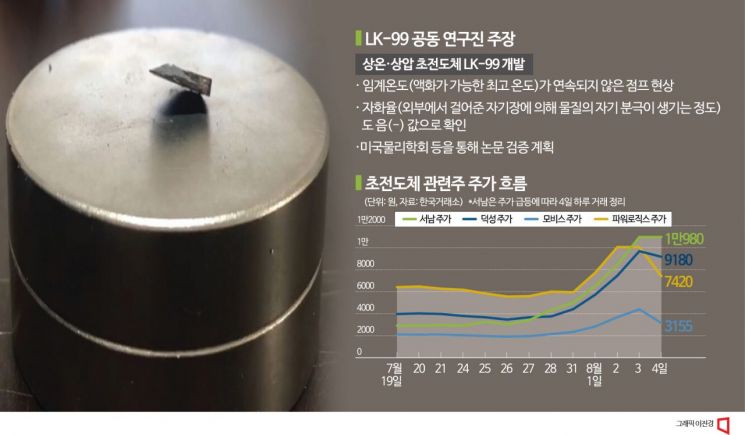 According to Market Point on the 14th, as of 9:16 AM, Powerlogics (047310) is trading at 16,280 KRW, up 26.50% from the previous trading day. Seonam (294630) has also risen 19%, while Deoksung (004830) and Mobis (250060) have surged 23.47% and 21.98%, respectively. The photo is not related to the specific content of the article.
 Photo by Lee Jin-kyung, Asia Economy
In a subsequent post, Kim explained the basis of his judgment, stating, "Anyone who properly synthesizes this material should obtain needle-like fine grains, and the actual sample is a mixture of these grains," adding, "Depending on how copper substitutes for lead in lead apatite, the material can become a room-temperature superconductor, a ferromagnet, or an insulator."
Regarding this, Kim Hyun-tak, a professor at William & Mary in the United States and one of the authors of the LK-99 paper, said, "This is the correct interpretation. The paper also described it as one-dimensional."
'LK-99 Verification Committee' to Secure Key Material 'Lead Sulfate' and Begin Verification
Experts' opinions and rumors about the authenticity of the superconductor are divided.
Overseas researchers have expressed negative views. Previously, various superconductivity-related academic communities in the United States, China, India, and other countries have conveyed skepticism about LK-99. On the 9th, the Center for Materials Theory at the University of Maryland stated, "It appears to induce magnetic instability rather than superconductivity." Additionally, a research team including the Max Planck Institute for Chemical Physics of Solids in Germany analyzed that "it is more likely a magnet than a room-temperature and ambient-pressure superconductor."
As the controversy continues, the Korean Society of Superconductivity and Cryogenics' 'LK-99 Verification Committee' has secured the key material 'lead sulfate' and plans to synthesize samples and begin verification soon. The committee stated in a written briefing on the 11th, "The material supply issue is expected to be resolved by early next week," and "The sample synthesis period is expected to take about two weeks."
© The Asia Business Daily(www.asiae.co.kr). All rights reserved.
![Clutching a Stolen Dior Bag, Saying "I Hate Being Poor but Real"... The Grotesque Con of a "Human Knockoff" [Slate]](https://cwcontent.asiae.co.kr/asiaresize/183/2026021902243444107_1771435474.jpg)
















