A Massive Semicircular Shape... Formed Before the Cretaceous
Boasts a Beautiful Scenery Blending with the Blue Sea
A unique fold in Buan, Jeonbuk is being managed as a natural monument. On the 11th, the Cultural Heritage Administration announced its plan to designate the 'Buan Wido Jinri Daewol Fold (大月褶曲)' as a nationally designated cultural heritage natural monument. Opinions from various sectors will be collected for one month, and the designation will be finalized after review by the Cultural Heritage Committee.
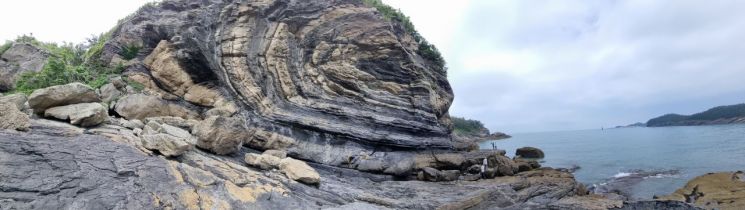
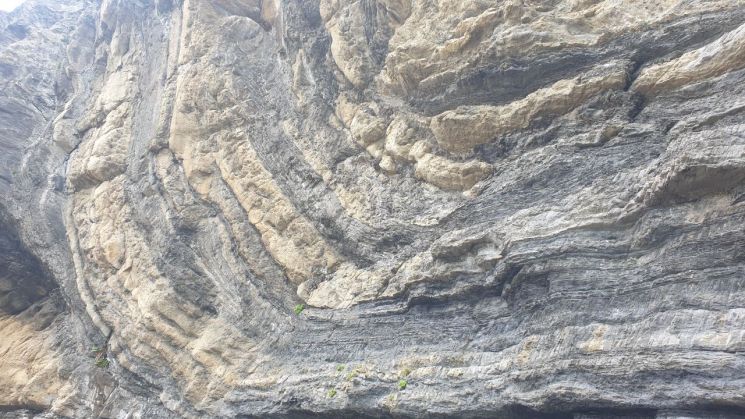
It is a massive semicircular fold that has long been called the "Big Moon." A fold is a phenomenon where rock layers form wave-like wrinkles. Unlike typical folds, the Buan Wido Jinri Daewol Fold is estimated to have formed by partially unconsolidated rock layers curling to create a huge geological structure. Its formation period is understood to be after the Cretaceous period. The Cultural Heritage Administration explained, "Most large folds in Korea were formed before the Cretaceous period, which makes this fold distinctive."
The Buan Wido Jinri Daewol Fold features rock layers with clear boundaries extending horizontally in each stratum. Its diameter is about 40 meters. It appears as a beautiful landscape harmonizing with the blue sea.
Meanwhile, the Cultural Heritage Administration will designate the 'Pohang Odori Columnar Joint' as a natural monument on the 17th. It is a columnar joint with various shapes and sizes. Columnar joints are volcanic rock pillars formed when underground magma cools, contracts, and cracks. Regarding the Odori Columnar Joint, the Cultural Heritage Administration stated, "The entire island is one columnar joint," and added, "Its scenery is very outstanding, and since it is a form not well known domestically, it has high academic and educational value."
© The Asia Business Daily(www.asiae.co.kr). All rights reserved.
![Clutching a Stolen Dior Bag, Saying "I Hate Being Poor but Real"... The Grotesque Con of a "Human Knockoff" [Slate]](https://cwcontent.asiae.co.kr/asiaresize/183/2026021902243444107_1771435474.jpg)
















