'6G White Paper' Outlining Core Standardization Requirements and Directions
"Killer Services Like 3D Video, UHD Streaming, AR·VR, Autonomous Driving Are Insufficient"
"5G Speed Also Fails to Meet User Expectations"
"6G Should Set Achievable Goals"
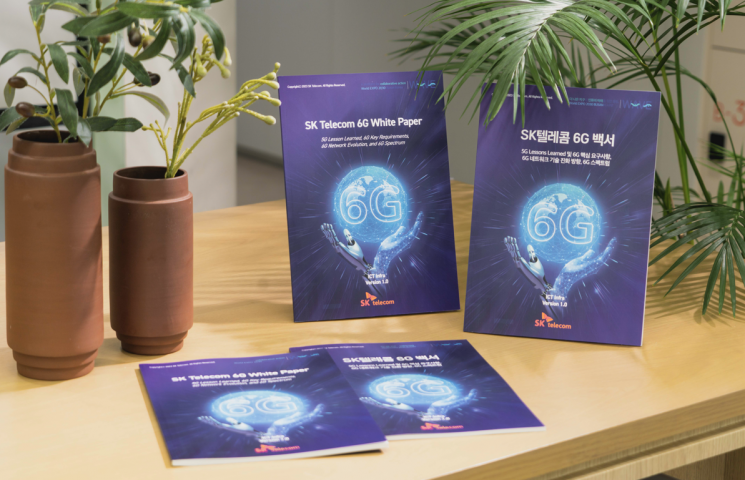
SK Telecom acknowledged in its '6G White Paper,' which outlines the core requirements and directions necessary for 6G standardization, that the killer services and speeds of 5G fell short of initial expectations.
On the 11th, SKT stated in the 6G White Paper, "At the time of preparing for the introduction of 5G, we anticipated a variety of futuristic services such as AR, VR, and autonomous driving, but many cases did not lead to actual service activation as expected."
They noted that the preparation for the overall environment constituting 5G services was insufficient, and that from the early stages of commercialization, the expectations for 5G performance and the innovative services based on it were excessively high.
SKT cited representative services that are still not commercialized or activated, including three-dimensional (3D) video, UHD streaming, AR, VR, autonomous driving, and remote surgery. The company analyzed that the failure of these services was not due to a single factor such as the current 5G technology performance limitations, but rather a complex result of multiple factors including device form factor constraints, immature device and service technologies, near-absent market demand, and policy and regulatory issues.
They added, "If we had taken a more objective view on whether the rosy outlook that 5G technology alone could change the future was realistic, and whether the overall environment for services could be prepared simultaneously, the gap between the general public’s and society’s expectations of 5G would not have been so large."
SKT also addressed the issue related to the 'maximum speed of 20Gbps,' which was regarded as an icon of 5G performance. The company said, "5G is based on the same radio access technology, frequency aggregation technology, and multiple antenna system technology as LTE, with performance enhancements and improvements applied to these technologies. Considering this, it was difficult to immediately replicate the transmission speed increase seen in LTE with 5G."
Previously, the Korea Fair Trade Commission imposed corrective orders and fines totaling 33.6 billion KRW on three mobile carriers?SKT, KT, and LG Uplus?for falsely and exaggeratedly advertising 5G speeds and unfairly comparing their speeds as the fastest.
In fact, as of 2021, the average 5G speed of the three carriers was 0.8Gbps, only about 4% of the 20Gbps they advertised. Contrary to the claim of speeds 20 times faster than LTE, the actual speeds were only about 4 to 7 times faster than LTE speeds.
The fines were calculated based on each company’s revenue, with SKT fined 16.83 billion KRW, KT 13.93 billion KRW, and LG Uplus 2.85 billion KRW. The imposed fines represent the second-largest case in the history of violations of the Act on Labeling and Advertising.
Regarding this, SKT stated, "Although early commercialization of 5G was pursued, due to the frequency characteristics of 5G, more base station equipment was required compared to LTE to build a nationwide network, demanding more cost and time efforts. The company made significant efforts to shorten the construction period and secure coverage, but customers expected LTE-level coverage to be established in a short time."
SKT emphasized that in the upcoming '6G era,' the gap between the ITU-R’s 6G vision recommendations and customer expectations must be narrowed. ITU-R is an international standardization organization under the UN that defines concepts such as target services and key performance indicators for 5G and 6G.
SKT said, "Considering the gap that existed between the 5G vision recommendations and customer expectations, achievable goals should be set through technological maturity and customer communication. All participants in the ecosystem must work together to ensure that the overall environment is prepared in tandem with 6G technology."
© The Asia Business Daily(www.asiae.co.kr). All rights reserved.
![Clutching a Stolen Dior Bag, Saying "I Hate Being Poor but Real"... The Grotesque Con of a "Human Knockoff" [Slate]](https://cwcontent.asiae.co.kr/asiaresize/183/2026021902243444107_1771435474.jpg)















