A hernia mesh similar to the abdominal wall (muscle, fascia, skin) has been developed. This mesh is designed to match the characteristics of the abdominal wall and uses a material that can change shape according to the patient's body temperature, providing an effect to prevent hernia recurrence.
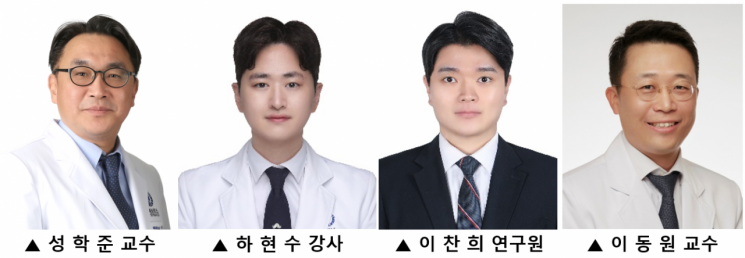
Professor Seong Hakjun, Lecturer Ha Hyunsoo, and Researcher Lee Chanhee from the Department of Medical Engineering at Yonsei University College of Medicine, along with Professor Lee Dongwon from the Department of Plastic Surgery at Severance Hospital, announced on the 14th that they have created a surgical mesh that reflects the actual mobility of the abdominal wall and changes its shape autonomously according to the hernia location.
A hernia is a condition where an organ protrudes outside the abdominal wall due to high pressure on the abdomen caused by obesity, pregnancy, intense exercise, etc. When a hernia occurs, surgery is performed using a mesh to block the protruding abdominal wall.
The abdominal wall continuously experiences intra-abdominal pressure, repeatedly contracting and relaxing, and moves more flexibly in the vertical direction than in the horizontal direction. Existing meshes were not only difficult to reflect these characteristics of the abdominal wall but also hard to change shape according to the hernia location. Moreover, they were made rigid and could not follow actual movements, resulting in a high risk of recurrence.
To overcome the limitations of existing meshes, the research team developed a design tailored to the characteristics of the abdominal wall along with a material that can change shape according to the patient's body temperature.
First, they analyzed the movement of the abdominal wall using finite element analysis, a computer simulation that predicts how objects behave under various physical conditions, and derived a new mesh design and pattern. Unlike existing meshes that are rigid in all directions, the new design is flexible in the vertical direction, where the abdominal wall mainly moves, and resistant in other directions.
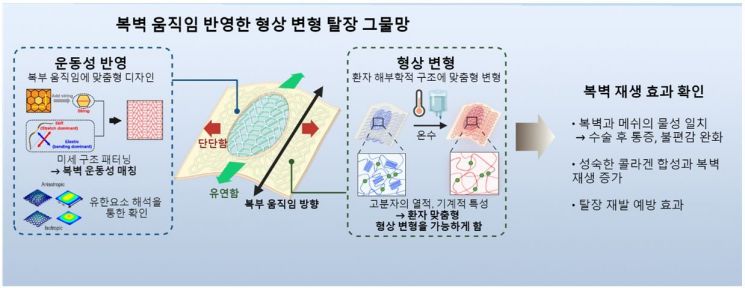
The material technology that autonomously changes shape according to the diverse abdominal wall structures of each patient was applied. By combining polymers suitable for human use, the material is induced to change shape by absorbing surrounding heat. When water at a temperature slightly higher than body temperature is applied, the developed material changes shape to fit the abdominal wall.
The research team verified the efficacy of the artificial mesh in a rat model that induced hernia. The developed mesh promoted the differentiation of myofibroblasts more than existing meshes, increasing the regeneration rate of abdominal wall components such as collagen by more than six times. It is known that hernia recurrence is lower when the proportion of type I collagen, a component of the abdominal wall, is higher. This mesh increased the proportion of type I collagen by more than twice, inducing mature abdominal wall regeneration and showing an effect in preventing hernia recurrence.
Professor Seong Hakjun said, "Recently, the development of patient-customized medical devices through medical simulation technology has been gaining attention," adding, "This study demonstrated that such medical device development is possible by integrating precise material engineering and design technology." The research results were published in the international journal Small (IF 15.153).
© The Asia Business Daily(www.asiae.co.kr). All rights reserved.
![Clutching a Stolen Dior Bag, Saying "I Hate Being Poor but Real"... The Grotesque Con of a "Human Knockoff" [Slate]](https://cwcontent.asiae.co.kr/asiaresize/183/2026021902243444107_1771435474.jpg)
















