Toyota Electric Vehicle bZ3 Recalled in China
Third Recall This Year Related to Core Electric Vehicle Technologies
Growth Positive but Concerns Over Repeated Recalls
"Challenge to Regain Consumer Trust Due to Image Damage"
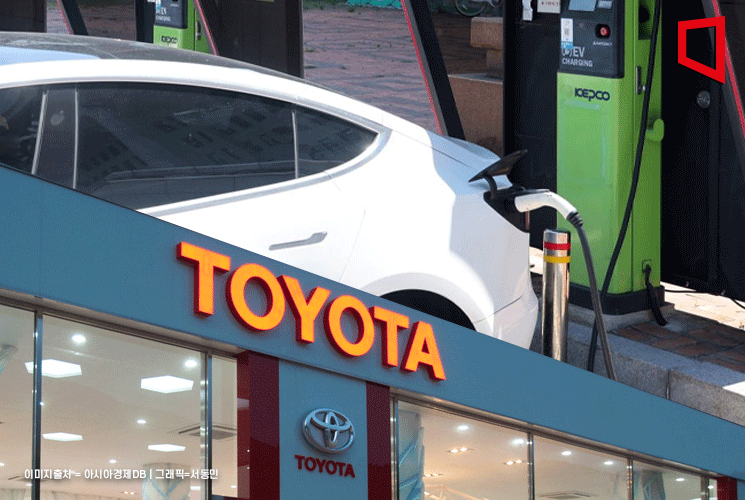
Automakers are all boarding the train called 'electrification' and moving forward. Toyota, which boarded the 'last train,' has been catching up by consecutively releasing pure electric vehicles. However, various defects have been revealed, leading to frequent recalls. This has resulted in a decline in consumer trust, raising concerns that Toyota may be left behind in the newly entered market.
Toyota recently conducted a recall of the sedan-type electric vehicle bZ3 in China. The recall targets 12,205 units sold since its launch in April. This vehicle is Toyota's second electric car, developed exclusively for the Chinese market in collaboration with BYD. The problematic part is the recessed door handle. Due to a design error, an excessive gap forms between the handle and the door lock mechanism, causing the lock to malfunction. There is even a risk that the rear door could open while driving.
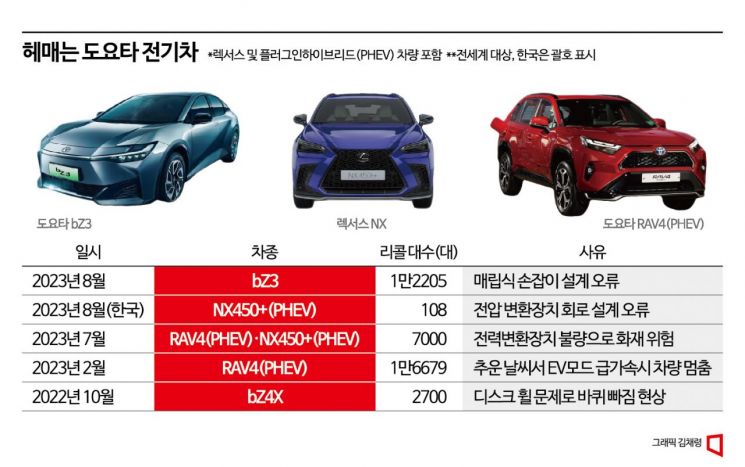
This is the third recall this year (including plug-in hybrid electric vehicles, PHEVs). All are related to defects in the electric drive and power conversion systems. Last month, a continuous current flow issue caused by a defective power conversion device was found in the compact SUV RAV4 Prime and Lexus NX450h+, leading to a recall of 7,000 units due to fire risk. In February, 16,679 units of the 2021 RAV4 in the U.S. were recalled for a problem where the vehicle stops when rapidly accelerating in EV mode (fuel-free mode) in cold weather. In October last year, the first mass-produced electric vehicle bZ4X was recalled due to a disk wheel issue where bolts loosen and wheels detach when accelerating and braking repeatedly.
Not only Toyota but other Japanese electric vehicles also experience frequent recalls. Nissan recalled 1.38 million units last month in the U.S., Europe, and other regions due to issues with sudden acceleration during cruise control or motor stoppage. Mazda also recalled 10,000 units in April due to a power conversion device control program problem.
Japanese automakers announced their electrification plans later than their competitors. The International Council on Clean Transportation (ICCT) classifies Toyota, Honda, and Nissan as latecomers in the electric vehicle sector. Toyota announced plans to launch 10 electric vehicles by 2026 and achieve annual sales of 1.5 million units. Honda also revealed it aims to produce 2 million electric vehicles by 2030 and plans to introduce a total of 7 electric vehicle models by 2027.
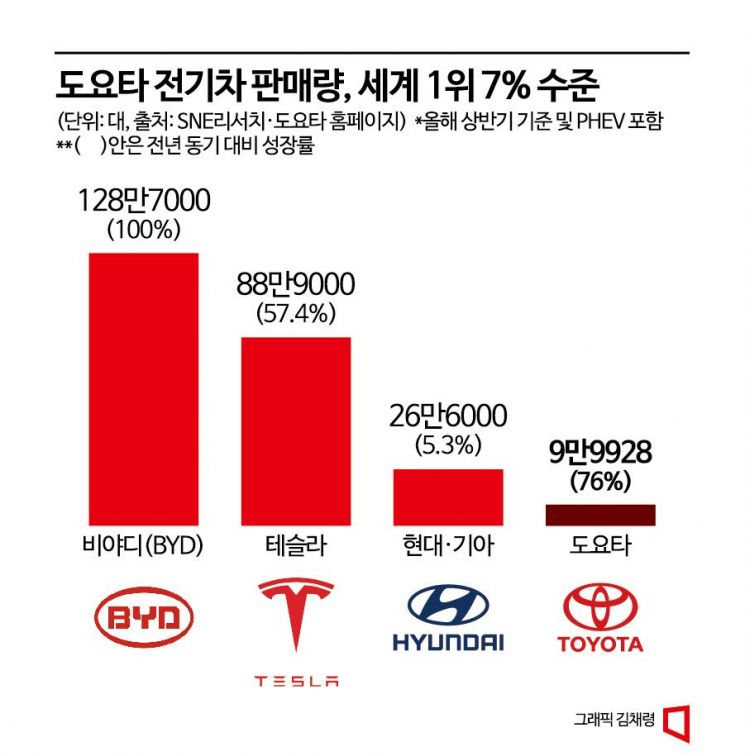
Nevertheless, growth in the electric vehicle market is positive. Toyota sold 99,928 electric vehicles (including PHEVs) worldwide in the first half of this year, a 76% increase compared to 56,801 units in the same period last year. Although the sales volume is small, the growth rate is significant. In 2020, Toyota sold only 1,032 pure electric vehicles worldwide. Since then, it has sold 46,171 electric vehicles this year alone, growing approximately 40 times.
However, if recalls continue and damage the brand image, the already lower sales volume compared to competitors could decline further. According to SNE Research data, BYD ranked first in electric vehicle (including PHEVs) deliveries in the first half of the year, selling 1,287,000 units. Toyota's sales volume is about 7% of BYD's. Toyota's sales also lag behind competitors such as Tesla (889,000 units) and Hyundai Motor Company and Kia (266,000 units).
An official from the Korea Automotive Technology Institute stated that while recalls indicate that automakers voluntarily report and correct issues and do not necessarily reflect quality, “Japanese legacy automakers face challenges in securing consumer trust as their image is being damaged by electric vehicle defects, especially when early movers like Tesla have already established strong brands.”
© The Asia Business Daily(www.asiae.co.kr). All rights reserved.
![Clutching a Stolen Dior Bag, Saying "I Hate Being Poor but Real"... The Grotesque Con of a "Human Knockoff" [Slate]](https://cwcontent.asiae.co.kr/asiaresize/183/2026021902243444107_1771435474.jpg)

















