Institute for Basic Science, Research Results on Climate and Vegetation Changes
The European continent was a barren wasteland unsuitable for human habitation approximately 1.1 million to 900,000 years ago. A domestic research team has uncovered the reason for this.
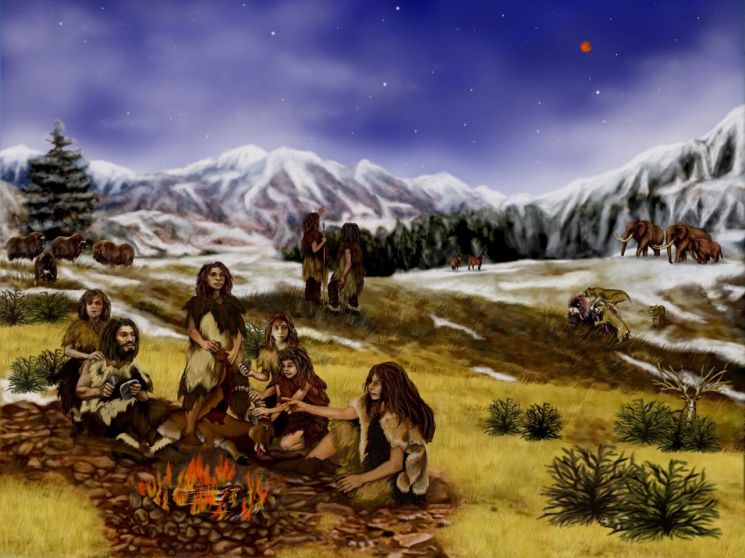
On the 11th, the Institute for Basic Science (IBS) announced research results from a team led by Axel Timmermann, Director of the Climate Physics Research Group (also an adjunct professor at Pusan National University), in collaboration with the Imperial College London research team. Their joint study revealed that the cooling event in the North Atlantic about 1.12 million years ago, along with the resulting changes in climate, vegetation, and food resources, turned Europe into an 'uninhabited zone' at that time.
Ancient humans, Homo erectus, who went extinct about 100,000 years ago, migrated from Africa to Central Eurasia around 1.8 million years ago. They gradually expanded their habitat from Central Eurasia to Western Europe, reaching the Iberian Peninsula (Southern Europe) approximately 1.5 million years ago. Fossil evidence from different periods explaining the migration and habitation of ancient humans has been found in Georgia, Russia, Italy, Spain, and other locations.
However, no fossil evidence has been found indicating that ancient humans inhabited Europe between 1.1 million and 900,000 years ago. There is ongoing academic debate on whether Homo erectus continuously inhabited Europe but evidence has not been discovered, or if habitation was temporarily interrupted due to intensified glacial periods starting around 1.2 million years ago.
The research team conducted a study to understand the environmental conditions experienced by early humans in Europe. They combined a 2-million-year-long paleoclimate-human habitat model simulation with deep-sea sediment core data obtained from the ‘U1395’ site off the coast of Portugal. Based on this, they reconstructed the climate and vegetation before and after the period during which population decline is presumed to have occurred.
In particular, the team focused on analyzing small plant pollen (pollen grains) preserved in marine sediment cores. Rivers and wind transport small pollen grains from adjacent land to the sea, where they settle in deep waters. By analyzing thousands of accumulated pollen components, regional vegetation and climate can be inferred. For example, temperate forest pollen serves as evidence of a warm climate. Alongside this, organic compounds left by small seaweeds were also analyzed. These organic compounds vary in their degree of unsaturation depending on water temperature, allowing inference of sea temperature changes through analysis.
During this process, the team discovered that the sea temperature near the eastern North Atlantic, which was about 20°C approximately 1.127 million years ago, dropped to 7°C. This serves as evidence of the ‘terminal site’ phenomenon observed at the end of glacial periods. The researchers analyzed that the rapid cooling of the North Atlantic transformed the vegetation in southern and western Europe into a semi-desert environment (similar to a desert but with higher precipitation), unsuitable for early human habitation. The terminal site phenomenon lasted about 4,000 years.
Subsequently, to quantitatively understand how early humans responded to rapid climate change, the team conducted another climate simulation for the terminal site period. Rapid short-term climate changes mainly occur due to sudden expansions and retreats of ice sheets. Considering this, they refined existing climate model experiments by adding freshwater generated from the sudden collapse of European ice sheets into the North Atlantic, enabling a more precise simulation of the terminal site phenomenon. The results conservatively estimated that human habitat suitability decreased by about 50%.
This study is the first to link fossil and archaeological evidence with climate data to identify environmental conditions suitable for Homo erectus habitation. The researchers concluded that during the terminal site period, Homo erectus could not survive in many parts of Southern Europe. Later, around 900,000 years ago, the European population increased again, driven by the Homo antecessor group, which was better adapted to the intensified glacial conditions.
Axel Timmermann, the group leader, stated, “Temperature changes in the North Atlantic closely affect vegetation and human food resources in Southern Europe,” adding, “This study will add another line of evidence that human history was shaped by past climate changes.”
The research results were published in the international academic journal Science (IF 56.9) on the same day.
© The Asia Business Daily(www.asiae.co.kr). All rights reserved.
![Clutching a Stolen Dior Bag, Saying "I Hate Being Poor but Real"... The Grotesque Con of a "Human Knockoff" [Slate]](https://cwcontent.asiae.co.kr/asiaresize/183/2026021902243444107_1771435474.jpg)















