Institute for Basic Science Publishes Related Paper in Science
The genes of modern humans contain some genetic material from other Homo species, not just from their direct ancestor Homo sapiens. A domestic research team has revealed that this is because Homo species, whose habitats expanded due to climate change, came into contact and interbred.
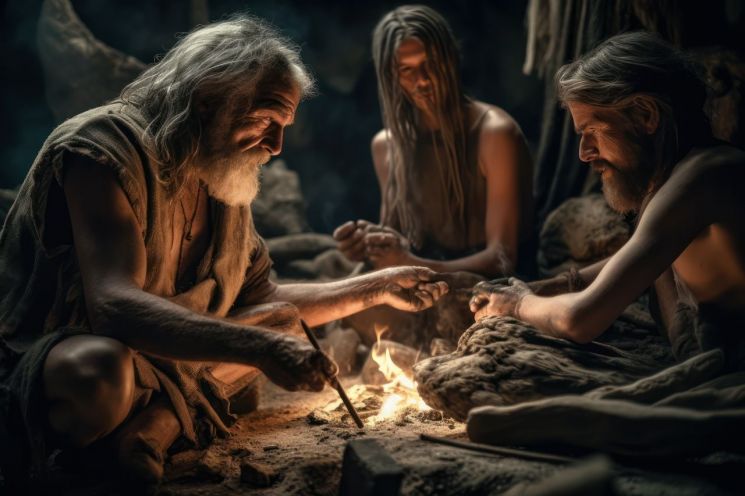
The Institute for Basic Science (IBS) announced on the 11th that a research team led by Axel Timmermann, head of the Climate Physics Research Division and adjunct professor at Pusan National University, identified that climate change played a key role in determining the timing and location of interbreeding among early human species by combining supercomputer-based high-resolution climate and vegetation simulations with paleoanthropological evidence.
The Neanderthals and Denisovans, now extinct, were archaic humans who survived until the most recent times alongside Homo sapiens. Although their habitats differed, they lived contemporaneously for tens of thousands of years and engaged in genetic exchanges. The small amounts of Neanderthal and Denisovan DNA remaining in modern humans indirectly prove this. Direct evidence that interbreeding was common among different human species was presented in 2018. Svante P??bo, director of the Max Planck Institute for Evolutionary Anthropology in Germany and Nobel Prize laureate in Physiology or Medicine in 2022, and his team confirmed that a fossil named ‘Denny’ found in the Denisova Cave in the Altai Mountains of Siberia was a 13-year-old girl with a Denisovan father and a Neanderthal mother.
However, when, where, and how interbreeding among Homo species occurred has not been clearly established until now. To answer the question, "Who are humans, and where did we come from?" scientists have relied on rare fossil specimens and genetic analyses of ancient DNA. The IBS Climate Physics Research Division approached the problem differently by collaborating with climate and paleobiology research teams from Italy.
The research team conducted supercomputer-based high-resolution climate simulations and combined these results with paleoanthropological evidence and genetic data to identify the differing habitat preferences of Neanderthals and Denisovans. Denisovans were better adapted to cold environments such as tundra and boreal forests, while Neanderthals preferred temperate forests and grasslands. This is the first time the habitat of Denisovans has been estimated.
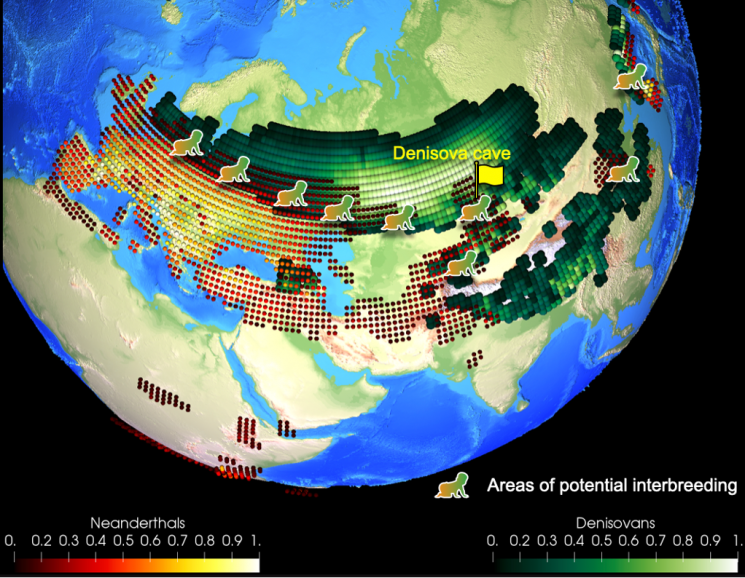
Research fellow Jiaoyang Ruan explained, “Neanderthals preferred southwestern Eurasia, and Denisovans preferred northeastern Eurasia,” meaning “their habitats were geographically separated.”
They also estimated the locations and times when interbreeding between the two Homo species occurred. Climate change caused by Earth's axial tilt and orbital variations affects human habitats. According to the simulations, when Earth's orbit was more elliptical and the Sun and Earth were closer during the Northern Hemisphere's summer, the habitats of the Homo species geographically overlapped. It is estimated that at least six interactions occurred during coexistence periods in regions such as the Altai Mountains, Sarmatic mixed forests, and the Iberian Peninsula in Northern Europe and Central Asia.
The interbreeding regions between the two species shifted from west to east during interglacial periods. To prove that this change was due to climate, the research team also analyzed how vegetation patterns in the Eurasian region changed over the past 400,000 years. They confirmed that rising atmospheric carbon dioxide concentrations and mild interglacial conditions expanded temperate forests from Northern Europe eastward into central Eurasia, creating pathways that allowed Neanderthals to reach the primary habitats of Denisovans.
Axel Timmermann said, “When Neanderthals and Denisovans shared habitats, interactions between the two groups increased, raising the likelihood of interbreeding,” adding, “The glacial-interglacial cycles created a ‘love story’ of humans whose genetic traces remain to this day.”
The results of this study were published in the international journal Science (IF 56.9) on the same day.
© The Asia Business Daily(www.asiae.co.kr). All rights reserved.
![Clutching a Stolen Dior Bag, Saying "I Hate Being Poor but Real"... The Grotesque Con of a "Human Knockoff" [Slate]](https://cwcontent.asiae.co.kr/asiaresize/183/2026021902243444107_1771435474.jpg)

















