Statistics Korea July Employment Trends
Number of Employed Increased by 211,000 Compared to Previous Year
Youth Employment Decreased by 138,000
Last month, the employment rate reached an all-time high of 63.2% for July, and the unemployment rate was the lowest at 2.7% since the 1999 statistical standard change. However, the increase in the number of employed persons has slowed for four consecutive months, and youth employment has decreased for nine consecutive months. This is attributed to the decline in daily and temporary workers due to worsening weather conditions caused by heavy rains last month. The employment growth rate is expected to slow down somewhat going forward.
According to the 'July Employment Trends' released by Statistics Korea on the 9th, the employment rate last month was 63.2%, the highest for July since statistics began in 1989. The employment rate for ages 15-64, which is the OECD comparison standard, also rose by 0.5 percentage points year-on-year to 69.6%. However, the youth employment rate fell by 0.7 percentage points during the same period to 47%.
The number of unemployed persons was 807,000, down by 30,000. This is the lowest July figure since the 1999 standard change. The unemployment rate dropped by 0.2 percentage points to 2.7%. Among the economically inactive population, those who were 'resting' increased by 116,000 (5.4%). The increase was mainly driven by those aged 60 and over (75,000) and those in their 20s (36,000). The populations involved in childcare (-128,000) and housework (-21,000) decreased. The number of discouraged job seekers fell by 57,000 to 388,000.
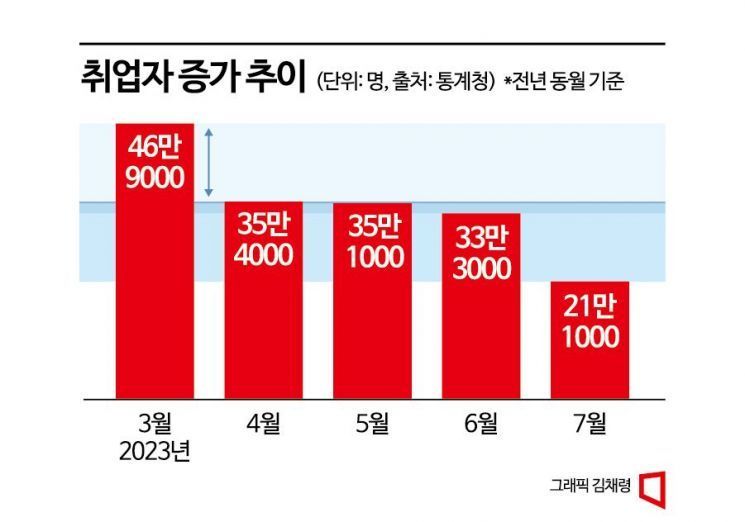
The number of employed persons last month was 28,686,000, an increase of 211,000 compared to the same month last year. This marks 29 consecutive months of growth since March 2013, when employment increased by 314,000. However, the increase in employment has shrunk for four consecutive months. After March (469,000), the increases gradually declined through April (354,000), May (351,000), and June (333,000), before sharply dropping to 211,000 in July. The growth, which had been maintained around 300,000 to 400,000 since the beginning of this year, has significantly slowed. This is the smallest increase in 29 months since February 2021.
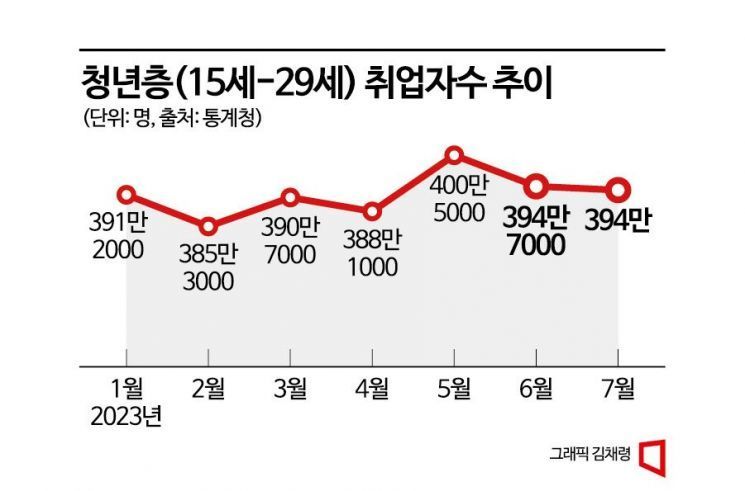
Youth employment (ages 15-29) was 3,947,000, down by 138,000 year-on-year, continuing a nine-month decline. The decrease also showed an increasing trend from May (99,000) and June (117,000). In contrast, employment among those aged 60 and over increased significantly by 298,000 compared to the same month last year. Employment also rose by 51,000 among those in their 30s and by 61,000 among those in their 50s. Seounju, Director of the Social Statistics Bureau at Statistics Korea, explained, “The decrease in youth employment is due to population decline,” adding, “The base effect of last year’s relatively high employment level should also be considered.”
Due to worsening weather conditions, the number of temporary and daily workers, who are sensitive to climate impacts, also decreased. The number of daily workers fell by 188,000 (16.1%) year-on-year, marking the largest decline since January 2021, when it decreased by 232,000. Temporary workers also declined for the 14th consecutive month, dropping by 144,000 (3.0%). The number of employed persons working 36 hours or more per week decreased by 285,000. However, the number of regular wage workers increased by 513,000 (3.3%) year-on-year.
The heavy rains also affected employment declines in construction, agriculture, forestry, and fisheries. Compared to the same month last year, employment in construction (-43,000) and agriculture, forestry, and fisheries (-42,000) decreased. Employment in manufacturing also fell by 35,000, continuing a seven-month decline. On the other hand, employment increased in health and social welfare services (145,000), accommodation and food services (125,000), and professional, scientific, and technical services (62,000). Director Seo explained, “During the survey period (July 9-15), heavy rains and worsening weather conditions caused employment declines in construction, agriculture, forestry, and fisheries.”
The Ministry of Economy and Finance stated, “Going forward, employment and unemployment rates are expected to maintain a steady trend, mainly in face-to-face service industries and health and welfare sectors. However, the increase in the number of employed persons is expected to gradually shrink due to the slowdown in construction and manufacturing employment.” They added, “In particular, adverse weather conditions such as heatwaves and typhoons in August may act as limiting factors for employment growth in construction and agriculture, forestry, and fisheries.”
© The Asia Business Daily(www.asiae.co.kr). All rights reserved.


















