Center for Condensed Matter Theory "No Discovery of Superconductivity"
Uncertain About Diamagnetism in Levitation Phenomenon
The Center for Materials Theory and Condensed Matter Physics (CMTC) at the University of Maryland in the United States has concluded that the material 'LK-99,' which was speculated to be a room-temperature and ambient-pressure superconductor, is "not a superconductor." Previous experiments conducted by other research institutes also failed to verify the superconductivity of LK-99.
On the 8th (local time), CMTC stated on its official social media account, "Sadly, we now believe the game is over. LK-99 is not a superconductor."
They added, "(LK-99) showed no superconductivity at room temperature or even at low temperatures," and "It is merely a low-quality material with very high resistance. Fighting the truth is pointless. The data has spoken."
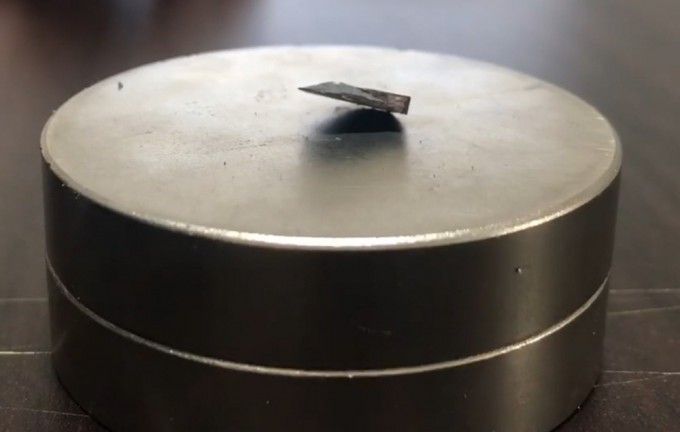 A material presumed to be a room-temperature superconductor, LK-99, claimed to be developed by domestic researchers. [Image source=Yonhap News]
On the previous day, CMTC also introduced research papers related to LK-99 from two research institutions. The first paper came from a laboratory affiliated with the Indian government, which concluded that "no superconductivity was found in LK-99, only a slight diamagnetism."
Another preprint from a research institute at Peking University in China suggested that LK-99 might be a simple ferromagnet.
The 'levitation phenomenon' shown in actual LK-99 sample videos had long been suspected to be due to ferromagnetism. Earlier, on the 6th, a physicist from Harvard University demonstrated a levitation phenomenon similar to LK-99 using a ferromagnetic material.
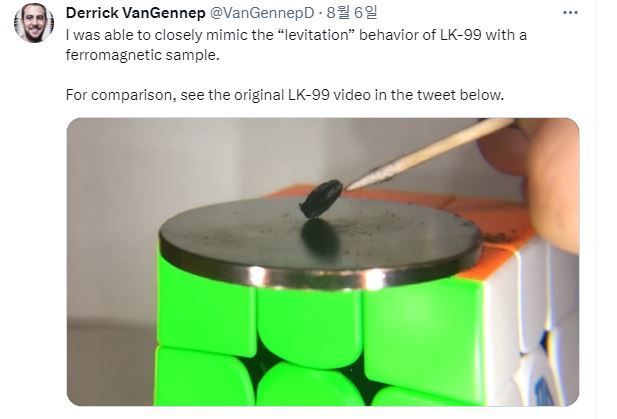 A researcher affiliated with Harvard University in the US suggested that the levitation phenomenon demonstrated by LK-99 might be ferromagnetism rather than diamagnetism. [Image source=Twitter]
Typically, superconductivity refers to a material that exhibits zero electrical resistance and the Meissner effect, i.e., perfect diamagnetism. If the previous preprint claims are true, LK-99 has failed to meet any of the prerequisites for being a superconductor.
CMTC also dismissed the possibility that LK-99 is a new material never seen before. The center explained, "Some people ask if LK-99 would be interesting even if it were only diamagnetic, but the answer is 'no.' The materials that make up LK-99?copper (Cu), lead (Pb), and phosphorus (P)?are diamagnetic."
Meanwhile, LK-99 is the name given to the material discovered by the lead research team of Lee Seok-bae at the Quantum Energy Research Institute. The lead research team recently attracted international researchers' attention by posting a related preprint claiming to have observed superconductivity in the material.
They also disclosed the preparation method of the material on social media platforms such as LinkedIn, prompting many international research institutes to engage in replication experiments and verification efforts.
© The Asia Business Daily(www.asiae.co.kr). All rights reserved.
![Clutching a Stolen Dior Bag, Saying "I Hate Being Poor but Real"... The Grotesque Con of a "Human Knockoff" [Slate]](https://cwcontent.asiae.co.kr/asiaresize/183/2026021902243444107_1771435474.jpg)

















