Seoul Grand Park "Investigating the Cause"
A male Siberian tiger named 'Suho,' classified as a first-class endangered wild animal, died at Seoul Grand Park. There are concerns that he was left defenseless in the heatwave with temperatures exceeding 35 degrees Celsius.
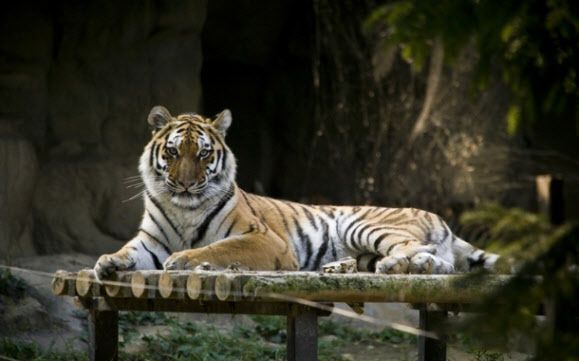 A male Siberian tiger named 'Suho,' a first-class endangered wild animal, has died at Seoul Grand Park.
 [Photo by Seoul Grand Park]
According to Seoul Grand Park on the 8th, Suho, a male Siberian tiger born in 2013 at the zoo's carnivore house, passed away on the afternoon of the 6th. On that day, he showed no abnormal symptoms and moved as usual, but when the zookeeper tried to guide him back inside after being released, he did not respond, prompting emergency treatment.
However, Suho did not get up and eventually died. The cause of death has not yet been determined. The park stated that pathological examinations are underway to find the exact reason.
The Seoul Grand Park website announced Suho's death, saying, "On the 6th, he was living well as usual but was lying in his favorite spot and showed no movement, so emergency treatment was performed, but he sadly passed away."
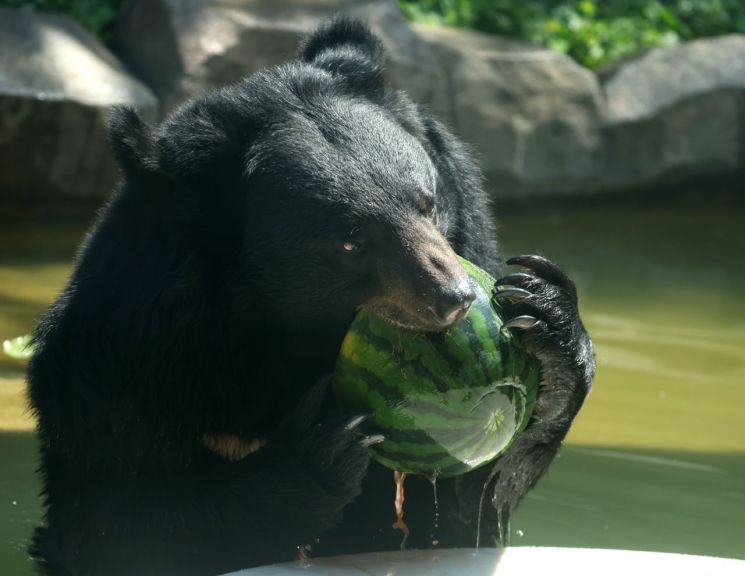 On the morning of the 3rd, during the ongoing heatwave, a bear at Gwacheon Seoul Grand Park Zoo is eating fruit provided as a special summer meal. [Image source=Yonhap News]
Some suspect that Suho's death was due to the heatwave. Typically, individuals survive over 20 years, so his sudden death is unusual. Moreover, the carnivore house's indoor enclosure lacks air conditioning, making it vulnerable to heatwaves. There are also criticisms that the door connecting the exhibition area to the indoor enclosure was closed, making temperature control difficult.
Meanwhile, this is the second tiger death at Seoul Grand Park in three months, following 'Parang' in May. Parang, a female Siberian tiger who had recently celebrated her first birthday, died from illness. It was reported that Parang was infected with feline panleukopenia, a viral infectious disease.
This contagious disease affects only felines and causes a rapid decrease in white blood cells, which is fatal to young animals with weak immune systems. At the time, a park official said, "Despite administering vaccines three times between June and August last year, the disease occurred." Other tigers, 'Haerang' and 'Sarang,' showed similar symptoms to Parang, leading Seoul Grand Park to suspend carnivore house visits until the 25th of last month.
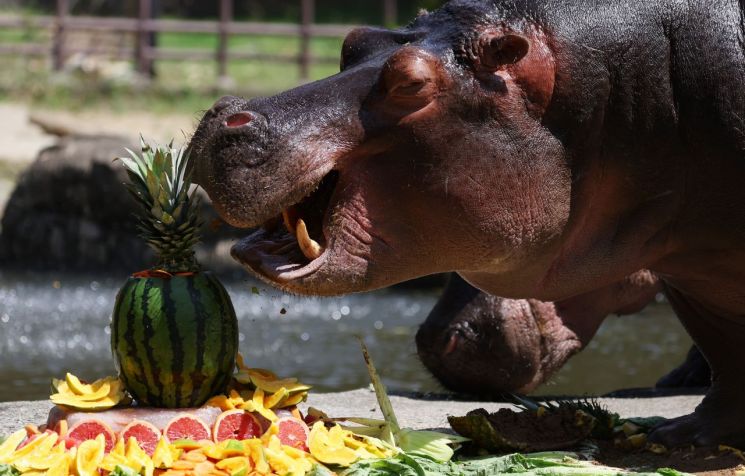 On the 3rd, during the ongoing heatwave, a hippopotamus at Gwacheon Seoul Grand Park Zoo is eating fruit provided as a special summer meal.
 [Image source=Yonhap News]
Although carnivore house visits resumed after 12 days, with the endangered Siberian tiger dying again, it is expected to be difficult to avoid criticism regarding the park's vulnerable facilities.
© The Asia Business Daily(www.asiae.co.kr). All rights reserved.



















