Opposition Criticizes Yoon Government's 'Sangjeohago' Remark as 'Yunjeojeojeo'
"Worst Economic Performance Ever... Less Competent Than Chun Doo-hwan and Roh Tae-woo Governments"
The Democratic Party of Korea strongly criticized the economic policies of the Yoon Suk-yeol administration and called on the government to "completely reshuffle the economic cabinet and change the economic policy direction." This demand for practical alternatives to the recent economic policy directions of the Yoon government, such as opposition to the tax reform bill and supplementary budget, also raised accountability for the decline in various economic indicators.
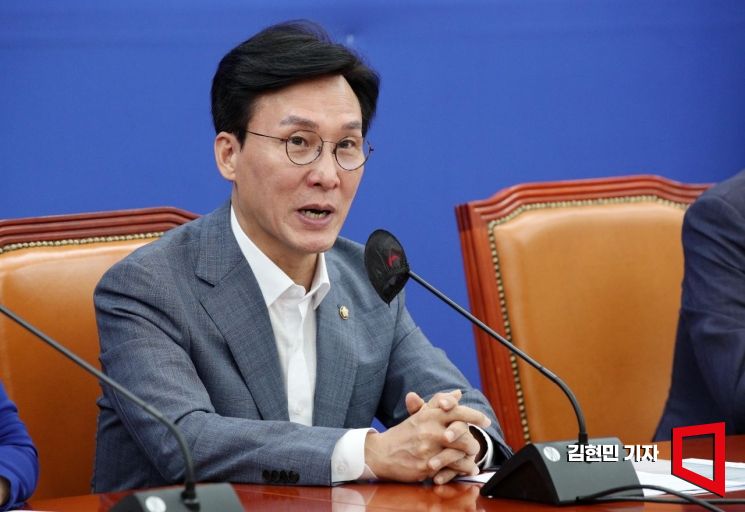 Kim Min-seok, the Policy Committee Chairman of the Democratic Party of Korea, is speaking at the party floor strategy meeting held at the National Assembly on the 8th. Photo by Kim Hyun-min kimhyun81@
On the 8th, Kim Min-seok, chairman of the Democratic Party's Policy Committee, said at a policy coordination meeting held at the National Assembly, "The government says the economy will improve in the second half, calling it 'sangjeohago' (high in the beginning, low in the end), but public opinion says the Yoon government's economy is wrong, calling it 'Yunjeojeojeo' (low from the start to the end under Yoon)." He added, "As Clinton said, 'It's the economy, stupid,' the Yoon Suk-yeol administration is an 'economic fool government.'"
The Democratic Party also raised its voice in criticism of the government's tax reform bill released last month and the ruling party and government's opposition to the supplementary budget (chugyeong). Kim, the Policy Committee chairman, argued, "The head is for tax cuts for the rich, the words are about sound fiscal management, but the reality is a mismatch with tax revenue shortages, and policy dogmatism is a typical example of foolishness." He claimed, "The economic performance is the worst ever, making this government more incompetent than the Chun Doo-hwan and Roh Tae-woo administrations."
Kim also held the government responsible for the deterioration of domestic economic indicators. He continued, "The economic growth rate is the lowest ever, with red lights on production, consumption, investment, exports, and fiscal debt. The economic scale has been downgraded to 13th place, and Korea is the only country experiencing a decline in growth rate, making the economic performance the worst ever, more incompetent than the Chun Doo-hwan and Roh Tae-woo administrations." He added, "The Chinese market has shrunk while the government was inactive, and the practical benefits gained from semiconductors and automobiles in the U.S. are also insufficient."
In fact, when measured by total Gross Domestic Product (GDP), the Korean economy has retreated. According to the Bank of Korea, Korea's nominal GDP last year, converted to dollars, was $1.6773 trillion, a 7.9% decrease. This is estimated to be the 13th largest in the world, which is a drop of three ranks compared to maintaining 10th place consecutively in 2020 and 2021 (according to the United Nations).
Kim emphasized, "With the Yoon Suk-yeol government's ability that internationally embarrassed the Republic of Korea, known for K-pop and K-quarantine, with just one jamboree, the pride of being an economic top student is hanging by a thread." He demanded, "Although the Minister of Justice who rules by enforcement decree, the irresponsible Minister of the Ministry of the Interior and Safety during the Itaewon incident, and the Minister of Land, Infrastructure and Transport from the family side are all problematic, I urge a complete economic cabinet reshuffle to change the economic policy direction."
Kim also pointed out many cases of sharp increases in health insurance premiums among ordinary citizens who received Didimdol and Buteemok loans due to loopholes in the housing finance debt deduction system. He explained, "The housing finance debt deduction system is designed to prevent premium increases by considering loans for owner-occupied housing as asset increases, but Didimdol and Buteemok loans are excluded from this system." He added, "For example, a 120 million won loan for jeonse funds causes health insurance premiums to jump from around 20,000 won to 80,000 won." The housing finance debt deduction system, applied by the Ministry of Health and Welfare since September last year, excludes loans for purchasing or renting housing for actual residence from the calculation of health insurance premiums for regional subscribers.
He continued, "The Democratic Party will immediately push for the revision of Article 72 of the Health Insurance Act, which excludes Didimdol and Buteemok loans from deduction benefits," emphasizing, "We will eliminate the unreasonable burden of regional subscribers receiving health insurance premium shocks."
© The Asia Business Daily(www.asiae.co.kr). All rights reserved.
![Clutching a Stolen Dior Bag, Saying "I Hate Being Poor but Real"... The Grotesque Con of a "Human Knockoff" [Slate]](https://cwcontent.asiae.co.kr/asiaresize/183/2026021902243444107_1771435474.jpg)















