US Department of Energy Releases Critical Minerals Assessment Report
Copper, the Material for Battery Anode Material Copper Foil
Korean Battery Copper Foil Companies Likely to Receive Subsidies
North American Investment Expected to Accelerate
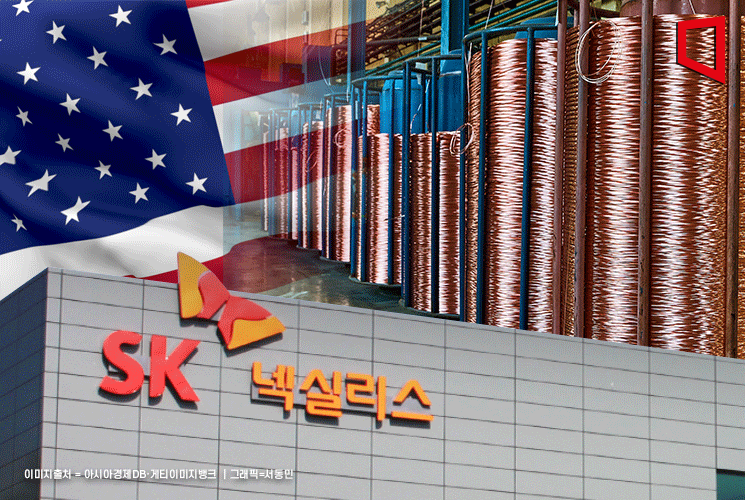
Copper, the most common metal in the industry, has been included in the U.S. government's list of 'Critical Materials.' With copper now classified as a critical material, which is a criterion for receiving subsidies, Korean copper foil companies are expected to gain momentum in building local factories.
In the '2023 Critical Materials Assessment' recently released by the U.S. Department of Energy (DOE), copper was included in the critical materials list for the first time. Copper has very high conductivity. Simply put, it allows electricity to flow easily. For this reason, it is widely used in renewable energy generation and storage sectors. The DOE stated in the report, "5.5 tons of copper are required for 1 MW of solar power generation, and 1.56 tons for a 1 MW wind system," adding, "approximately 39 to 83 kg of copper is used per electric vehicle battery." The importance of copper is expected to increase further after 2025, when the battery and renewable energy industries are anticipated to flourish.
This report is drawing attention due to the potential benefits for domestic companies producing battery copper foil using copper. Copper foil is a thin copper sheet that wraps the anode material of electric vehicle batteries. It serves as a pathway for electron movement and helps dissipate heat generated in the battery to the outside. The detailed regulations of the U.S. Inflation Reduction Act (IRA) announced in April this year did not recognize copper foil as a critical mineral or component. The substantial subsidies under the IRA were also not directly related to copper foil. However, with copper now included as a critical material in this report, the possibility of subsidy payments has increased.
Although the U.S. government has not yet finalized this, there is a high likelihood that subsidies will be provided for local factory construction. The U.S. Department of Energy defines 'critical materials' as those that play an important role in energy production, transmission, and storage and have a high risk of supply chain disruption. Inclusion as a critical material is a criterion for receiving subsidies. The Inflation Reduction Act stipulates that when factories in the eco-friendly energy sector process critical materials, 30% of the investment can be refunded. This is an Investment Tax Credit (ITC) benefit. For example, if an investment of 10 billion KRW is made, 3 billion KRW can be refunded by the U.S. government to start the business.
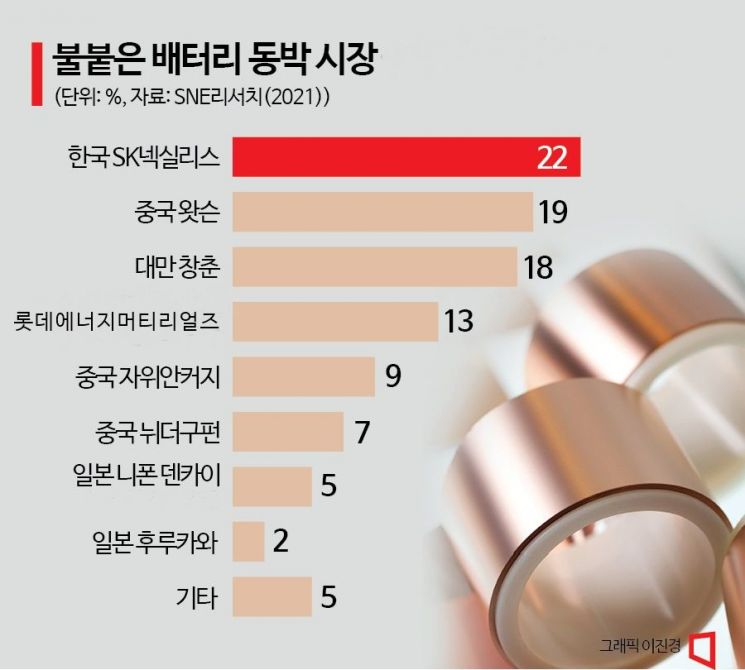
This means that domestic battery copper foil companies, which are receiving overseas interest from Europe and other regions, will have more options. SK Nexilis, the world's number one battery copper foil company, signed a large-scale supply contract worth 1.4 trillion KRW with Northvolt, Europe's largest battery manufacturer, in February this year, followed by an exclusive supply contract with the German battery company VARTA. A factory with an annual capacity of 52,000 tons will start operations in Malaysia next month, and a 50,000-ton annual capacity factory is being built in Poland, targeting production next year. SK Nexilis aims to expand its current annual copper foil production capacity of 52,000 tons to 250,000 tons by 2025. Ten thousand tons of copper foil corresponds to the amount needed for 300,000 to 400,000 electric vehicles.
Lotte Energy Materials, the second-largest domestic and fourth-largest global copper foil company, is also accelerating its factory expansion. Lotte Energy Materials currently produces 60,000 tons of copper foil domestically in Iksan (20,000 tons) and Malaysia (40,000 tons), and is building a factory with an annual capacity of 30,000 tons in Monroych, Catalonia, Spain, investing 560 billion KRW. The company plans to achieve a global high-end copper foil market share of 30% with a target production volume of 240,000 tons by 2028.
© The Asia Business Daily(www.asiae.co.kr). All rights reserved.
![Clutching a Stolen Dior Bag, Saying "I Hate Being Poor but Real"... The Grotesque Con of a "Human Knockoff" [Slate]](https://cwcontent.asiae.co.kr/asiaresize/183/2026021902243444107_1771435474.jpg)
















