China invited diplomatic envoys from developing countries to the Xinjiang Uygur Autonomous Region, which has been criticized for suppressing the human rights of ethnic minorities. Analysts suggest this move aims to dilute the controversy over human rights abuses.
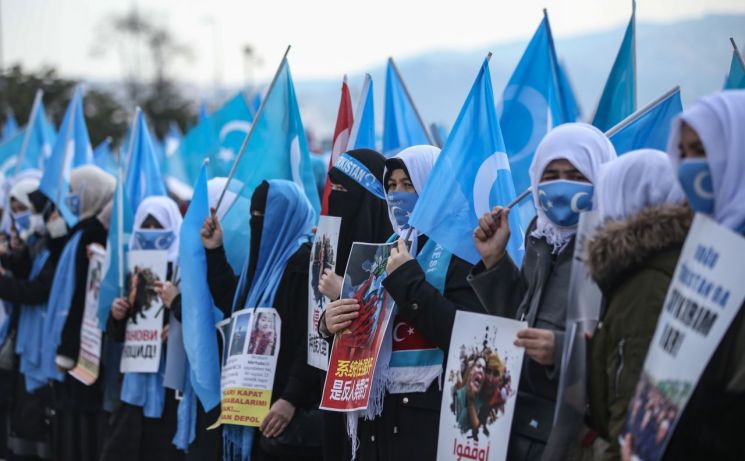 Uighur women are protesting against China's oppression of the Xinjiang Uighur population in front of the Chinese Embassy in Istanbul, Turkey. [Image source=Yonhap News]
According to China's state-run news agency Xinhua on the 6th, the Chinese Ministry of Foreign Affairs invited diplomatic envoys from 25 countries, including the Dominican Republic, Myanmar, Iran, Uzbekistan, Peru, Mexico, Pakistan, and Nicaragua, to Xinjiang from the 31st of last month to the 4th. They reportedly toured Islamic mosques, cotton fields, and anti-terrorism exhibition halls in Urumqi, Kashgar, Aksu, and interacted with local residents.
Some of the diplomatic envoys participating in the event told Xinhua that "the lies fabricated by Western media about Xinjiang do not match the actual situation," or that "the Chinese government is ensuring that Xinjiang residents can live comfortably," expressing support for the Chinese authorities.
However, among the countries participating in this event mentioned by the agency, there were no Western countries such as the United States, the United Kingdom, or Canada that have raised the issue of human rights in Xinjiang, leading to analysis that only diplomatic envoys from developing countries friendly to China were invited to showcase strength.
Meanwhile, a spokesperson for the Chinese Embassy in the UK rebutted on the 5th (local time) the BBC's report claiming that China is suppressing Uygurs living overseas, calling it "completely fabricated." The spokesperson said, "Currently, Xinjiang is experiencing the best period in its history," adding, "The truth of social harmony and stability in Xinjiang, continuous economic development, and the comfortable lives of the people cannot be shattered by any lies."
However, the West criticizes that various human rights abuses, including forced labor, are taking place in Xinjiang. The United States has enacted the 'Uygur Forced Labor Prevention Act' to block imports of products suspected to be made with forced labor from Xinjiang. The United Nations Human Rights Office also stated in a report released after the visit of Michelle Bachelet, the UN High Commissioner for Human Rights, to Xinjiang last year, that discriminatory detention against Uygurs has occurred in Xinjiang and that this may constitute crimes against humanity.
© The Asia Business Daily(www.asiae.co.kr). All rights reserved.

















