Analysis of Fitch Reports from 9 Countries

Global credit rating agency Fitch has downgraded the United States' sovereign credit rating. Fitch judged that due to the worsening fiscal situation in the U.S., the likelihood of stable management of the national debt burden in the future has decreased. In contrast, nine countries maintaining higher ratings than the U.S. (Australia, Denmark, Germany, Luxembourg, Netherlands, Switzerland, Norway, Sweden, Singapore) are highly rated for their government's fiscal stability. It is evaluated that these countries have secured a high level of trust in their fiscal health over time, as efforts to expand government revenue have been continuously pursued in parallel.
On the 1st of this month (local time), global credit rating agency Fitch downgraded the U.S. sovereign credit rating from AAA to AA+ immediately after the New York stock market closed. The cause of the downgrade was cited as the deterioration of the U.S. fiscal situation. Fitch explained, "We have reflected the expected fiscal deterioration over the next three years, the increase in national debt burden, and weakening governance." The worsening fiscal deficit in the U.S., combined with the unstable agreement structure regarding the debt ceiling repeatedly seen over the past 20 years in the political arena, led Fitch to conclude that resolving fiscal problems will remain difficult in the future.
In its report, Fitch stated, "We expect the U.S. fiscal deficit to surge from 3.7% of GDP in 2022 to 6.3% in 2023, further expanding to 6.6% in 2024 and 6.8% in 2025," adding, "Especially ahead of the November 2024 elections, no substantial fiscal consolidation measures can be expected." Additionally, Fitch projected the U.S. national debt-to-GDP ratio to be 112.9% this year, surpassing the pre-pandemic level of 100.1% in 2019, and steadily rising to 118.4% by 2025.
Australia, Denmark, Germany, Luxembourg, Netherlands, Switzerland, Norway, Sweden, Singapore Maintain AAA Ratings
With the U.S. removed from the AAA rating, the countries currently holding the highest rating of AAA from Fitch are Australia, Denmark, Germany, Luxembourg, Netherlands, Switzerland, Norway, Sweden, and Singapore?nine countries in total. A common feature among these nine countries is their high evaluation for government fiscal management stability. Government finances essentially represent a country's household budget. They operate primarily on tax revenue; if expenditures exceed revenue, a deficit occurs, and if revenue exceeds expenditures, a surplus is recorded. Governments worldwide increased spending to counteract the economic downturn caused by the COVID-19 pandemic, which deepened fiscal deficits.
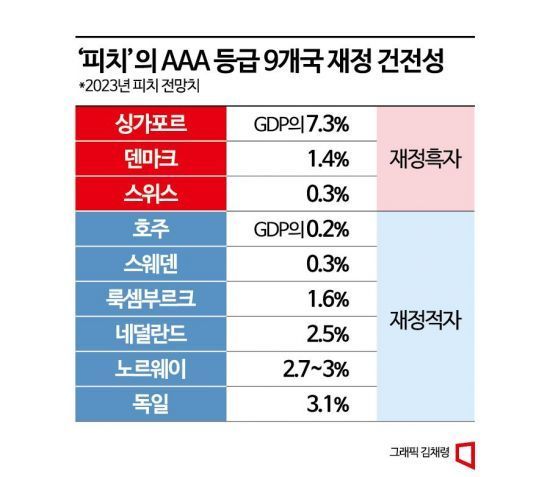
These countries also increased spending similarly. However, Fitch assessed that these countries maintained fiscal balance without significant disruption due to concurrent efforts to expand revenue and conservative fiscal management. Some countries even maintained fiscal surpluses. Notably, Singapore showed a fiscal surplus of 7.3% of GDP, Denmark 1.4%, and Switzerland 0.3%, demonstrating high fiscal stability. Compared to the U.S., which recorded a 6.3% fiscal deficit of GDP, and South Korea, which recorded a 1.0% deficit, these levels are distinctly more stable.
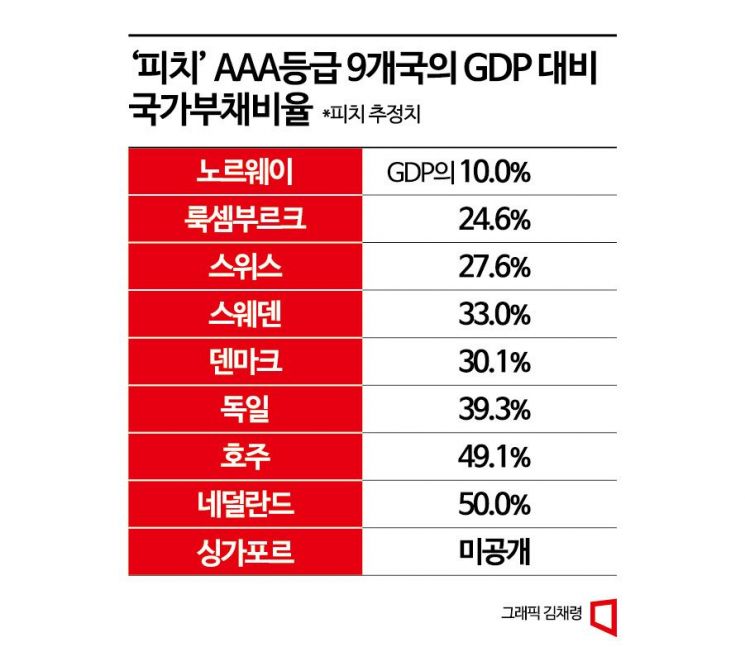
These nine countries also tended to manage their national debt-to-GDP ratios stably. When national debt increases, the amount of interest payments from revenue rises, limiting fiscal investment possibilities for future generations. Norway had the lowest national debt-to-GDP ratio at 10%, while Luxembourg (24.6%) and Switzerland (27.6%) did not exceed 30%. Even the Netherlands, with the highest debt ratio among the nine, did not surpass 50% of GDP. In contrast, the U.S. debt ratio is projected at 112.9% of GDP.
Reflecting Government's 'Stable Revenue Expansion and Fiscal Balance Efforts'
Fitch particularly focused on these countries' efforts to maintain stable fiscal conditions 'going forward.' Even among AAA-rated countries with relatively higher national debt ratios, the evaluation reflects governments' consistent efforts toward stable fiscal management. For example, the Netherlands' national debt-to-GDP ratio is about 50%, similar to South Korea's 49.1% in 2022. Fitch stated, "The Netherlands' fiscal soundness is supported by strong fiscal policies, and robust economic recovery (4.6% growth in 2022) continues."
Fitch also highlighted the stable environment conducive to medium- to long-term revenue expansion. Among the nine countries, Singapore, which has the highest fiscal stability, does not disclose national asset or debt information according to government policy. Nevertheless, Fitch noted that Singapore "continues to maintain a large current account surplus and the authorities plan to raise goods and services tax rates to increase budget revenue in the long term." Regarding Norway, which has a fiscal deficit similar to South Korea's (2.7% in 2022) and a Fitch forecast of 2.7% to 3% of GDP in 2023, Fitch emphasized the structural environment that inevitably leads to revenue expansion. Fitch pointed out, "Due to the sharp rise in energy prices triggered by the Ukraine war, Norway's oil revenues have increased dramatically."
© The Asia Business Daily(www.asiae.co.kr). All rights reserved.



















