The northeastern region of China has been flooded due to continuous heavy rains caused by successive typhoons. As crop flooding damage spreads, some predict that China's important 'food security' could be impacted.
On the 4th, Hong Kong's South China Morning Post (SCMP) reported, "Concerns about China's food security have increased due to consecutive typhoons," adding, "International grain prices are already under pressure as countries like India impose export bans."
The heavy rains have caused damage spreading in Beijing and Hebei Province, with at least 20 deaths reported. Earlier on the 2nd, China's Ministry of Agriculture and Rural Affairs allocated 432 million yuan (approximately 78.3 billion KRW) in financial support for farmers in Beijing. According to authorities, over 10 million acres (4 million hectares) of farmland have been damaged by natural disasters, an increase of 1.3 million acres compared to the same period last year.
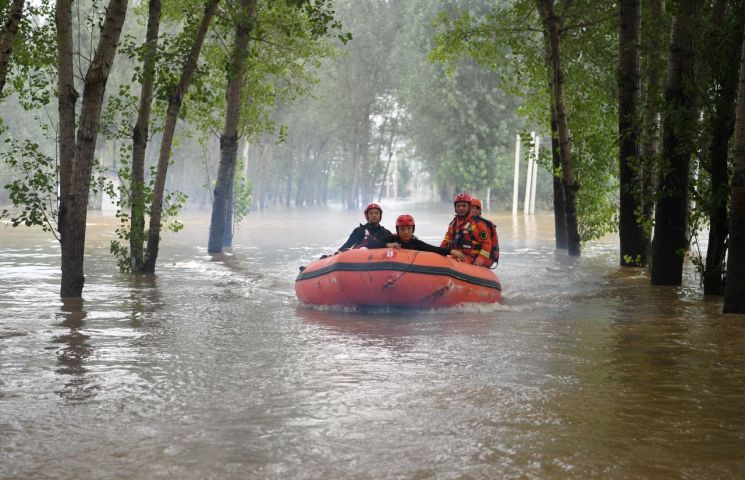
SCMP explained, "Following Typhoon Doksuri's landfall in China last week, Typhoon Khanun flooded farmlands in the northeastern region, affecting the grain production base of Northeast Asia," adding, "Several countries, including major suppliers like India, have recently announced rice export bans, raising concerns about price surges and panic buying despite sufficient domestic supply."
India, the world's largest rice exporter, announced a partial ban on white rice exports last month to curb domestic price increases. Subsequently, Russia and the UAE also introduced similar restrictions. Liu En, a senior analyst at ChinaGrain.com, an agricultural information provider in China, predicted, "With multiple countries banning rice exports, global rice prices will rise further," adding, "This will affect not only supply and demand but also market participants' sentiment." Analyst Liu also forecasted, "Due to farmland restructuring, the rice planting area has decreased, so this year's production may decline moderately compared to last year."
Ma Wenfeng, chief analyst at Orient, a Chinese agricultural consulting firm, warned, "The impact of this rain is limited, but it serves as a warning about increasingly frequent abnormal weather," adding, "It will clearly have a negative effect on crop yields."
China also experienced heavy rain damage in late May in Henan Province, the largest wheat-growing area, resulting in the first summer harvest decline since 2018.
© The Asia Business Daily(www.asiae.co.kr). All rights reserved.
![Clutching a Stolen Dior Bag, Saying "I Hate Being Poor but Real"... The Grotesque Con of a "Human Knockoff" [Slate]](https://cwcontent.asiae.co.kr/asiaresize/183/2026021902243444107_1771435474.jpg)















