Estimated 2.5 Million Vegan Population in 2021
Top Reason for Interest in Vegan Food: 'Diet'
The number of food products labeled with the term ‘Vegan (Vegun)’ has been steadily increasing every year.
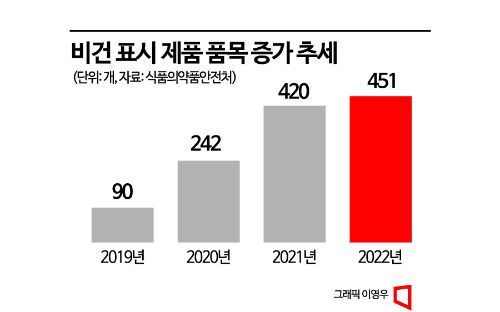
According to the Ministry of Food and Drug Safety on the 7th, the number of vegan-labeled products last year was counted at 451. Vegan-labeled products, which numbered 90 in 2019, increased to 242 the following year, and rose to 420 in 2021, growing more than fivefold over three years until last year. Vegan foods generally refer to foods that do not add or use any animal-derived ingredients at all stages of manufacturing, processing, and cooking, and are not tested on animals. Animal-derived ingredients include not only animal products such as meat, seafood, and eggs but also milk, lactose, honey, beeswax, and other substances derived from or processed from animals.
As consumers aiming for value-based consumption increase, the domestic vegan population is also rapidly growing. According to the Korea Vegetarian Union, the number of vegetarians in Korea, which was only 150,000 in 2008, is estimated to have increased explosively to 2.5 million as of 2021. The reasons for starting vegetarianism are also becoming more diverse. In a survey by the Korea Agro-Fisheries & Food Trade Corporation asking why respondents became interested in vegan foods (multiple answers allowed), 36.7% answered ‘dieting,’ followed by health deterioration (35.3%), environmental and food issues (27.8%), exposure to vegan foods and dishes (26.0%), and witnessing unethical breeding and slaughter (25.6%).
As demand and sales of vegan foods increase, labeling standards for vegan foods are gradually becoming clearer. Like the United States and the European Union, Korea operates a voluntary labeling system regarding vegan food labeling. Private certification bodies such as the Korea Vegan Certification Institute, rather than national certification agencies, handle certification tasks. Food companies bear the burden of proof that the labeling and advertising of each product are factual under the ‘Act on Labeling and Advertising of Foods,’ which has been in effect since 2019. If a product is falsely labeled or advertised as vegan when it is not, the company may face fines or business suspension.
However, since the certification bodies are private organizations and not managed or supervised by the Ministry of Food and Drug Safety, there have been criticisms that the lack of clear legal standards or certification systems for vegan products causes confusion among consumers. In response, the Ministry investigated about 100 companies for false labeling and advertising last July. Subsequently, in March, it announced the ‘Guidelines for Labeling and Advertising of Vegan Foods,’ and only when the raw materials and manufacturing and management standards presented in the guidelines are followed can a product be labeled and advertised as vegan.
© The Asia Business Daily(www.asiae.co.kr). All rights reserved.
![Clutching a Stolen Dior Bag, Saying "I Hate Being Poor but Real"... The Grotesque Con of a "Human Knockoff" [Slate]](https://cwcontent.asiae.co.kr/asiaresize/183/2026021902243444107_1771435474.jpg)















