'2023 First Half Export Trends of Small and Medium Enterprises'
Relatively Small Decline Compared to Total Exports
In the first half of this year, the export value of small and medium-sized enterprises (SMEs) amounted to 55.8 billion dollars.
The Ministry of SMEs and Startups announced the ‘2023 First Half SME Export Trends’ containing this information on the 2nd.
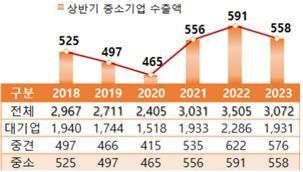
The 55.8 billion dollars represents a 5.5% decrease compared to the 59.1 billion dollars recorded in the first half of last year. The Ministry of SMEs and Startups analyzed this as being influenced by sluggish exports of intermediate goods to China and Vietnam due to the global economic downturn, as well as a decrease in demand for diagnostic kits following the endemic phase.
However, SME exports showed a relatively smaller decline compared to total exports and exports by large and mid-sized enterprises, which decreased by 12.4% and 13.8%, respectively. The number of SMEs participating in exports increased by 3.4% to 76,310 companies. The number of new exporting companies rose by 13.5%, while the number of companies that stopped exporting decreased by 8.2%.
The export contribution of SMEs increased. SMEs accounted for 18.2% of total exports. The share increased consecutively from February to June, resulting in a 1.3 percentage point rise compared to the same period last year based on the first half of the year.
Looking at the monthly export growth rates, SME exports recorded a low of -17.1% in January, followed by 3.3% in February, -9.1% in March, -6% in April, -5.7% in May, and 3.1% in June.
Among major items, automobiles and cosmetics recorded the highest first-half performance ever. Cosmetics exports increased by 13.0% to 2.6 billion dollars. The Ministry explained, “Exports expanded to emerging markets such as Russia and the United Arab Emirates (UAE), turning the declining trend that started in July 2021 into positive growth from February this year.” Automobiles also showed 2.5 billion dollars, growing 124.6% compared to the same period last year.
On the other hand, diagnostic kits, which saw decreased demand after the endemic phase, dropped by 1.94 billion dollars, affecting overall exports.
Exports to major export countries including China, the United States, Japan, and Vietnam all decreased. The decline in intermediate goods due to the manufacturing recession was cited as the main cause for China and Vietnam, while decreased demand for diagnostic kits was the main reason for the United States and Japan.
In contrast, emerging markets such as Russia and Mexico showed record first-half performances. Exports increased in automobiles (228.3%) and cargo handling machinery (268%) in Russia, and automobile parts (77.8%) in Mexico.
Choi Won-young, Director of Global Growth Policy at the Ministry of SMEs and Startups, said, “Through the ‘SME Export Situation Review and Response Direction’ announced in May, we are implementing measures such as temporarily suspending limits on the number of policy fund supports, preferential support for loans, guarantees, and research and development, expanding strategic market bases in the Middle East, the United States, and Europe, supporting participation in large-scale export exhibitions, and easing the burden of obtaining overseas certification.” He added, “We will actively promote an export drive led by SMEs in the second half of the year to nurture strong domestic companies into exporting companies and foster global small giants leading the world market.”
© The Asia Business Daily(www.asiae.co.kr). All rights reserved.
![Clutching a Stolen Dior Bag, Saying "I Hate Being Poor but Real"... The Grotesque Con of a "Human Knockoff" [Slate]](https://cwcontent.asiae.co.kr/asiaresize/183/2026021902243444107_1771435474.jpg)
















