"Move to a Relatively Cool and Shaded Urban Area"
Immediately Leave the Area and Report to Fire Department if a Snake is Found
Snakes seeking relatively cool places during the scorching heat are appearing throughout urban areas, requiring citizens to be cautious.
"Gasp, it's a snake"... Sightings throughout urban apartment complexes
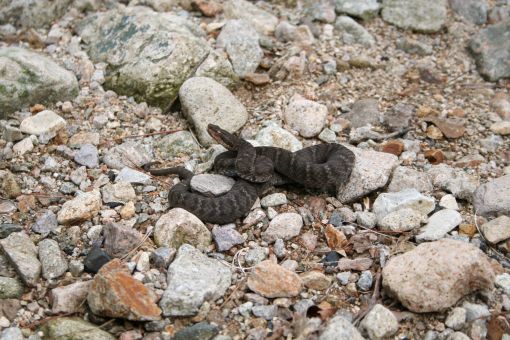 The appearance of a viper
 Photo by Asia Economy DB
Recently, a large-scale snake eradication operation took place in an apartment complex in Jung-gu, Incheon, where white powder was spread throughout the complex. This was due to frequent incidents of dogs being bitten by snakes suddenly emerging from the grass while walking with their owners.
On June 12, a 2-meter-long rat snake was found in a residential area in Yeosu, Jeollanam-do, and firefighters who responded released it into a nearby mountain.
On the 30th of last month, a 1.4-meter-long snake appeared in downtown Gangneung, Gangwon-do. Fire authorities captured the snake hiding under the hood of a parked car after about 30 minutes and released it into a nearby mountain.
Such snake sightings are occurring nationwide. Some apartment complexes where snakes have appeared have posted "Beware of Snakes" signs throughout the area to warn residents.
Experts explain that the recent increase in snake sightings is due to snakes moving into residential areas and other places where it is relatively easier to live, as hot and humid weather continues.
Being cold-blooded animals, snakes cannot easily adapt to extreme dry, cold, or hot climates. This is also why they tend to hibernate for long periods during winter and summer. Therefore, snakes that cannot endure the hot and humid wild environments gather in urban areas with relatively suitable humidity and temperature.
Park Chang-deuk, a senior researcher at the National Institute of Ecology, explained, "Snakes also feel hot in the scorching heat, so they move around cool places like shaded areas to lower their body temperature. They can be found in urban apartment complexes, especially in tree-lined walking paths or near artificial waterfalls."
Immediately report if you encounter a snake... Capture and extermination are prohibited
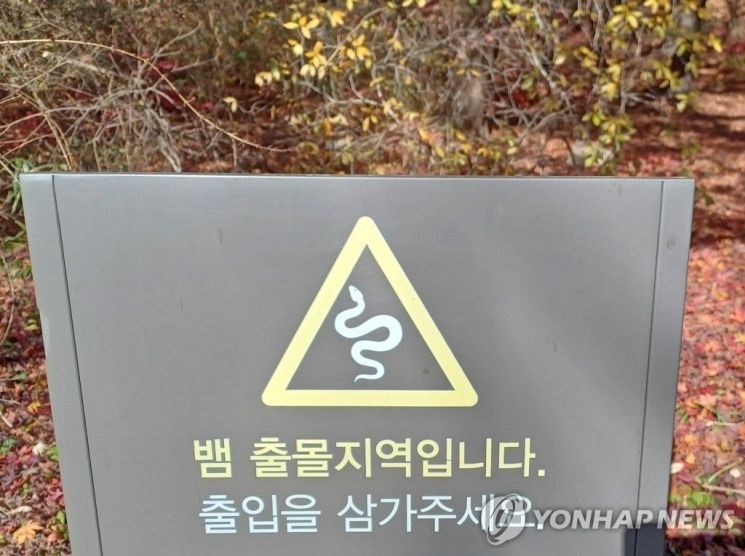
The best course of action upon discovering a snake is to quickly leave the area and report it to the fire department.
The commonly appearing Guryongmok-i (Korean rat snake) in residential areas was previously known as a non-venomous species, but recent studies have found it has venom glands. Another frequently seen snake, the salamander viper (salmo-sa), is well known as a venomous snake.
Additionally, snakes are protected under the Wildlife Protection and Management Act, making their capture prohibited.
Most snakes commonly found on the Korean Peninsula, including the continental Guryongmok-i, Neunggureongi (Amur rat snake), Silbaem (thread snake), Nurukbaem (fermented rice snake), and salamander viper, are designated as protected wildlife. Killing wildlife, including snakes, can result in imprisonment of up to two years or a fine of up to 20 million won.
For this reason, even when firefighters capture snakes, they do not exterminate them but release them into nearby mountains.
Researcher Park emphasized, "The best method is to report to 119 immediately upon discovering a snake in urban areas. If bitten by a snake, wash the affected area with clean water, apply pressure to the wound to prevent venom from spreading, and quickly visit an emergency room."
© The Asia Business Daily(www.asiae.co.kr). All rights reserved.
![Clutching a Stolen Dior Bag, Saying "I Hate Being Poor but Real"... The Grotesque Con of a "Human Knockoff" [Slate]](https://cwcontent.asiae.co.kr/asiaresize/183/2026021902243444107_1771435474.jpg)
















