Started Business in 2019... Considering Additional Investment in Vietnam
'Lighter and Farther' Usable Across Electric Vehicles
Doosan Corporation announced on the 31st that it has achieved a cumulative order amount of approximately 500 billion KRW for PFC (Patterned Flat Cable), a new electric vehicle material business started in 2019. The export destinations include Japan, Europe, and North America.
PFC is a material that connects cells, the smallest unit of electric vehicle batteries. It is made by coating a flexible copper clad laminate (FCCL) with an insulating film. PFC integrates components such as a fuse, which manages the electrical parts during overcurrent, and a thermistor, which detects circuit temperature changes, by patterning them into the circuit. It also internally mounts the Battery Management System (BMS), which is installed in a separate space within the vehicle.
Compared to copper wiring harnesses used in electric vehicle batteries as well as door, seat, and roof cables, PFC reduces weight and volume by more than 80%, enabling vehicle lightweighting, cost reduction, and increased driving range. Doosan’s PFC is the world’s first to develop and apply a roll-to-roll manufacturing process, capable of handling electric vehicle electrical parts up to 3 meters in length.
Due to these advantages, PFC is evaluated as a potential replacement for wiring harnesses in the electric vehicle market. Global market research firm MarketsandMarkets forecasts that the wiring harness market for electric vehicles will grow to approximately 8 trillion KRW worldwide by 2026.
Doosan Corporation established a PFC production line in Hai Duong, Vietnam last year and is mass-producing the product. The company is expanding the factory to more than double production capacity. Additionally, Doosan is focusing on yield improvement, cost reduction, and timely volume expansion to achieve its PFC sales targets of 50 billion KRW in 2024 and 100 billion KRW in 2025.
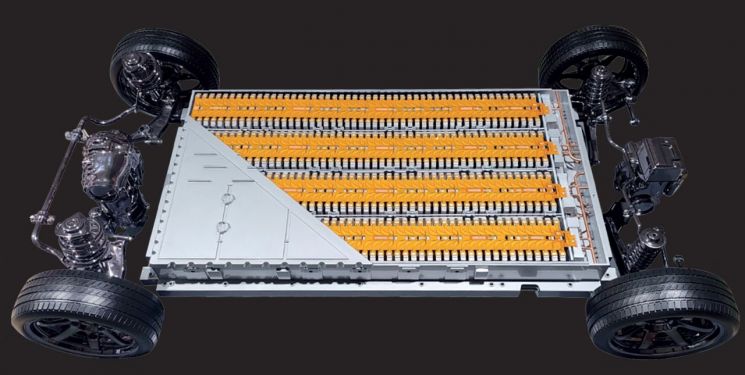 Model image of an electric vehicle battery platform applied with PFC, a new electric vehicle material business of Doosan Corporation
 [Photo by Doosan Corporation]
Electric vehicles are more than 30% heavier than internal combustion engine vehicles. The average weight of an electric vehicle battery is 400 to 450 kg, and increasing battery capacity to extend driving range proportionally increases weight.
Heavier vehicles cause greater damage in accidents. In South Korea, vehicles exceeding certain weight limits cannot use mechanical parking lots (large mechanical parking lots allow a total weight of up to 2200 kg, medium up to 1850 kg). Additionally, heavier vehicles negatively impact accelerated wear of consumables and road surface deterioration, making electric vehicle lightweighting a key industry-wide challenge.
A Doosan Corporation official stated, "Since improving electric vehicle battery performance takes time, PFC, which can reduce battery weight while increasing driving range, is receiving attention from global electric vehicle manufacturers as an optimal solution. As the electric vehicle market is rapidly growing, we will build a strong collaboration system with our partners to further expand orders in Japan, Europe, North America, and other regions."
© The Asia Business Daily(www.asiae.co.kr). All rights reserved.
![Clutching a Stolen Dior Bag, Saying "I Hate Being Poor but Real"... The Grotesque Con of a "Human Knockoff" [Slate]](https://cwcontent.asiae.co.kr/asiaresize/183/2026021902243444107_1771435474.jpg)















