Discovery of Brine with 60 Times Higher Lithium Concentration Than Regular Seawater
Currently 1/20th the Concentration of Commercial Brine
Though Proposed as an Alternative 'Direct Extraction Technology'
No Cases of Implementation in Processes by Major Countries or Companies
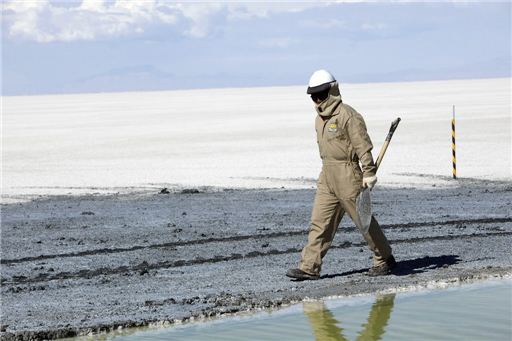 Uyuni Salt Flat in Bolivia. The salt here contains a high amount of lithium. Photo by Bloomberg
Is it possible to mine lithium, a key mineral in the electric vehicle era, in Korea? Lithium-containing underground water has been discovered off the coast of Sinan-gun, Jeollanam-do. A company aiming to commercialize this resource has also emerged. However, questions still remain about domestic lithium mining, often called the 'white oil.'
Lithium is also Deposited Domestically
Terra Science is pursuing a project to extract lithium from brine groundwater near Amhaedo Island in Sinan through its subsidiary, Sinan Lithium. The company explained, "The lithium content shows values of 10.5 mg per liter at 550 meters underground, 13.9 mg per liter at 750 meters, and 14.8 mg per liter at 1000 meters, with a tendency for lithium content to increase with depth." This result was obtained from an analysis of the characteristics of Sinan brine groundwater commissioned from the Korea Institute of Geoscience and Mineral Resources. The average lithium content in normal seawater is 0.17 mg per liter. The brine groundwater in question was found to have lithium concentrations about 60 to 90 times higher than normal seawater.
The company stated, "We plan to apply the environmentally friendly DLE (Direct Lithium Extraction) technology, which can extract lithium even at low concentrations, and place early orders for production facilities." They added, "The approximate volume in the survey area is estimated to be about 10 billion tons, which could produce about 760,000 tons of lithium." They further claimed, "Since brine groundwater is continuously supplied, the amount could reach 300 to 500% of the lithium production capacity." Considering the current lithium price exceeding 37 million KRW per ton (based on lithium carbonate), this is said to be worth tens of trillions of won.
'White Oil' Domestic Mining and Production Still a 'Question Mark'
Can lithium be extracted from Sinan brine groundwater for commercial use? It remains uncertain. The lithium concentration in commercially mined lithium salt lakes is 300 to 400 mg per liter. Although the brine groundwater near Amhaedo Island in Sinan has a concentration (up to 14.8 mg per liter) nearly 90 times higher than normal seawater (0.17 mg per liter), it is only about 1/20th the concentration of commercially used lithium salt lakes (300 mg per liter). In other words, it lacks commercial viability.
Lithium is one of the lightest metals. It is present in trace amounts in normal seawater and rocks. About 0.006% of the Earth's crust is lithium. The problem lies in the cost of extracting lithium. Extracting lithium from low-concentration salt lakes or ores (minerals containing lithium) requires more money and time. This is why governments and companies worldwide are flocking to mine lithium from high-concentration salt lakes. About 87% of the world's lithium is deposited in salt lakes.
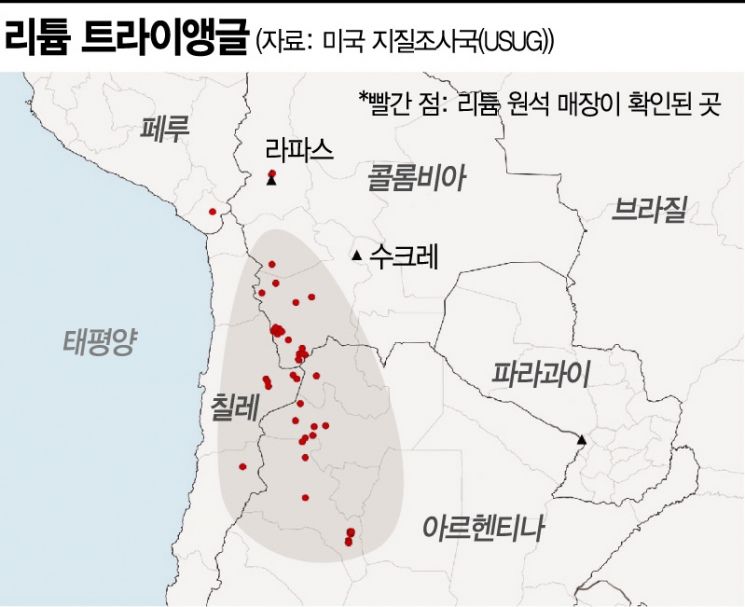
Nearly 60% of the world's lithium reserves are concentrated in the 'Lithium Triangle' of Chile, Bolivia, and Argentina. Due to active volcanic activity, there are large lithium deposits underground, and profitability is high when lithium continuously seeps into groundwater. The Lithium Triangle meets these conditions. Traditional lithium extraction is possible here. Brine is pumped from hundreds of meters underground and then passed through several ponds (artificial lakes) where the water evaporates. This process increases lithium concentration and then removes impurities. It usually takes 12 to 18 months. Because lithium is concentrated by drying in sunlight, the method is environmentally friendly. The Lithium Triangle is near the equator, where high temperatures and dry climates allow natural evaporation-based lithium extraction and production. In Korea, the same process would inevitably take longer. Additionally, land prices are high, making it more expensive to secure the necessary land for operations.
Between Profitability and Price... Could 'Direct Extraction Technology' Be an Alternative?
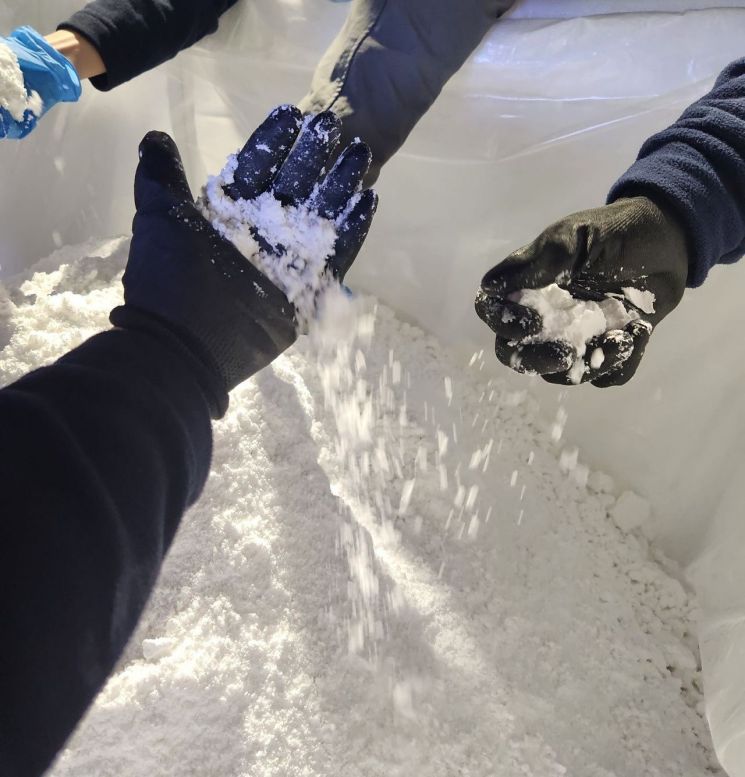
Recently, market interest has surged even in low-concentration lithium salt lakes due to the rising value of lithium. The next-generation technology capable of extracting lithium from low-concentration salt lakes is Direct Lithium Extraction (DLE). This technology uses lithium's chemical properties to adsorb lithium ions or filter lithium ions through ion separation methods, extracting only lithium elements. Compared to traditional lithium extraction methods, it requires smaller-scale plants and can extract lithium even from low-concentration brines with many impurities. It can also reduce the lithium concentration process, which previously took several months, to just a few hours.
Most companies in Korea that have announced lithium development projects are promoting DLE technology. They say, "Lithium prices have increased more than tenfold in just three years, making previous economic evaluations meaningless," and "Even with some investment costs, extracting lithium is economically viable." The problem is that predicting lithium price changes is difficult. For example, recent lithium prices have dropped by about half compared to last year's peak. According to the Korea Mineral Information Service (KOMIS), the price of lithium carbonate on July 25 was 280.5 yuan per kilogram. This is 51% lower than the peak in November last year (581.5 yuan/kg). Also, if recycling of used batteries increases and related technologies advance, lithium prices could fall.
Major countries and companies are preparing to introduce next-generation technologies capable of extracting lithium from low-concentration salt lakes and brines. However, none have been fully commercialized yet. This is because they have not overcome the large-scale energy input and cost issues or implemented the process in actual operations. Companies such as Lilac Solutions, EnergyX, Standard Lithium, and Australian mining company Rio Tinto, which have received investment from General Motors (GM) in the U.S., have completed pilot tests and are evaluating commercial viability. DLE technology also needs to overcome the drawback of high water usage. Large amounts of clean water, at drinking water quality, are required to remove lithium ions adsorbed on filters. The battery industry estimates that producing 1 ton of lithium via direct extraction technology requires more than 10 tons of clean water.
Lithium exists in seawater, lakes, rocks, and soil. Therefore, lithium content is crucial. The technology and cost of extracting lithium are also important. Equally important is demand. The lithium market price is determined by supply and demand. Lithium experts say that with current methods and technologies, lithium production in Sinan is not commercially viable. It is difficult to compete in terms of cost. On the other hand, Sinan Lithium claims this problem can be overcome with new technology. There was a lithium-related stock frenzy in the securities market for a while. Now, some say it is the end of the boom. Sinan Lithium is evaluated as having purchased the last ticket on a gamble that, if it fails, will be labeled a scam.
© The Asia Business Daily(www.asiae.co.kr). All rights reserved.
![Clutching a Stolen Dior Bag, Saying "I Hate Being Poor but Real"... The Grotesque Con of a "Human Knockoff" [Slate]](https://cwcontent.asiae.co.kr/asiaresize/183/2026021902243444107_1771435474.jpg)
















