Until 2018, More Sexual Contact Between Opposite Sex
Recent Increase in Infections Due to Shared Drug Injection Needles
Cases of human immunodeficiency virus (HIV) infection through same-sex sexual contact have surpassed those through opposite-sex sexual contact. HIV is the causative virus that causes acquired immunodeficiency syndrome (AIDS).
The number of HIV infections among drug users sharing syringes has also suddenly increased, prompting health authorities to remain vigilant.
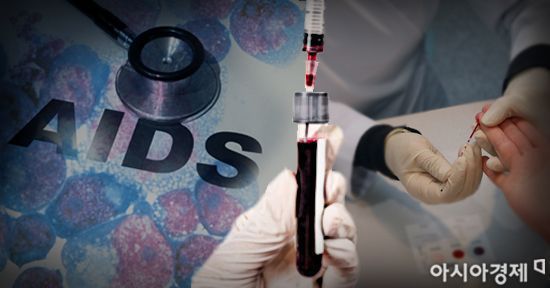 People in our country are mainly infected with the human immunodeficiency virus (HIV), which can cause acquired immunodeficiency syndrome (AIDS), through sexual contact. Recently, cases of HIV infection through sexual contact between the same sex have increased more than those between opposite sexes.
 [Photo by Asia Economy DB]
According to the Korea Disease Control and Prevention Agency's '2022 HIV/AIDS Report,' from the first report of HIV/AIDS in South Korea in 1985 until the end of 2022, excluding foreigners, the cumulative number of reported domestic HIV infections (including deaths) was 19,001. By gender, there were 17,782 men (93.6%) and 1,219 women (6.4%).
Excluding deaths, as of the end of 2022, the number of surviving domestic HIV-infected individuals was 15,880, consisting of 14,882 men (93.7%) and 998 women (6.3%).
When looking at the age distribution of surviving domestic HIV-infected individuals, there were ▲2 aged 10?14 ▲21 (0.1%) aged 15?19 ▲336 (2.1%) aged 20?24 ▲1,488 (9.4%) aged 25?29 ▲2,356 (14.8%) aged 30?34 ▲1,807 (11.4%) aged 35?39 ▲1,616 (10.2%) aged 40?44 ▲1,940 (12.2%) aged 45?49 ▲1,738 (10.9%) aged 50?54 ▲1,649 (10.4%) aged 55?59 ▲1,235 (7.8%) aged 60?64 ▲851 (5.4%) aged 65?69 ▲and 841 (5.3%) aged 70 and above.
Among domestic HIV-infected individuals who responded to epidemiological investigations excluding non-responses, the infection routes by year (1985?2022) were mostly identified as sexual contact.
Notably, until 2018, infections through opposite-sex sexual contact outnumbered those through same-sex sexual contact since statistics began in 1985; however, from 2019 onward, infections via same-sex sexual contact surpassed those via opposite-sex sexual contact.
Among the 825 newly diagnosed domestic HIV-infected individuals last year, based on self-reported infection routes, 577 (99.1%) reported infection through sexual contact. Of these, 348 (59.8%) were infected through same-sex sexual contact, which was higher than the 229 (39.3%) infected through opposite-sex sexual contact.
Infections due to blood transfusions or blood products occurred occasionally until 2005, but none have been reported since 2006.
Recently, cases of HIV infection through shared use of syringes among drug users have also increased. Infection cases due to shared drug injection were sporadic, with one case each in 1992, 2000, 2008, 2010, and 2017. However, in recent years, there have been continuous reports for four consecutive years: 2 cases in 2019, 2 in 2020, 1 in 2021, and 5 in 2022, causing health authorities to closely monitor the situation.
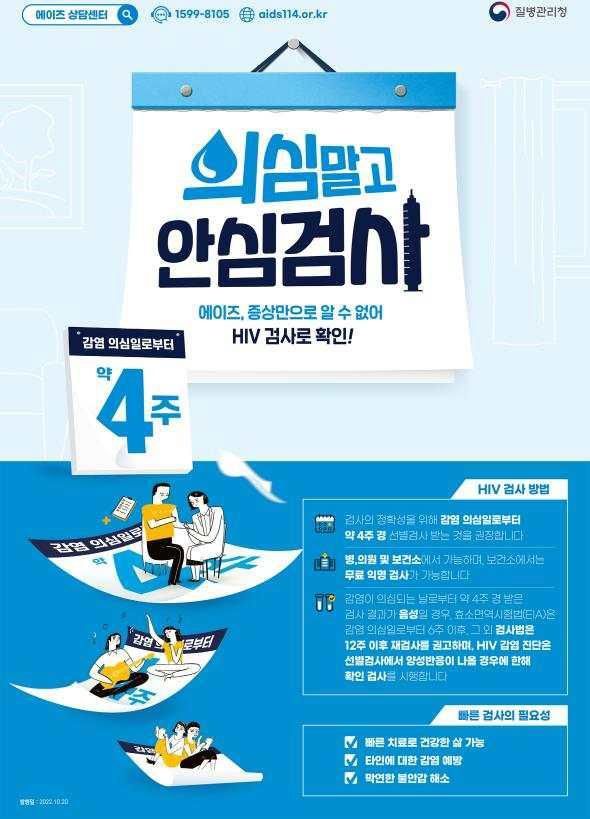
Meanwhile, HIV survives and replicates within the human body and is transmitted from person to person through the blood or bodily fluids of an infected individual.
Not everyone infected with HIV is an AIDS patient. AIDS patients are those among HIV-infected individuals whose immune systems have been damaged or weakened, or who have developed diseases such as cancer during infection. AIDS refers to people who develop severe immune deficiency and complications after HIV infection.
There is no need to fear HIV-infected individuals unconditionally.
HIV is not transmitted by holding hands or exercising together. Sharing food from the same bowl does not transmit HIV.
HIV cannot be transmitted through mosquito or insect bites from an HIV-infected person. Bodily fluids exchanged through casual physical contact (such as sweat) contain only very small amounts of the virus, which cannot cause HIV infection even if they enter another person's body.
HIV infection occurs only when the virus enters the body through sexual contact, wounds, or mucous membranes.
However, not all sexual contact with an HIV-infected person results in infection. The probability of infection from a single sexual encounter is low, about 0.1?1%. Nevertheless, since there is a risk of infection, it is advisable to use condoms during sexual activity.
Currently, AIDS is classified as a chronic disease rather than a fatal illness. Without any treatment, it takes about 10 to 12 years from HIV infection until death due to immune deficiency. With proper treatment and health management, individuals can live healthily for more than 30 years.
Although the available treatments are not cures, consistent medication allows infected individuals to live healthy lives.
HIV testing is available at hospitals and public health centers, with anonymous and free testing offered at public health centers.
The Korea Disease Control and Prevention Agency stated, "Thanks to the development of treatments, AIDS has become a manageable chronic infectious disease. However, to eradicate AIDS, it is important to avoid unsafe sexual contact in daily life and to get tested promptly if infection is suspected."
© The Asia Business Daily(www.asiae.co.kr). All rights reserved.
![Clutching a Stolen Dior Bag, Saying "I Hate Being Poor but Real"... The Grotesque Con of a "Human Knockoff" [Slate]](https://cwcontent.asiae.co.kr/asiaresize/183/2026021902243444107_1771435474.jpg)

















