Teacher Authority Decline Incidents Continue, Checklist Gains Attention
Teachers Admit to Hearing 'Typical Phrases from Troublemaker Parents'
Recently, incidents of infringement on teachers' authority have been occurring one after another, including the recent death of a new teacher at Seo-i Elementary School in Seoul and cases of elementary school students assaulting teachers. Amid this, a 'Checklist for Troublesome Parents' and a chart of 'Common Phrases of Troublesome Parents' are spreading mainly on social networking services (SNS) and online communities.
It is said that parents can gauge for themselves whether they are engaging in 'gapjil' (abuse of power) against teachers.
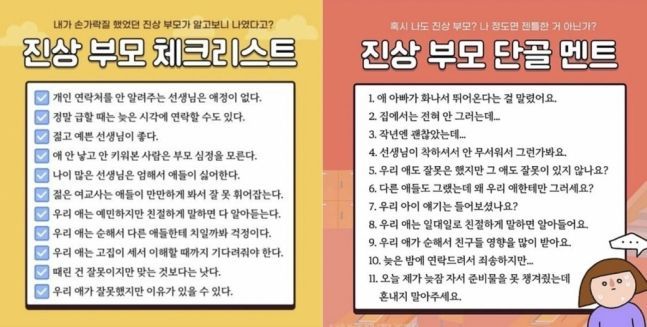 Amid a series of cases infringing on teachers' rights, including the recent death of a new teacher at Seoi Elementary School in Seoul and incidents of elementary students assaulting teachers, the 'Problematic Parent Checklist' is gaining attention.
 [Photo source=Online Community]
The chart consists of a total of 11 items, including statements such as ▲Teachers who do not share their personal contact information do not care ▲In truly urgent cases, it is acceptable to contact late at night ▲Young and pretty teachers are preferred ▲People who have never had or raised children do not understand parents' feelings ▲Young female teachers are easily underestimated by children and thus have difficulty managing them.
There are also evaluations regarding their own children, such as ▲My child is sensitive but understands everything if spoken to kindly ▲My child is gentle, so I worry they might be bullied by others ▲My child is stubborn, so you need to wait until they understand ▲Hitting is wrong, but it is better than being hit ▲My child was wrong, but there may be reasons behind it.
The 'Common Phrases of Troublesome Parents' also draw attention. Examples include ▲I stopped the child's father who was coming in anger ▲At home, the child is never like that ▲The teacher is kind and not scary, so that might be why ▲My child was wrong, but wasn't the other child also at fault?
Other examples include ▲My child understands when spoken to kindly one-on-one ▲I overslept today and couldn't prepare the materials, so please don't scold my child. Some current teachers have seen this chart and acknowledged, "These are really common phrases."
Kim Hee-seong, deputy spokesperson of the Seoul Teachers' Union, expressed in an interview with YTN's 'News Rider' on the 25th, "As can be seen from the checklist, there are parents who demand teachers' personal phone numbers and frequently contact them even at dawn or on weekends." Regarding the mention of 'the child's father,' he also lamented, "This is not an unusual phrase; almost every teacher has heard it at least once."
© The Asia Business Daily(www.asiae.co.kr). All rights reserved.
![Clutching a Stolen Dior Bag, Saying "I Hate Being Poor but Real"... The Grotesque Con of a "Human Knockoff" [Slate]](https://cwcontent.asiae.co.kr/asiaresize/183/2026021902243444107_1771435474.jpg)















