[Nakao, Becoming a Global Tech Company①]
"New Technologies Must Become Part of Customers' Lives"
Need to Secure AI Competitiveness and Regulatory Reform
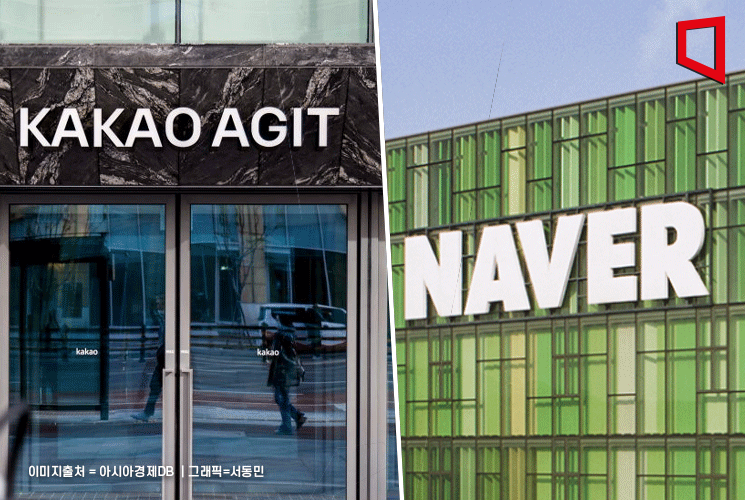
Naver's market capitalization is 34 trillion won. It ranks 12th domestically by market cap and is a leading IT company in South Korea. From its early days as a search portal site, it targeted the global market. In 2000, it established Naver Japan, and in 2011, it launched the social networking service (SNS) 'Line,' marking a full-scale overseas expansion. It entered the KOSDAQ market in 2002 and now operates in various sectors including commerce, finance, artificial intelligence (AI), and content.
Kakao also operates a wide range of businesses encompassing platforms and content, including the SNS KakaoTalk and the portal site 'Daum,' as well as commerce, finance, and entertainment. Its market capitalization is 22 trillion won, ranking 14th among companies. As of the end of last year, it had as many as 127 affiliates.
Neither Naver nor Kakao in the Top 100 Brands
However, neither Naver nor Kakao (collectively referred to as 'Nekao') appear on the list of the world's top 100 brands. The global brand consulting firm Interbrand conducts an annual brand valuation of global brands and selects the top 100 global brands. Last year, the top four brands were Apple, Microsoft, Amazon, and Google?all big tech companies that started as startups. Korean brands listed were only manufacturers such as Samsung (5th), Hyundai Motor (35th), and Kia (87th); no tech companies made the list.
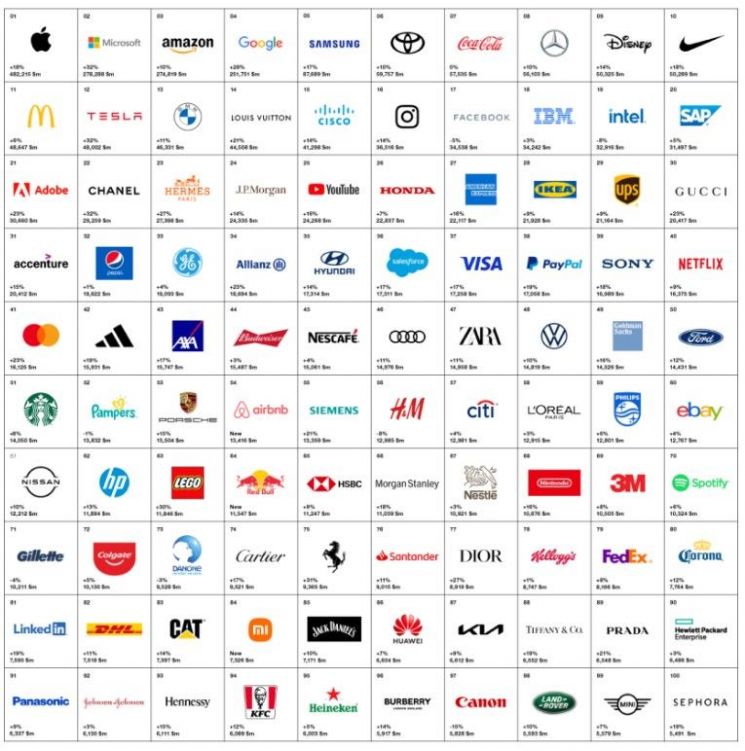
Interbrand selects brands based on a comprehensive evaluation of the influence of the brand on customer purchasing decisions, brand competitiveness, and the company’s financial performance. It has the longest history in brand valuation and was the first in the industry to obtain ISO certification, lending it credibility. So, where do the brand values of companies selected by Interbrand stand?
Microsoft (MS), ranked 2nd, was valued at $278.3 billion in brand value. It was highly rated for pursuing clear direction and transparency for companies and organizations, which increased trust. Particularly notable was its development of programs focused on talent and organizations, i.e., people. In 2021, MS launched 'Microsoft Viva,' a work tool service designed to support continuous growth from employee onboarding to collaboration.
Tesla, ranked 12th, boosted its brand value by having engineers directly participate in customer inquiries to provide rapid feedback. Airbnb focused on events and campaigns to strengthen its brand and provided more personalized services for guests and hosts. Through these efforts, Airbnb entered the top 100 brands for the first time last year, ranking 54th. Gonzalo Brujo, Chairman of Interbrand, said, "A good brand is one that uses new technologies to create improved experiences for consumers and becomes a part of their lives."
Global Visitor Rankings: Naver 127th, Daum 995th
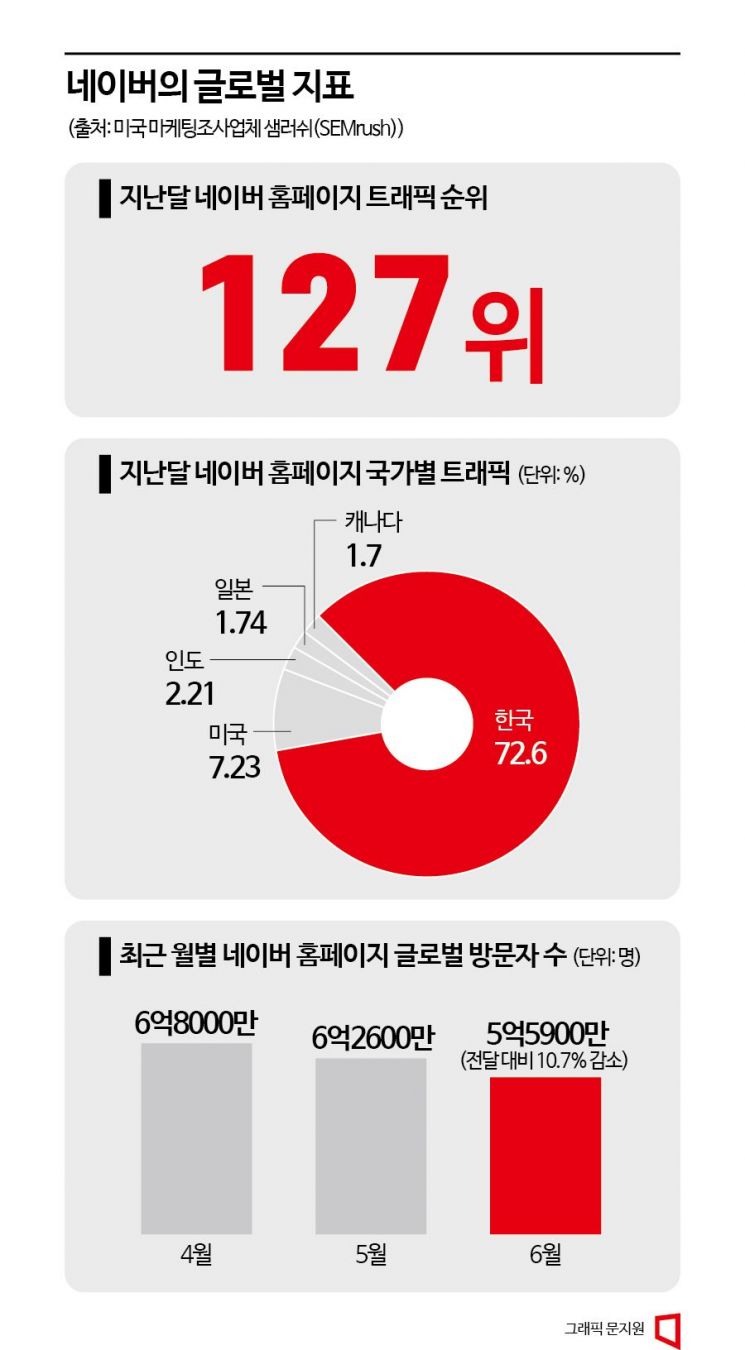
Brand awareness aside, the number of overseas users of Nekao is far too small compared to their position and status in Korea. According to a survey by the U.S. marketing research firm SEMrush, last month Naver's homepage visitors decreased by 10.7% from the previous month to 559 million, ranking 127th globally. Analyzing visitor traffic, South Korea accounted for 72.6%, the U.S. 7.23%, India 2.21%, Japan 1.74%, and Canada 1.7%. In April last year, CEO Choi Soo-yeon announced a goal to secure 1 billion global users for Team Naver, including Naver and its affiliates’ services. Daum's homepage visitors last month were 94.1 million, down 4.6% from the previous month, ranking 995th globally.
Google, ranked 1st globally, had 93 billion visitors last month. Analyzing traffic by country, the U.S. accounted for 16.27%, followed by India (10.2%), Japan (5.48%), Brazil (5.23%), and Germany (3.4%).
Professor Shin In-su of Hanyang University’s Business Administration Department evaluated, "To become a global company, innovation that provides new user experiences is necessary, but so far, our platform companies have employed a fast follower strategy by enhancing existing functions." He added, "To be a first mover, you need to create a market. It is true that this requires significant investment and time," and suggested, "We need to find ways to provide user experiences that reflect different ethnicities and cultures beyond Asia."
Urgent Need for AI Competitiveness and Government Support
For the two major domestic tech giants, Nekao, to rise as global star companies, they must secure an advantage in the intensifying international competition in the artificial intelligence (AI) ecosystem. Both companies plan to launch new AI chatbot services within the year, drawing attention to how they will improve user experience going forward. If generative AI can overcome language barriers, increase productivity, and enable high-quality content production, they could stand shoulder to shoulder with global tech companies.
There is a growing call for the government and National Assembly to work as a team with companies for South Korea to become a protagonist in the AI revolution. Koo Tae-eon, a member of the Digital Platform Government Committee, pointed out, "To develop the AI industry, sufficient data must be secured," and criticized, "The government’s privacy protection for anonymized data is excessive." Also, AI learning and big data analysis require large amounts of data such as text, images, and videos, which sometimes leads to copyright infringement controversies. In January 2021, the Ministry of Culture, Sports and Tourism proposed the 'Copyright Act Revision Bill' (led by Representative Do Jong-hwan) to the National Assembly, which introduced an exemption clause allowing free use of copyrighted works during information analysis for AI development, but the bill has been pending for over two years.
The Online Platform Fairness Act has also been stalled for nearly three years, acting as an obstacle to innovation and growth of big tech companies. The government’s big tech policy direction has been skewed toward domestic perspectives focusing on unfair trade, power dynamics, and monopolies. Mr. Koo said, "Regulatory omnipotence is not helpful," and added, "The government should empower companies to solve market side effects on their own." He noted, "Content such as K-pop and K-drama, which have been enjoyed domestically, are gaining popularity overseas," and emphasized, "Similarly, for big tech companies to expand into global markets, government support and collaboration among companies are necessary."
© The Asia Business Daily(www.asiae.co.kr). All rights reserved.



















