With the decision to hold the Personal Information Disclosure Committee for the Seoul Sillim-dong stabbing murder suspect on the 26th, the debate over expanding the disclosure of personal information of violent criminals has reignited. Although nearly 100% of respondents in a survey by the Anti-Corruption and Civil Rights Commission supported expanding personal information disclosure, there are still opinions that the effectiveness and legality of such disclosure should be carefully considered.
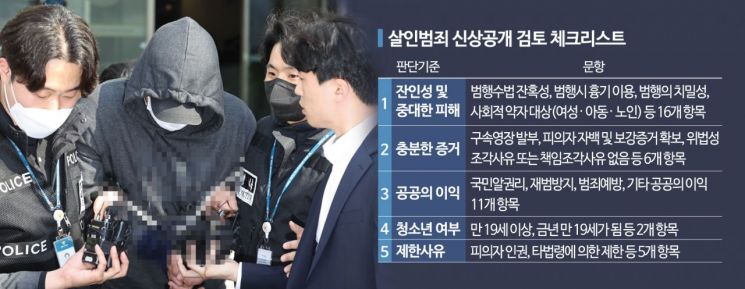
◆ Majority of the Public “Expansion of Personal Information Disclosure Needed”= In a recent survey conducted by the Anti-Corruption and Civil Rights Commission involving 7,474 citizens, 96.3% of respondents answered that "expanding the disclosure of personal information of violent criminals is necessary." Respondents cited ‘protection of victims and prevention of crime recurrence’ (41.8%) as the primary reason for the need to expand disclosure. Under current law, personal information can be disclosed only when there is sufficient evidence to believe that the suspect of a specific violent crime, characterized by cruel means and serious damage, committed the crime. If the suspect is a juvenile or the crime is infanticide, these do not fall under specific violent crimes, making disclosure impossible. A mother who killed her infant in Suwon, Gyeonggi Province, also avoided disclosure due to such legal loopholes.
Additionally, 94.3% of respondents said that "child sex crimes, random assaults, and serious crimes (such as drugs and terrorism) should be included in the scope of personal information disclosure." 95.5% answered that "recent photos should be disclosed regardless of the criminal’s consent." Under the current system, even if disclosure of personal information is decided, recent photos cannot be disclosed if the suspect refuses. Professor Lee Yun-ho, Chair of the Department of Police Science at Korea Cyber University, said, “Disclosing a photo taken 30 years ago of Lee Chun-jae in a school uniform is meaningless,” adding, “Since social consensus on the necessity of disclosure has been formed, it should change to a more effective method.”
◆ The President Ignites the Debate... Police Also Agree= Following the ‘Busan roundhouse kick incident,’ a bill to expand disclosure of heinous criminals’ personal information was proposed, and discussions on mugshot-related legislation were reignited by the ‘Jung Yoo-jung murder case.’ President Yoon Suk-yeol also directly instructed to promote measures to expand disclosure of personal information of perpetrators of violent crimes against women, accelerating related discussions.
Advocates for expanding disclosure expect it to satisfy the public’s right to know, instill caution in potential offenders, and prevent recidivism. Seung Jae-hyun, Senior Research Fellow at the Korea Institute of Criminology and Justice Policy, said, “The legal requirements for disclosure include ‘guaranteeing the public’s right to know, preventing recidivism, and crime prevention,’” adding, “Since everyone has a basic right to know about specific incidents, disclosure is possible simply by fulfilling the ‘right to know.’” The police also agree on the need to expand disclosure. Cho Ji-ho, Deputy Commissioner of the National Police Agency, said at a press briefing last month, “From the police perspective, it is basically necessary to expand a little more than the current level,” and “It should be expanded gradually while monitoring side effects.”
◆ Opposition Voices: “Unrelated to Crime and Recidivism Rates”= There are also voices opposing disclosure. Lawyer Lim Jae-sung of the law firm Haemaru said, “Numerous studies based on objective statistics prove that there is no correlation between disclosure and crime or recidivism rates,” adding, “Research shows that both figures increase even after disclosure.” He said, “Who would say ‘no’ when asked if violent criminals’ personal information should be disclosed or if they should be severely punished?” and added, “Such public opinion surveys are unnecessary and seem like surveys designed to obtain predetermined desired results.” The Korea Institute of Criminology and Justice Policy’s report on ‘Evaluation of the Effectiveness of Medium Punishment Criminal Sanctions’ also stated that disclosure “may cause inappropriate characteristics such as unfairness, injustice, stigma, and shame, leading to resistance from subjects and undermining or offsetting effectiveness.”
The Constitutional Court is currently reviewing the constitutionality of the personal information disclosure system for sex crime suspects. This follows the Seoul High Court Chuncheon branch’s request for a constitutional review during the appeal trial of a defendant who purchased illegal recordings on Telegram’s ‘Nth Room’ and opposed disclosure. The challenge is based on the claim that disclosure infringes on fundamental rights such as personality rights and the right to control personal information. If the Constitutional Court rules it unconstitutional, the discussion on expanding disclosure is likely to be halted. Professor Han Sang-hee of Konkuk University Law School said, “Personal information should not be disclosed solely to satisfy victims’ or the public’s desire for revenge,” adding, “Before deciding whether to expand disclosure, investigations into causality on how to reduce recidivism and lower crime rates socially must precede.”
© The Asia Business Daily(www.asiae.co.kr). All rights reserved.

















