Partial Amendment to the Cultural Heritage Protection Act Passed by the National Assembly Plenary Session
Management Classified into Cultural Heritage, Natural Heritage, and Intangible Heritage
A bill to change the term 'Munhwajae' (Cultural Property) to 'Gukgayusan' (National Heritage) or 'Munhwayusan' (Cultural Heritage) passed the National Assembly plenary session on the 18th. It is one of ten bills, including the partial amendment of the Cultural Heritage Protection Act, which was primarily proposed by National Assembly Culture, Sports and Tourism Committee member Bae Hyun-jin in September last year. The bill includes provisions to uniformly change the term 'Munhwajae,' which perceives all transmitted heritage as commodities, to 'Gukgayusan' and other terms that reflect a future-oriented concept of heritage. Bae’s office explained, "It is significant in reflecting the changed policy environment and aligning with international standards such as those of UNESCO."
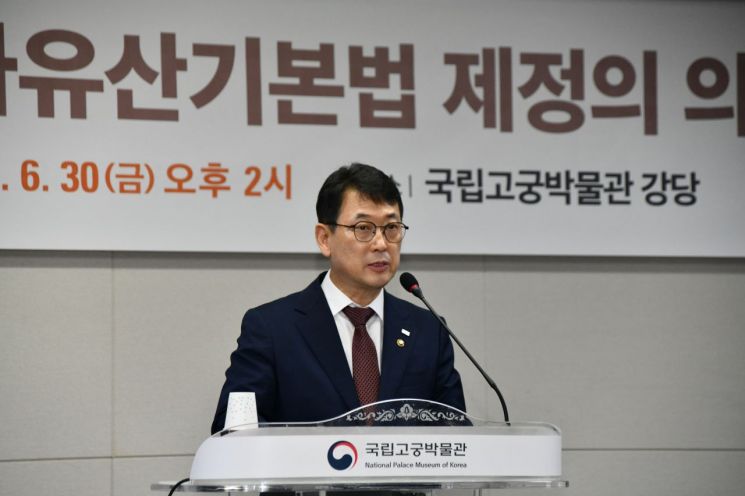
Currently, Munhwajae is managed by classification into tangible cultural properties, intangible cultural properties, monuments, and folk cultural properties. Going forward, they will be divided into cultural heritage, natural heritage, and intangible heritage. Tangible cultural heritage, monuments, and folk cultural heritage will be collectively referred to as cultural heritage. Animals, plants, landforms, geology, natural protection areas, natural landscapes, historical cultural landscapes, and complex landscapes will be classified as natural heritage. Traditional performances, traditional arts, traditional technologies, traditional knowledge, oral traditions, traditional customs, and folk religious rituals will be classified as intangible heritage.
The Cultural Heritage Administration will revise subordinate laws such as enforcement decrees, enforcement rules, and administrative regulations in line with the implementation of the 'Gukgayusan Basic Act' scheduled for May next year. Several 'Gukgayusan Policy Forums' will be held within the year to establish future strategies. A Cultural Heritage Administration official stated, "We plan to collect and synthesize opinions from related experts, local governments, industries, and the youth, and announce the results by the end of the year." They added, "Within the framework of the 'Gukgayusan Basic Act' enacted last May, heritage laws will be reorganized into three (Cultural Heritage Act, Natural Heritage Act, Intangible Heritage Act), and the term 'Munhwajae' in eight laws including the Buried Cultural Heritage Act will be uniformly revised to 'Gukgayusan.'"
The amended bill includes various provisions beyond the transition to the national heritage system. From now on, the Cultural Heritage Administration can verify disqualifications of national intangible heritage transmitters through criminal background checks. Construction project implementers who fail to submit or submit false buried heritage survey reports will be subject to fines.
© The Asia Business Daily(www.asiae.co.kr). All rights reserved.
![Clutching a Stolen Dior Bag, Saying "I Hate Being Poor but Real"... The Grotesque Con of a "Human Knockoff" [Slate]](https://cwcontent.asiae.co.kr/asiaresize/183/2026021902243444107_1771435474.jpg)















