The concept of 6G, known as the "dream communication," is becoming more concrete. Based on transmission speeds dozens of times faster than 5G, 6G is expected to serve as a core infrastructure for future industries such as autonomous vehicles and Urban Air Mobility (UAM). Commercialization is anticipated by 2030 at the latest, and domestic telecom companies are actively engaged in technology research and development to prepare for the "6G era."
How is it different from 5G?
The global standard for 6G has not yet been finalized. Governments around the world, including ours, are collaborating to create guidelines. At the 44th International Telecommunication Union (ITU) Radiocommunication Sector (ITU-R WP5D) meeting held last month in Geneva, Switzerland, a draft recommendation of the IMT-2030 framework (6G vision) was released, outlining the target services and key performance indicators for 6G.
The 6G vision serves as the blueprint for international standardization efforts to be pursued until 2030. According to the draft recommendation, 6G target services are set as ▲ communication-based services that expand 5G domains such as augmented reality and digital twins (technology that replicates real-world machines or equipment in a virtual world) ▲ new converged services based on the integration of artificial intelligence and sensing. The characteristics that must be applied to all these services include sustainability, security, privacy protection and recoverability, connectivity expansion, and intelligence (intelligent connection technology utilizing AI).
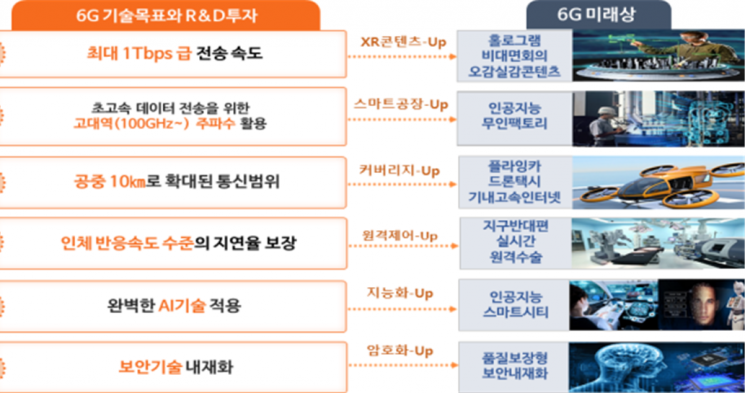
For 6G key performance indicators, six new items (coverage, positioning, sensing indicators, AI indicators, sustainability, interoperability) were added to the existing nine 5G indicators (maximum transmission speed, user-experienced speed, frequency efficiency, traffic capacity per area, connection density, mobility, latency, reliability, security/privacy/recoverability), making a total of 15 items.
If 6G is commercialized based on these goals, what changes will occur in the communication environment? The industry expects 6G to be at least 5 to 50 times faster than 5G in terms of speed. The Ministry of Science and ICT also anticipates that 6G will utilize the ultra-high frequency terahertz (THz) band to achieve speeds up to 1 terabit (1Tbps = 1000Gbps). If this holds true, it would be 50 times faster than the maximum speed of 5G (20Gbps).
The latency, which is the response speed of the network, is expected to be about 0.1ms (0.0001 seconds), one-tenth that of 5G. With almost no latency, precise real-time control will be possible, enabling applications in safety-critical autonomous driving as well as aviation technologies like UAM. The industry expects 6G commercialization around 2030, but the Yoon Seok-yeol administration has set a goal to demonstrate 6G technology first in the world by 2026.
How far has domestic 6G technology come?
The key issue is whether the technology level can reach the 6G target services proposed globally. With only about seven years left until the commercialization target, the three domestic mobile carriers are busy with related technology research and development.
KT is focusing on open RAN research and development. Open RAN is a technology that separates hardware and software of mobile communication equipment such as base stations and standardizes interfaces between equipment so that devices from different manufacturers can interoperate. Simply put, it means that any communication equipment from different manufacturers can be used interchangeably. It is similar to the principle of charging all smartphone models with a single smartphone charger. Using open RAN increases compatibility between equipment from different manufacturers, reducing installation costs and time. Therefore, it is considered a key technology transitioning from 5G to 6G.
Recently, KT participated as the host in the global open RAN demonstration event "Plugfest Spring 2023" organized by the international open RAN standardization organization 'O-RAN Alliance,' successfully achieving multi-vendor interoperability of open RAN virtualized base stations, demonstrating its technological capabilities.
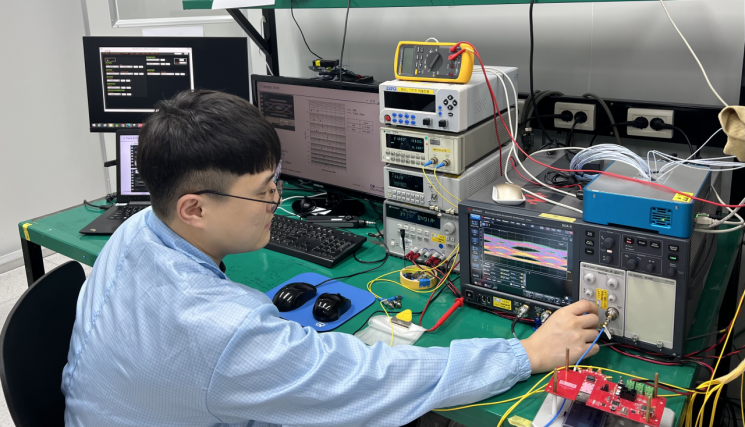
SK Telecom developed wavelength expansion technology necessary for high-speed transmission of the fronthaul, called the "capillaries of mobile communication." Fronthaul is a wired network connecting the central unit (Digital Unit, DU) and distributed radio units (Radio Unit, RU) of 5G base stations.
After 5G commercialization, continuous technological development of base station equipment increased the transmission speed of the optical communication network constituting the fronthaul from a maximum of 10Gbps to 25Gbps. However, when transmitting optical signals at speeds above 25Gbps, the optical signal bandwidth broadens, causing efficiency degradation. This also affected the maximum reach distance.
To solve this, SKT collaborated with Oisolution and Pointu Technology to develop an optical transceiver solution that corrects the broadening phenomenon of the optical signal bandwidth. An optical transceiver converts electrical signals to light signals and vice versa between optical cables connecting optical communication networks and transmission equipment responsible for data transfer. This technology development is evaluated to enable proactive response to increased transmission speeds not only for 5G but also for future 6G networks.
LG Uplus recently unveiled next-generation technology to resolve frequency shadow zones, developed in collaboration with Professor Hong Won-bin's research team at Pohang University of Science and Technology. The technology, called Reconfigurable Intelligent Surface (RIS), controls reflection, absorption, and transmission of various frequencies. It was also confirmed to operate without power consumption in the THz band above 100GHz, similar to actual usage environments.
THz has a wide available bandwidth, suitable for ultra-high-speed and large-capacity data services. However, due to its very short wavelength, transmission efficiency decreases when obstacles are present along the radio wave path. For example, efficiency drops indoors surrounded by walls.
By attaching RIS, radio waves can be arbitrarily allowed to pass or be blocked. It can be likened to mirrors, glass windows, or blackout curtains. LG Uplus explains that this technology development enables improved communication quality and provision of next-generation communication services based on THz.
© The Asia Business Daily(www.asiae.co.kr). All rights reserved.
![Clutching a Stolen Dior Bag, Saying "I Hate Being Poor but Real"... The Grotesque Con of a "Human Knockoff" [Slate]](https://cwcontent.asiae.co.kr/asiaresize/183/2026021902243444107_1771435474.jpg)

















