NBC Broadcast Introduction "Expanding Beyond Major Cities into the American Midwest and South"
Riding the wave of the Korean Wave, including K-pop, Korean-style hot dogs are gaining popularity in the United States.
On the 14th (local time), NBC reported on the popularity of Korean-style hot dogs, called 'Kondog' (corn dog) in the U.S. Thanks to the craze for K-pop, K-dramas, K-beauty, and K-food, the trend is spreading beyond major cities like New York and Los Angeles (LA) to the Midwest and the South of the United States.
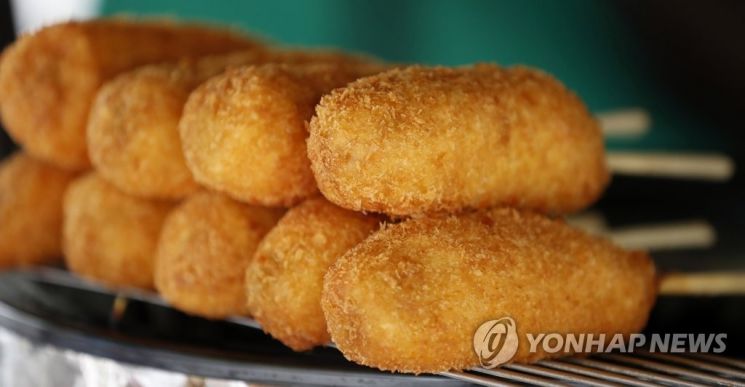
Unlike American hot dogs, Kondogs are characterized by a crispy and sweet taste because the bread is not sliced but coated with breadcrumbs and fried, then sprinkled with sugar and other toppings.
Korean-style hot dogs began trending in the U.S. through social media (SNS) platforms like TikTok and Instagram. In 2020, global pop star Cardi B attracted attention by posting a video on her Instagram eating a Myeongrang hot dog.
Scenes of locals lining up in front of Korean-style hot dog shops in major cities like New York to buy hot dogs have frequently appeared on social media.
The media reported that although the large-scale craze in places like New York and LA has somewhat subsided recently, Korean-style hot dog chains are expanding their presence by entering central U.S. states such as Arkansas, Kansas, Texas, and Missouri.
In the U.S., hot dogs are made by slicing ‘long’ bread and putting sausages or ketchup inside. While there is a ‘corn dog’ that is eaten on a stick, it is not very common.
NBC explained that Korean-style hot dogs use flour or rice flour batter instead of cornmeal to create a chewy texture, and mix sausage, mozzarella cheese, or fish cake in halves to offer various flavors.
It also explained the origin of Korean-style hot dogs, stating that in the 1970s when Korea was a low-income country, it was difficult to obtain meats like beef or pork, so hot dogs were made by mixing fish cake and flour.
The media particularly noted that after the Korean War, processed meats like ham and sausage were introduced to Korea by the U.S. military stationed there, allowing them to be used inside hot dogs.
Professor Joo-yeon Lee of Pennsylvania State University said, "Hot dogs became an old-fashioned food in Korea but were revived about 10 years ago through marketing that triggered nostalgia. Now, numerous hot dog franchises have emerged, and major food companies produce packaged hot dogs for export."
Food industry insiders predict that the popularity of Korean-style hot dogs in the U.S. will continue for a considerable time. The trend may spread to new areas such as small towns. In fact, in May, the UCLA school newspaper Daily Bruin introduced a hot dog food truck run by a Korean-American family.
David Ahn, who operates a Korean-style hot dog chain with his family in Kansas, said, "In big cities, most customers are Korean, but we target white and Black customers, and there are almost no Korean customers." He added, "Young people from Latinx, white, and Black communities are very interested, mostly thanks to K-pop."
Meanwhile, in the UK, Korean-style hot dogs and other street foods are also gaining popularity. Many locals have posted SNS reviews after trying street foods like tteokbokki and cupbap, and various websites have introduced Korean food recipes.
Reflecting this popularity, in 2021, the Oxford English Dictionary in the UK newly added words derived from Korean, symbolizing Korean food, such as banchan, mukbang, bulgogi, dongchimi, galbi, japchae, gimbap, samgyeopsal, and chimaek.
© The Asia Business Daily(www.asiae.co.kr). All rights reserved.
![Clutching a Stolen Dior Bag, Saying "I Hate Being Poor but Real"... The Grotesque Con of a "Human Knockoff" [Slate]](https://cwcontent.asiae.co.kr/asiaresize/183/2026021902243444107_1771435474.jpg)















