About 100 Units Fit in One Car... Twice the Capacity of Smartphones
President Jang Deok-hyun: "High Growth Potential as the 'Second MLCC'"
Samsung Electro-Mechanics announced on the 16th that it will mass-produce power inductors, essential components for electric vehicles and autonomous vehicles. The company will mass-produce power inductors installed in electric vehicle cameras equipped with autonomous driving systems. CEO Jang Deok-hyun stated, "We plan to nurture power inductors as the 'second multilayer ceramic capacitor (MLCC).'"
This is the first time Samsung Electro-Mechanics is mass-producing power inductors for automotive applications. Power inductors are electronic components that prevent sudden changes in current and supply stable power to semiconductors processing autonomous driving information.
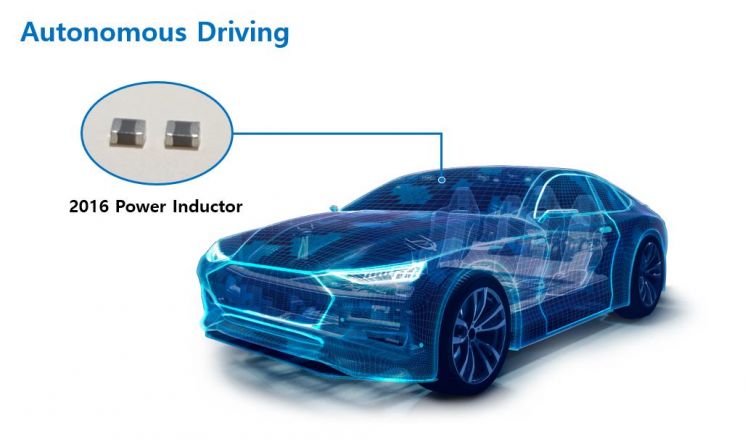 Samsung Electro-Mechanics power inductor installed in autonomous vehicles. [Photo provided by Samsung Electro-Mechanics]
The power inductors developed by Samsung Electro-Mechanics come in two types, both sized 2016 (2.0mm width, 1.6mm length), with inductance values of 1.0uH (microhenry) and 2.2uH respectively.
The performance of power inductors is generally determined by the magnetic material (a magnetized object) used as raw material and the number of coils (copper wire) wound inside. Samsung Electro-Mechanics’ power inductors are thin-film type products, made by forming thin coils on a substrate. Samsung Electro-Mechanics explained, "Thin-film products have advantages such as higher productivity and easier miniaturization compared to wound-type products where coils are wound around magnetic materials."
Samsung Electro-Mechanics announced that it independently developed excellent magnetic materials. It utilized MLCC technology know-how. By applying photolithography (a manufacturing method that engraves circuits with light) used in semiconductor substrate manufacturing, the coils were precisely formed with fine spacing. These can also be used in other applications such as advanced driver assistance systems (ADAS) and infotainment within vehicles.
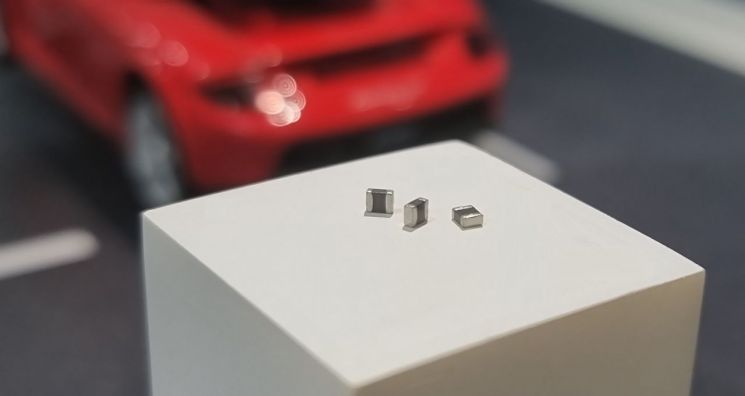 Power inductor for automotive electronics developed by Samsung Electro-Mechanics, measuring 2.0mm in width and 1.6mm in height. [Photo by Samsung Electro-Mechanics]
More than 100 power inductors are required per vehicle, which is more than twice the amount used in smartphones. As the use of electric vehicles and autonomous vehicles increases, the number of power inductors installed per vehicle is expected to more than double by 2030.
The power inductor market size is expected to grow at an average annual rate of about 9%, reaching $3.65 billion (approximately 4.6465 trillion KRW) by 2028. The growth rate of the automotive power inductor market is projected to reach about 12% annually.
CEO Jang said, "Based on differentiated technological capabilities through the convergence of materials and substrates, we plan to nurture power inductors as the 'second MLCC.'"
Since upgrading the 'Electronic Components Team' responsible for power inductors to the 'Electronic Components Business Team' in December last year, Samsung Electro-Mechanics has been actively expanding the business.
© The Asia Business Daily(www.asiae.co.kr). All rights reserved.
![Clutching a Stolen Dior Bag, Saying "I Hate Being Poor but Real"... The Grotesque Con of a "Human Knockoff" [Slate]](https://cwcontent.asiae.co.kr/asiaresize/183/2026021902243444107_1771435474.jpg)
















